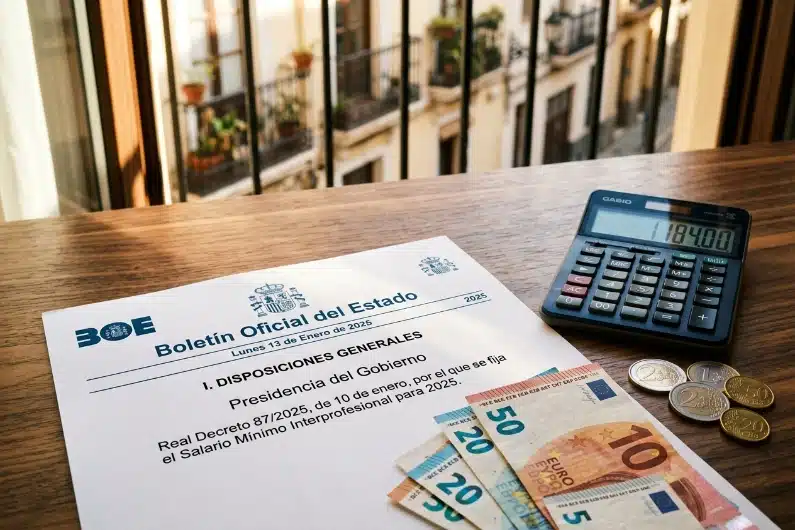
Minimum wage in Spain 2026: the key figures
- Monthly: €1,221 gross a month in 14 payments (12 monthly payments plus 2 extra payments), equal to €1,424.50 a month when the extra payments are spread over 12 months.
- Daily and annual: €40.70 gross a day and €17,094 gross a year, the annual floor no full-time worker can be paid below.
- Hourly: Spain sets no general hourly minimum wage. The only official hourly rate is €9.55 per hour actually worked for domestic workers paid by the hour. For a full-time worker on 40 hours a week, the annual minimum works out at about €9.36 per hour (our calculation, not an official rate: €17,094 ÷ 1,826 hours, the maximum annual working time). Temporary and seasonal workers hired for up to 120 days earn at least €57.82 per legal working day.
- Effective date: the rates apply from 1 January to 31 December 2026, so January and February wages must be topped up; the decree has been in force since 20 February 2026. The increase is 3.1% on the 2025 rate of €1,184.
- Legal basis: Royal Decree 126/2026 of 18 February (Real Decreto 126/2026, BOE of 19 February 2026).
How the 2026 interprofessional salary reshapes payroll obligations across Spain
Every January, Spanish employers wait to see whether the Council of Ministers will lift the statutory wage floor and by how much. For 2026, the answer arrived slightly late. Royal Decree 126/2026, published in the Boletín Oficial del Estado on 19 February 2026, established the 2026 interprofessional salary at €1,221 per month with retroactive effect from 1 January, closing a brief period of uncertainty that followed the repeal of an interim extension in late January. The sections below cover the official 2026 figures, the special rates for temporary and domestic workers, the compliance obligations for employers, and the wider implications for autónomos, digital nomad visa applicants and international businesses operating in Spain.How the 2026 interprofessional salary was set
The government initially extended the 2025 SMI through Royal Decree-law 16/2025 of 23 December 2025, but on 27 January 2026 Congress voted not to validate that decree-law, so the extension fell. The Directorate-General of Labour then issued an interpretative criterion (1/2026) stating that, while the 2026 decree was pending, wages for new hires could not be set below the 2025 minimum of €1,184 a month. Negotiations at the Social Dialogue table produced the final 3.1% figure, agreed with the principal trade union confederations CCOO and UGT. The employer organisations did not sign the agreement.Since 2018, Spain’s minimum wage has risen from €735.90 to €1,221 per month, a cumulative increase of 66% (La Moncloa, February 2026).
Official minimum wage rates in Spain for 2026
The 2026 minimum wage (salario mínimo interprofesional, SMI) is set by Articles 1 and 3 of Royal Decree 126/2026 as follows. Monthly gross: €1,221.00 across 14 payments. Daily gross: €40.70. Annual gross: €17,094.00, including two extraordinary payments. Only monetary remuneration counts towards the SMI floor, and payment in kind can never reduce the full cash entitlement.Minimum wage per hour in Spain
Spain has no general hourly minimum wage: the SMI is fixed per day, per month and per year. The only official hourly figure is €9.55 per hour actually worked for domestic employees paid by the hour (Article 4.2 of Royal Decree 126/2026). For other workers, the hourly equivalent is a calculation. On a full-time 40-hour week, the maximum annual working time recognised by the courts is 1,826 hours, which gives about €9.36 gross per hour (€17,094 ÷ 1,826). Where a collective agreement sets fewer annual hours, for example 1,780, the hourly equivalent rises to about €9.60.Regional context: the interprofessional salary in Valencia
The SMI is a nationally uniform floor, applied identically across all autonomous communities, including the Valencian Community. Sectoral convenios colectivos may set higher minimums but never lower ones, and Valencia’s labour market applies the same €1,221 monthly floor as Madrid, Barcelona or Bilbao. The region’s high concentration of seasonal and hourly-paid workers in tourism, agriculture, hospitality and logistics means that the 2026 uplift affects a proportionally larger share of the workforce here than in more services-heavy provinces. Many of these roles are filled by foreign workers in Spain whose contracts must respect the new wage floor regardless of nationality, contract type or duration.Special worker categories under the 2026 interprofessional salary
Not every worker falls under the standard monthly framework. Two categories receive their own dedicated rates: temporary workers below the 120-day threshold and domestic employees paid by the hour.Temporary and casual workers
Where cumulative services to the same employer do not exceed 120 days, the SMI is calculated on a daily basis at €57.82 per legal working day. This rate already includes the proportional share of Sundays, public holidays and the two extraordinary payments, and it applies equally to temporary and seasonal agricultural workers across the Valencian fruit and horticultural sectors.Domestic employees paid by the hour
Household staff, cleaners, external carers and similar workers receive a dedicated hourly minimum of €9.55 per hour worked, up €0.29 from the 2025 rate of €9.26. Employers of domestic staff must register workers with Social Security under the Special System for Household Employees regardless of the number of hours worked each week. Failure to register carries sanctions under the Law on Infringements and Sanctions in the Social Order (LISOS, Royal Legislative Decree 5/2000).| Worker type | Conditions | 2026 minimum rate | Change vs 2025 |
|---|---|---|---|
| Standard employees | Full-time, any sector | €1,221 per month (14 payments) | +3.1% (was €1,184) |
| Temporary or casual workers | Services for 120 days or fewer with the same employer | €57.82 per legal working day | +3.1% (was €56.08) |
| Domestic employees | Hourly external household work | €9.55 per hour worked | +3.1% (was €9.26) |
| Part-time workers | Any duration, proportional hours | Pro rata of €17,094 annually | +3.1% proportional |
The government estimates that the 2026 increase directly benefits about 2.5 million workers, especially women and young people (La Moncloa, 16 February 2026).
Impact on employers and payroll compliance
Every employer in Spain must audit their payroll against the new €17,094 annual floor and adjust wages accordingly. A 50% part-time contract now carries a minimum gross of approximately €610.50 per month, and a 75% contract approximately €915.75. The wage rise automatically lifts the minimum Social Security contribution base for affected employees, and employer contributions between 30% and 39% of gross salary mean the real cost per employee is materially higher than the headline figure. The government has also indicated forthcoming legislation to restrict the absorption of the SMI increase against existing salary supplements.
Under current rules, employers can in some cases offset the increase against absorbable complements, but the coming reform is expected to narrow that flexibility significantly.
The government has also indicated forthcoming legislation to restrict the absorption of the SMI increase against existing salary supplements.
Under current rules, employers can in some cases offset the increase against absorbable complements, but the coming reform is expected to narrow that flexibility significantly.
Employers hiring their first Spanish staff should also review our overview of labour law services in Valencia and the guide on relocating UK employees to Spain, both of which set out the wider payroll and social security framework.
How the 2026 interprofessional salary affects autónomos and visa applicants
The 2026 interprofessional salary does not apply directly to autónomos, who set their own fees. It nonetheless functions as a reference benchmark across several areas that shape self-employed compliance. Autónomos pay Social Security contributions under a 15-bracket system based on their real net income; the brackets and their contribution bases are set in the annual contribution rules, not by the SMI. The SMI does matter for the reduced flat-rate quota (tarifa plana): it can be extended for a second 12 months only if annual net income from the activity stays below the annual SMI, which is €17,094 for 2026 (Article 38 ter of Law 20/2007), a rule explained in more detail in our guide to becoming self-employed as an autónomo in Spain. The financial sufficiency threshold for the Digital Nomad Visa in Spain is set at 200% of the SMI for the principal applicant. Consulates apply it to the annual SMI, so for 2026 the requirement is €34,188 a year, about €2,849 per month. Family members add 75% of the annual SMI for the first (€12,820.50 a year, about €1,068 a month) and 25% for each additional one (€4,273.50 a year, about €356 a month). The SMI also sets the income tax threshold for low earners: a worker with gross employment income of up to €17,094 can claim a deduction of up to €590.89 in the 2026 IRPF return (additional provision 61 of the IRPF Law, as amended by Royal Decree-law 5/2026).Historical evolution of the interprofessional salary from 2018 to 2026
Understanding the trajectory of Spain’s minimum wage matters for long-term workforce planning, particularly for international businesses opening Spanish operations.| Year | Monthly SMI (14 payments) | Annual total | Year-on-year change |
|---|---|---|---|
| 2018 | €735.90 | €10,302.60 | Baseline |
| 2019 | €900.00 | €12,600.00 | +22.3% |
| 2020 | €950.00 | €13,300.00 | +5.6% |
| 2021 | €965.00 (from 1 September; €950 until then) | €13,510.00 | +1.6% |
| 2022 | €1,000.00 | €14,000.00 | +3.6% |
| 2023 | €1,080.00 | €15,120.00 | +8.0% |
| 2024 | €1,134.00 | €15,876.00 | +5.0% |
| 2025 | €1,184.00 | €16,576.00 | +4.4% |
| 2026 | €1,221.00 | €17,094.00 | +3.1% |
The cumulative €485.10 monthly increase since 2018 amounts to an additional €6,791.40 per year for workers at the interprofessional salary floor, materially reshaping compensation strategies for low-wage sectors.
The interprofessional salary and international employers in Spain
For UK, Dutch, French, German and Scandinavian companies opening Spanish subsidiaries, the SMI defines the effective compensation floor for any local hire. Because employer social security contributions layer on top, the real cost per minimum-wage employee sits closer to €22,000 per year rather than the headline €17,094. International employers should also factor in the 14-payment structure, the mandatory 30 calendar days of paid holiday, and any sectoral convenio colectivo that lifts the applicable minimum above the SMI, all of which shape budgeting for a first Spanish hire.
Employers planning payroll deadlines alongside the wage increase should cross-check our overview of Spanish tax filing deadlines, and self-employed professionals reviewing their tax exposure can start with our guide on reducing self-employment tax in Spain.
Common mistakes to avoid
- Failing to settle January and February arrears once Royal Decree 126/2026 was published on 19 February.
- Applying the SMI as a monthly figure without checking whether the contract uses 12 or 14 payments, producing incorrect gross calculations.
- Prorating part-time contracts against the wrong annual base and underpaying by several hundred euros a year.
- Absorbing the SMI increase against non-absorbable salary supplements protected by the applicable convenio colectivo.
- Overlooking Special System for Household Employees registration for domestic staff, exposing the employing household to Labour Inspectorate sanctions under LISOS.