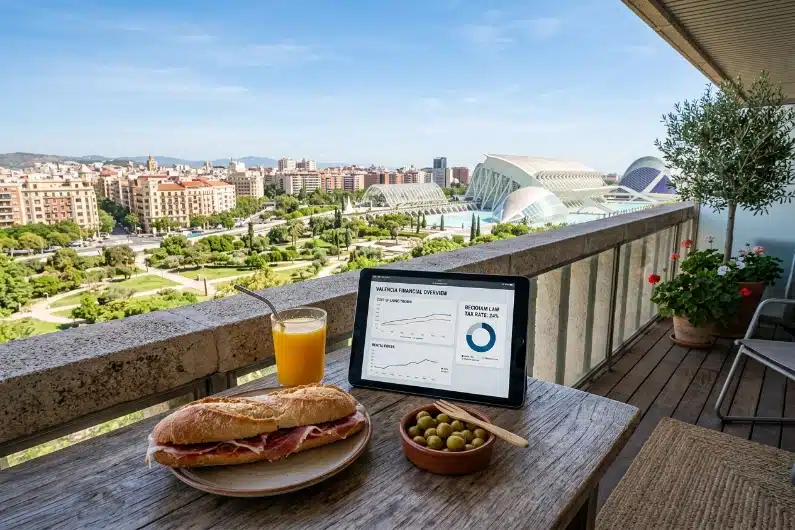
Is Valencia still affordable in 2026?
That is the question every professional, retiree and digital nomad asks before booking a viewing in Ruzafa or signing a rental contract in El Cabañal.
The short answer: yes, but with important nuances.
While the inflationary pressures of the early 2020s have left their mark, Valencia remains one of the most cost-effective coastal cities in Europe.
Compared to the eye-watering costs of London, New York, Sydney or Zurich, Valencia offers a lifestyle arbitrage that allows for a high quality of life without the capital-city price tag.
At Delaguía & Luzón, we help our international clients understand not just the price of a coffee, but the underlying fiscal structures that define long-term financial success in Spain, from property taxes to the Beckham Law.
Valencia cost of living 2026: the essentials at a glance
Valencia remains Europe’s best value coastal city for expatriates in 2026. Here is what matters before you commit.
- Rent in 2026: €900 to €1,800 for a 2-bedroom flat, depending on district. Patraix and Extramurs offer the best value; Ruzafa and Eixample command the premium.
- Purchase price: €2,200 to €5,000 per square metre across the main districts, with year-on-year rises of 5 to 7% in prime zones.
- Monthly living budget: A comfortable expat lifestyle in Valencia costs approximately €2,200 to €3,200 per person, all-inclusive.
- Beckham Law advantage: Eligible professionals pay a flat 24% tax on Spanish income for six years, compared with progressive rates climbing above 45% under the standard IRPF regime.
- Digital Nomad Visa threshold: Approximately €2,763 per month of proven remote income in 2026, plus private health insurance with no co-payments or waiting periods.
- Hidden costs to plan for: Private health insurance (€60 to €120 per month per person), IBI council tax, electricity during the July-August air-conditioning peak.
See also: Tax advisors in Spain · Property legal services · Residency and visas in Spain
Valencia’s position on the European affordability map
Before examining individual line items, the single most useful exercise is to locate Valencia on the European map of coastal cities.
Most professionals arriving from London, New York, Zurich or Sydney are not really comparing budgets.
They are comparing ratios: what proportion of monthly income goes towards rent, groceries, healthcare and leisure in each city.
On that measure, Valencia consistently ranks in the top three for value-for-money coastal cities in the European Union.
| City | Avg. rent 2-bed (centre) | Meal for two (mid-range) | Affordability index vs Valencia |
|---|---|---|---|
| Valencia | €1,400 – €1,800 | €50 – €70 | 1.0× (baseline) |
| Lisbon | €1,700 – €2,400 | €55 – €75 | 1.3× |
| Barcelona | €1,800 – €2,700 | €65 – €90 | 1.5× |
| Madrid | €1,900 – €2,800 | €65 – €90 | 1.5× |
| London | £2,400 – £3,800 | £80 – £120 | 2.4× |
| Zurich | CHF 3,200 – 4,500 | CHF 120 – 180 | 3.2× |
Indicative 2026 ranges. Sources: Instituto Nacional de Estadística, Eurostat and market reporting.
“Spain’s Consumer Price Index showed greater resilience in 2026 compared with the Eurozone average, with Valencia specifically benefiting from local agricultural production that buffers food inflation.”
The Valencia housing market in 2026
The Valencia housing market has seen a steady 5 to 7% annual increase in prime areas since 2022.
Two forces are driving this trend.
The first is sustained international demand from remote workers, retirees and investors seeking a Mediterranean base with reliable infrastructure.
The second is a limited housing supply in central districts, where the preserved architectural character constrains new construction.
Compared to Madrid or Barcelona, however, Valencia still offers significantly more floor space per euro.
Average rent and purchase prices by district
| District | Profile | Avg. rent 2-bed | Purchase per m² |
|---|---|---|---|
| Eixample / Ruzafa | Premium central, modernist architecture, vibrant food scene | €1,400 – €1,800 | €4,200 – €5,000 |
| El Cabañal | Historic beachfront, rapid gentrification, strong tourist demand | €1,200 – €1,600 | €3,500 – €4,500 |
| Extramurs | Central, residential, close to Turia Park | €1,100 – €1,400 | €3,000 – €3,800 |
| Patraix | Up-and-coming, family-friendly, excellent value | €900 – €1,200 | €2,200 – €2,800 |
Planning a purchase requires careful legal due diligence on the title deed, local planning compliance and the notarial process.
Our property legal services in Valencia cover the full acquisition cycle, from pre-contract verification to tax optimisation at completion.
Groceries, dining and the Mercado Central effect
Valencia is known as the orchard of Spain.
Buying seasonally and locally at the Mercado Central or neighbourhood markets can reduce your grocery bill by up to 30% compared with supermarket chains.
This single habit is the most important cost lever for expatriates during their first year in the city.
The almuerzo culture
The almuerzo is a mid-morning ritual of a sandwich, a drink, a coffee and a small plate of peanuts or olives.
In 2026, a traditional almuerzo still costs between €6 and €9 in most Valencian neighbourhoods.
It is a testament to the city’s commitment to affordable socialising and one of the clearest markers of Valencia’s lifestyle arbitrage.
Weekly budget benchmarks
- Groceries for one adult: €50 to €80 per week buying at local markets.
- Dinner out (mid-range, for two): €50 to €70 including wine.
- Flat white or cortado: €1.80 to €2.50.
- Metro monthly pass (zone A): €42.80.
- Gym membership (non-chain): €35 to €55 per month.
Utilities and climatization
The biggest surprise for many expatriates arriving from northern climates is the cost of electricity.
Valencia’s Mediterranean humidity makes air conditioning essential in July and August.
At the same time, poorly insulated older buildings in the centre often require electric or gas heating in January and February.
Typical utility bill ranges
- Electricity: €80 to €180 per month for a 2-bedroom flat, with seasonal peaks in summer and winter.
- Gas (if applicable): €40 to €80 per month in winter months.
- Water and rubbish: €25 to €45 per month.
- Fibre internet (600 Mbps): €30 to €40 per month.
- Mobile contract: €15 to €30 per month.
Optimising your potencia contratada
Every Spanish electricity bill includes a line item called potencia contratada, the contracted power capacity measured in kilowatts.
Many expatriates pay for significantly more capacity than they actually use.
Reducing the potencia by one or two kilowatts (where feasible) can save €10 to €25 per month without any impact on your daily consumption.
Purchasing power by home currency
In 2026, the strength of your home currency plays a decisive role in your felt cost of living.
Below is how Valencia’s value proposition shifts depending on where your income originates.
US dollar, Canadian dollar and Australian dollar
North American and Australian arrivals often find that electronics and imported cars are priced similarly to home.
However, human-centric costs including dining out, domestic help, childcare and healthcare are typically 40 to 50% cheaper than in their home markets.
British pound sterling (post-Brexit)
Post-Brexit volatility has largely stabilised, but UK retirees must carefully plan their pension drawdowns.
Valencia remains significantly cheaper than the UK’s South East, particularly regarding council tax (IBI), petrol, and public transport.
For a deeper dive, read our guide on post-Brexit considerations for British expats in Spain.
Swiss franc and Norwegian krone: the EFTA advantage
For professionals earning in CHF or NOK, Valencia qualifies as a luxury bargain.
A mid-level Swiss salary in Valencia supports a lifestyle that would require a C-suite income in Zurich or Geneva.
Hidden residency costs: visas and healthcare
For non-EU nationals, the cost of staying in Valencia is part of the overall cost of living.
Two visa categories dominate applications in 2026: the Digital Nomad Visa and the Non-Lucrative Visa.
Digital Nomad Visa (DNV)
The Digital Nomad Visa is designed for remote workers employed or contracted by companies outside Spain.
The 2026 income threshold is approximately €2,763 per month (200% of the Spanish minimum wage), with higher requirements for accompanying family members.
Read our step-by-step guide on how to apply for the Digital Nomad Visa in Spain.
Non-Lucrative Visa (NLV)
The Non-Lucrative Visa suits retirees and individuals with passive income who do not intend to work in Spain.
The 2026 financial requirement is approximately €2,400 per month of passive income, plus an additional 25% for each dependant.
Private health insurance: the mandatory companion
For both visa categories, you cannot rely on the Spanish public system during your initial years of residency.
You must hold a private health policy with no co-payments and no waiting periods, a requirement that is strictly verified at the consulate.
Expect to budget €60 to €120 per month per person in 2026, depending on age and pre-existing conditions.
For broader context on healthcare in Spain, see our overview of the Spanish healthcare system.
The Beckham Law: your biggest tax lever in 2026
The most significant financial lever available to professionals moving to Valencia in 2026 is the Special Tax Regime for Displaced Workers, widely known as the Beckham Law.
This regime was originally created to attract international talent and has been progressively expanded to include remote workers, highly skilled professionals in the tech sector, and qualifying entrepreneurs.
What the regime provides
- Flat tax rate: 24% on Spanish-sourced employment income up to €600,000. Above this threshold, the marginal rate is 47%.
- Territorial scope: Taxation applies only to Spanish income, not worldwide income (a major advantage for those with overseas assets).
- Duration: The year of arrival plus the following five tax years (six tax years in total).
- Wealth tax exemption: Qualifying individuals are generally exempt from Spanish wealth tax on non-Spanish assets during the regime period.
Beckham Law versus standard IRPF: an illustrative comparison
| Gross salary | Standard IRPF (progressive) | Beckham Law (24% flat) | Annual saving |
|---|---|---|---|
| €80,000 | ~€26,800 | €19,200 | ~€7,600 |
| €150,000 | ~€60,200 | €36,000 | ~€24,200 |
| €250,000 | ~€107,500 | €60,000 | ~€47,500 |
Illustrative figures only. Actual liability depends on deductions, regional coefficients and personal circumstances. Source: Agencia Tributaria (AEAT).
“The 2026 application of the Beckham Law has firmly established Spain, and Valencia in particular, as a top-tier destination for tax-efficient relocation, with its scope now covering remote workers and highly skilled professionals in the technology sector.”
The Beckham Law is powerful but procedurally strict.
Applications must be filed within six months of starting Spanish social security contributions, and errors in the initial election are often irreversible.
For a complete walk-through of eligibility, application procedures and edge cases, read our detailed guide on the Beckham Law Spanish tax regime.
Visual breakdown: where your euros go in Valencia
To give a sense of a typical monthly budget, the diagram below shows how a comfortable expatriate spend of €2,600 per person tends to distribute across categories.
Monthly expat budget in Valencia 2026 (indicative, per person)
Rent (2-bed, mid-range district)
€1,300
Groceries & dining
€600
Utilities (electricity, water, internet)
€210
Private health insurance
€100
Transport (metro + occasional taxi)
€70
Leisure, gym, eating out
€320
Scales up for families; rent can drop to €900 in Patraix
The striking observation is that fixed costs (rent + utilities + insurance) account for roughly 62% of a single-person budget.
Optimising these three categories is where most expatriates unlock real savings within their first year.
Your cost-of-living planner: five steps before relocating
Based on hundreds of relocation files handled by our team, the following sequence consistently produces the most accurate pre-move budget.
- Set your district shortlist. Use the district table above to pre-select two or three target neighbourhoods based on profile, commute and budget ceiling.
- Calculate your visa financial threshold. For non-EU nationals, verify that your income or passive resources meet the DNV or NLV requirement with a comfortable margin.
- Quote your private health insurance. Obtain written quotes confirming no co-payments and no waiting periods, signed off by a broker authorised to operate in Spain.
- Assess your Beckham Law eligibility. Consult a qualified tax advisor before signing any Spanish employment contract, because the six-month election window starts when you begin social security contributions.
- Model your fixed versus variable costs. Use the budget breakdown above to stress-test your monthly outgoings against a 12-month runway.
Plan your move with our Valencia legal and tax team
Moving your life to a new country involves far more than converting your savings into euros.
It requires a precise understanding of Spanish tax residency, wealth tax rules, inheritance law and the Beckham Law election window.
At Delaguía & Luzón, our tax advisors in Spain specialise in cross-border financial planning for international professionals, families and retirees.
Contact our team for a personalised cost-of-living projection and tax optimisation review.
Email: felix.delaguia@delaguialuzon.com
Phone: +34 963 74 16 57
Frequently asked questions about Valencia’s cost of living
Is Valencia cheaper than Madrid or Barcelona in 2026?
Yes, materially so.
A comparable 2-bedroom flat in Valencia costs approximately 30 to 35% less to rent than in central Madrid or Barcelona, while groceries and leisure are between 20 and 25% cheaper.
Valencia has been the fastest-closing of this gap since 2022, however, meaning the differential is narrower today than five years ago.
What monthly income do I need to live comfortably in Valencia?
A single professional can live comfortably on €2,200 to €2,800 net per month, covering rent in a mid-range district, groceries, dining out, transport and private health insurance.
For a family of four, a realistic benchmark is €4,200 to €5,500 net per month, depending on schooling choices and district.
Who qualifies for the Beckham Law in 2026?
The Beckham Law applies to individuals who become Spanish tax residents as a result of a new employment contract, a qualifying entrepreneurship project, or certain research and innovation activities.
Candidates must not have been Spanish tax residents during the five tax years prior to their arrival.
The election must be filed within six months of beginning social security contributions.
How much does private health insurance cost for a Digital Nomad Visa?
Private health insurance compliant with Spanish consular requirements typically costs €60 to €120 per month per person in 2026, depending on age, health history and the insurer.
The policy must include no co-payments and no waiting periods, conditions strictly verified during the visa application process.
What is IBI and how much does it cost?
IBI (Impuesto sobre Bienes Inmuebles) is the Spanish equivalent of council tax, levied annually on property owners.
In Valencia city, the annual IBI rate typically falls between 0.40% and 0.80% of the cadastral value of the property.
Because cadastral values are usually lower than market values, IBI bills tend to be significantly more affordable than UK council tax or French taxe foncière for equivalent properties.
How cold does Valencia get in winter and how much does heating cost?
January and February are the coldest months, with average daytime temperatures of 15 to 17°C and nighttime lows of 7 to 9°C.
Heating older flats can push electricity bills to €150 to €220 per month during the coldest period.
Choosing a well-insulated modern building or one with reversible air-conditioning units is the most effective way to keep winter utility costs under control.
Should I buy or rent during my first year in Valencia?
For most expatriates, renting for the first 12 to 18 months is the prudent choice.
This gives you time to confirm which district suits your lifestyle, build a local banking and credit profile, and assess property market trends in your preferred zones.
When you are ready to buy, our property legal team can guide you through due diligence, notarial completion and post-purchase tax obligations.