Apostille and sworn translation in Spain
- The UK and Spain are both parties to the 1961 Hague Apostille Convention, so UK public documents only need an apostille, not full embassy legalisation.
- The FCDO Legalisation Office charges £45 per document for postal applications, £40 through registered business providers and £35 for the e-Apostille.
- Sworn translations into Spanish must be produced by a traductor-intérprete jurado formally appointed by the Spanish Ministry of Foreign Affairs (MAEC).
- The combination of an apostille plus a sworn translation is required for most NIE, visa, property, inheritance and company formation matters.
- Foreign documents not issued in the UK cannot be apostilled by the FCDO. They must be legalised in the country that issued them.
Apostille and sworn translation in Spain: What UK clients need to know
Almost every interaction a UK national has with the Spanish administration eventually depends on two documents: an apostilled original and a
sworn Spanish translation.
The buyer of a flat in Valencia needs an apostilled birth certificate for the NIE.
The retiree applying for a non-lucrative visa needs an apostilled ACRO criminal record check.
The heir to a Spanish estate needs an apostilled grant of probate and a
traducción jurada of every English document submitted.
Getting these wrong is one of the most common reasons applications stall in front of the Spanish consulate, a notary or the Spanish tax office.
This guide explains the
apostille and sworn translation in Spain framework, the post-Brexit position for UK documents, current FCDO fees, the role of
traductores jurados recognised by the Spanish Ministry of Foreign Affairs, and the practical sequence every UK client should follow before sending anything to Spain.
The legal framework: Hague Convention and the post-Brexit position
The
Hague Convention of 5 October 1961 abolishing the requirement of legalisation for foreign public documents established the apostille as a single, simplified certificate that authenticates a public document for use across all member states.
Both the United Kingdom and Spain are long-standing parties to the Convention, which means UK public documents only require an apostille from the Foreign, Commonwealth and Development Office (FCDO) to be recognised in Spain.
Brexit did not change this position.
The
Hague Apostille Convention is an instrument of public international law, entirely separate from the European Union.
UK nationals continue to enjoy the same simplified document recognition route in Spain after 1 January 2021 as they did before.
What did change is the broader landscape: UK nationals are now
non-EU citizens for residency, work and tax purposes, which means the
volume of apostilled documents required to live, invest or do business in Spain has increased significantly.
Every TIE application, every property purchase by a non-resident, every visa file now routinely requires apostilles and sworn translations that EU citizens are simply not asked for.
Who needs an apostille and sworn translation in Spain
The
apostille and sworn translation in Spain requirement is not specific to any one practice area.
It cuts across virtually every legal matter our firm handles for UK clients.
- Immigration: NIE and TIE applications, non-lucrative visas, the Digital Nomad Visa, the Startup Visa, and family reunification files.
- Property: purchase deeds where the buyer cannot attend in person, granting of power of attorney from the UK to a Spanish solicitor, and mortgage applications.
- Inheritance: the UK grant of probate, the death certificate, the will, and every document of title relating to a deceased’s UK assets that need to be presented to a Spanish notary.
- Company formation: UK certificates of incorporation, articles of association, good standing certificates and director identity documents for setting up a Spanish SL.
- Family law: marriage certificates for joint property purchases, decrees of divorce, and court orders relating to custody or maintenance.
- Education and professional recognition: degree certificates, professional body memberships and DBS or ACRO certificates.
The general rule is straightforward: if the document was issued by a UK public authority and a Spanish authority needs to rely on it, the document needs an apostille and a sworn translation into Spanish.
FCDO fees and current 2026 turnaround times
The FCDO Legalisation Office is the only UK body authorised to issue apostilles for documents originating in England, Wales and Northern Ireland.
Documents from Scotland follow a parallel process administered through the Foreign Office, with notarisation handled by a Scottish notary public or solicitor.
As of 2026, the FCDO operates three service tiers, each with a different fee and turnaround.
| FCDO service tier |
Fee per document |
Typical turnaround |
Who can use it |
| Standard postal apostille |
£45 |
10 to 20 working days |
Any member of the public |
| e-Apostille |
£35 |
2 to 5 working days |
Digital documents signed by a UK notary or solicitor |
| Business counter (registered providers) |
£40 |
24 to 48 hours |
FCDO-registered notaries and agencies |
| Premium same-day |
£100 |
Same business day |
Selected registered providers, urgent files |
Notary or
solicitor certification is
required separately for any private document, such as a power of attorney, degree certificate, photocopy of a passport or company resolution.
Total UK-side cost for a private document apostille typically lands between £100 and £200 once notary fees, FCDO fees and a service provider’s handling charge are combined.
Sworn translations: The role of the traductor-intérprete jurado
Spanish authorities do not accept English-language documents on their face.
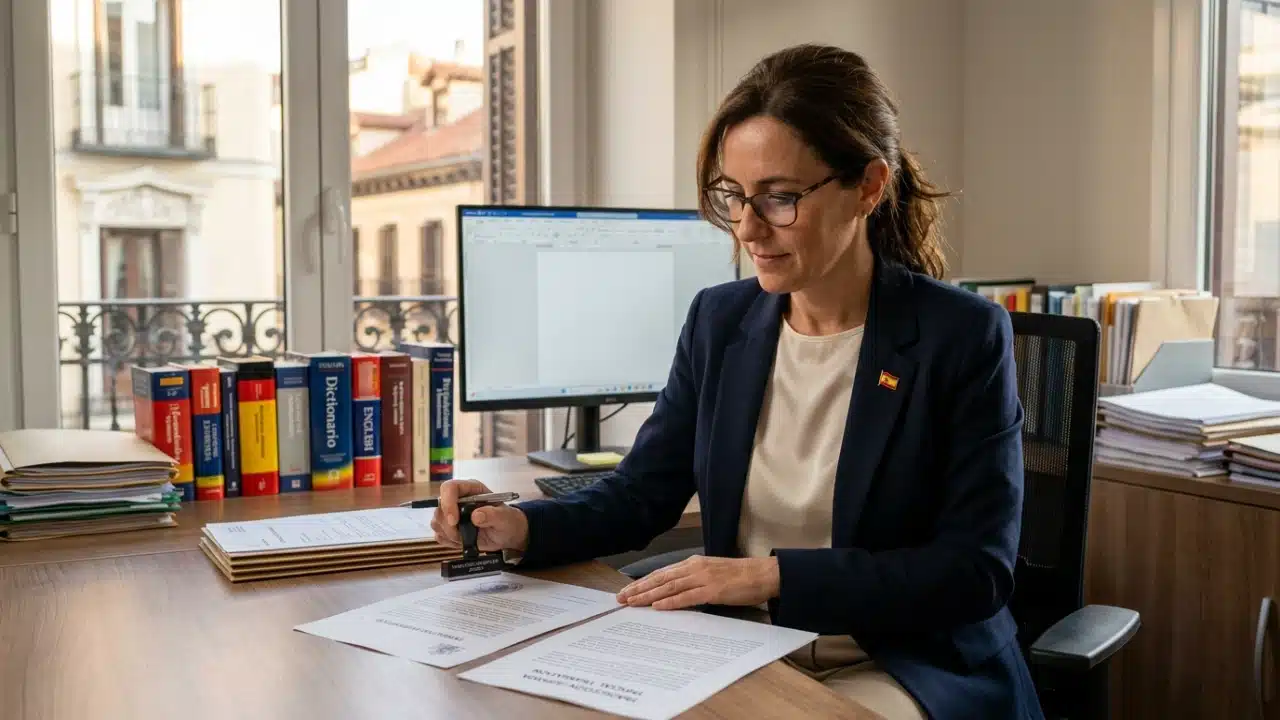
An accompanying
traducción jurada (sworn translation) into Spanish is required for any document filed with a notary, the Land Registry, the Spanish Tax Agency (AEAT), the Civil Registry, a court or an immigration office.
A sworn translation is not the same as a certified translation by an agency. It must be produced by a
traductor-intérprete jurado formally appointed by the Spanish Ministry of Foreign Affairs, European Union and Cooperation (MAEC).
Each sworn translator holds an individual licence, a registered stamp and an official accreditation number that appears on every page of the translation.
The MAEC maintains a public list of all currently licensed sworn translators by language combination, which is the authoritative source for verifying credentials.
“There were over 7,500 active sworn translators and interpreters registered with the Spanish Ministry of Foreign Affairs in the official OETI database as of 2024.”
The correct sequence for UK documents going to Spain
The single most common mistake we see in our office is clients translating documents
before apostilling them, or apostilling photocopies that the FCDO will reject.
The sequence matters and should always be followed in this order.
- Obtain the certified original. Birth, marriage and death certificates should come from the General Register Office (or equivalent in Scotland or Northern Ireland) in long-form, not a photocopy.
- Notarise or solicitor-certify if needed. Private documents such as powers of attorney, degree certificates and company resolutions need notary certification before the FCDO will accept them.
- Apostille. Submit the original (or notarised) document to the FCDO. The apostille is physically attached to the document or issued electronically as an e-Apostille.
- Sworn translation. Send the apostilled document to a MAEC-registered traductor jurado who will translate both the document and the apostille certificate itself into Spanish.
- File in Spain. The bundle (apostilled original plus sworn translation) is now ready for the Spanish notary, AEAT, consulate or administrative authority.
Some Spanish authorities accept the apostille on a notarised copy rather than the original.
Others insist on the original.
Always verify the specific authority’s requirements before applying.
Our
immigration team typically does this for each client at the outset of a file.
Common UK documents and their Spanish use cases
| UK document |
Apostille route |
Sworn translation required? |
Typical Spanish use |
| Birth certificate (GRO long-form) |
Direct FCDO |
Yes |
NIE, visa, family reunification |
| Marriage certificate |
Direct FCDO |
Yes |
Property purchase, visa dependants, inheritance |
| ACRO criminal record check |
Direct FCDO |
Yes |
All long-stay visas (NLV, DNV, Startup, work) |
| Grant of probate |
Direct FCDO |
Yes |
Spanish inheritance proceedings |
| Power of attorney |
Notary then FCDO |
Yes |
Remote property purchase, banking, NIE |
| Degree certificate |
Notary or university, then FCDO |
Yes |
Digital Nomad Visa, professional recognition |
| Companies House documents |
Direct FCDO |
Yes |
Spanish SL incorporation, foreign branch registration |
| Passport copy |
Solicitor or notary certify then FCDO |
Usually no (international document) |
Director identity, NIE, banking |
e-Apostille and Spanish acceptance
The e-Apostille is a digital apostille issued by the FCDO on electronically signed PDF documents.
It is cryptographically secure and verifiable through an online register.
Spain accepts e-Apostilles in principle under the
Hague Convention’s digital apostille framework, but individual Spanish authorities still vary in practice.
Some notaries, particularly in smaller municipalities, continue to request paper documents.
For property completions and inheritance proceedings, we generally recommend the paper apostille route despite the higher cost.
For routine administrative filings such as visa appointments at a Spanish consulate in the UK, the e-Apostille is widely accepted and significantly faster.
Common pitfalls and how to avoid them
- Apostilling an uncertified copy. The FCDO will reject any photocopy that has not first been certified by a UK notary or solicitor.
- Translating before apostilling. The sworn translator must translate the apostille as well, so the apostille must be issued first.
- Using a non-sworn translator. Spanish authorities do not accept agency translations or “certified by the translator” wording unless the translator is on the MAEC register.
- Letting documents expire. ACRO certificates, certain bank statements and good standing certificates are often only accepted by Spanish authorities if issued within three to six months.
- Apostilling documents not issued in the UK. The FCDO can only apostille UK-origin documents. Any non-UK certificate must be apostilled in the issuing country.
- Mistaking an apostille for embassy legalisation. An apostille is sufficient for Spain because Spain is a Hague-Convention member. Embassy legalisation is a separate, longer process required only for non-Hague countries.
How Delaguía y Luzón coordinates the full apostille and translation workflow
Our office handles the
apostille and sworn translation in Spain workflow as part of every UK client engagement that requires Spanish official filings.
For new arrivals, we typically begin with a single document inventory covering all the apostilles required across the NIE, visa, property, banking and tax-residence file.
This avoids the very common situation where a client apostilles documents one at a time, paying multiple FCDO fees and waiting unnecessarily between filings.
We work with a panel of MAEC-registered sworn translators who handle high volumes of UK to Spanish work, which keeps turnaround times tight and costs predictable.
For clients still in the UK, we coordinate directly with FCDO-registered apostille providers, which gives access to the £40 business counter rate rather than the £45 public postal rate.
Our practice areas across
immigration,
property,
inheritance and
commercial all sit under one firm, so the same document inventory can serve a UK client across multiple legal matters without duplication.
Contact our legal team for personalised guidance on your apostille and sworn translation in Spain
If you are a UK national preparing documents for use in Spain, the right sequence of apostille, sworn translation and filing can save weeks of delay and several hundred pounds of avoidable fees.
Contact our legal team for personalised guidance on your case.
Email: felix.delaguia@delaguialuzon.com
Telephone: +34 963 74 16 57
Office: Avinguda Regne de Valencia, 6, 1º-2º, 46005 Valencia, Spain.
FAQs
How long is a UK apostille valid for use in Spain?
An apostille itself does not expire.
However, the underlying document may have a Spanish acceptance window. ACRO certificates, bank statements and certificates of good standing are typically accepted only if issued within the last three to six months.
Can I apostille a document myself at the FCDO?
Yes.
You can apply directly through gov.uk for £45 per document by post, with a 10 to 20 working day turnaround. Most UK clients prefer to use a registered service provider to access faster turnaround and to avoid courier risk on original certificates.
Do I need both an apostille and a sworn translation?
For most Spanish official uses, yes.
The apostille proves authenticity. The sworn translation makes the content accessible to the Spanish authority. They are two separate requirements served by two separate professionals.
Can a sworn translation be done in the UK?
Spanish sworn translations must be produced by a translator on the MAEC register.
Some MAEC-registered
traductores jurados are based in the UK and can produce valid sworn translations from there. The translation is recognised as the same as one produced in Spain.
What is the difference between an apostille and embassy legalisation?
An apostille is a simplified Hague Convention authentication used between member countries.
Embassy legalisation is the longer, multi-step process required for non-Hague Convention countries. For the UK to Spain, the apostille alone is sufficient because both states are Hague members [1].
Are Scottish documents handled differently from English ones?
Scottish documents are still apostilled by the FCDO, but the notarisation step is handled by a Scottish notary public or solicitor under Scots law.
The destination process in Spain is identical.
Can my Spanish solicitor handle the whole apostille and translation process for me?
Most UK-focused Spanish law firms, including ours, coordinate the full process end-to-end.
For UK-issued documents, we work with FCDO-registered providers and MAEC-registered sworn translators. For Spanish-issued documents needing an apostille for use abroad, we handle the Spanish Ministry of Justice apostille route directly from Valencia.