Key takeaways on the digital certificate Spain
- The digital certificate lets you identify yourself and sign documents online with every Spanish public administration.
- The standard certificate for individuals is issued by the FNMT and the Royal Mint, and is free of charge.
- Foreigners can obtain it with their NIE, either through in-person verification or video identification.
- The personal certificate is valid for four years and can be renewed online.
- Cl@ve PIN and Cl@ve Permanente are lighter alternatives suitable for many everyday procedures.
- Tax filings, social security procedures, immigration applications and padrón certificates can all be completed online with it.
- Certificates must be protected carefully, because they carry full legal signing power.
What is the Digital Certificate Spain?
Spanish public administration has moved decisively online, and the queue at the office has been replaced by a login screen.
The key to that screen is the digital certificate, a small cryptographic file that proves your identity to the tax agency, the social security system, immigration offices and town halls.
For expats, obtaining a digital certificate Spain early is one of the highest-value administrative moves available, because it removes the appointment bottleneck from dozens of later procedures.
This guide explains how the certificate works, how foreigners obtain it, and how the Cl@ve system fits alongside it.
What the digital certificate Spain actually does
The certificate is an electronic identity document issued to a specific person, installed in a browser, computer or mobile device.
It performs two functions: authentication, proving who you are to an online office, and an electronic signature, giving your submissions full legal effect.
Its legal force rests on the EU eIDAS Regulation on electronic identification, which Spain applies across its administrations, a framework we examined in our article on eIDAS authentication for EU citizens in Spain.
The most widely used personal certificate is the certificado de persona física issued by the FNMT-RCM, the Spanish Royal Mint.
Spain ranks among the leading EU countries for digital public services according to the European Commission’s Digital Decade monitoring, and most routine procedures no longer require any physical visit.
Who can obtain it, and what you need
Any individual aged 18 or over, Spanish or foreign, can request the FNMT certificate.
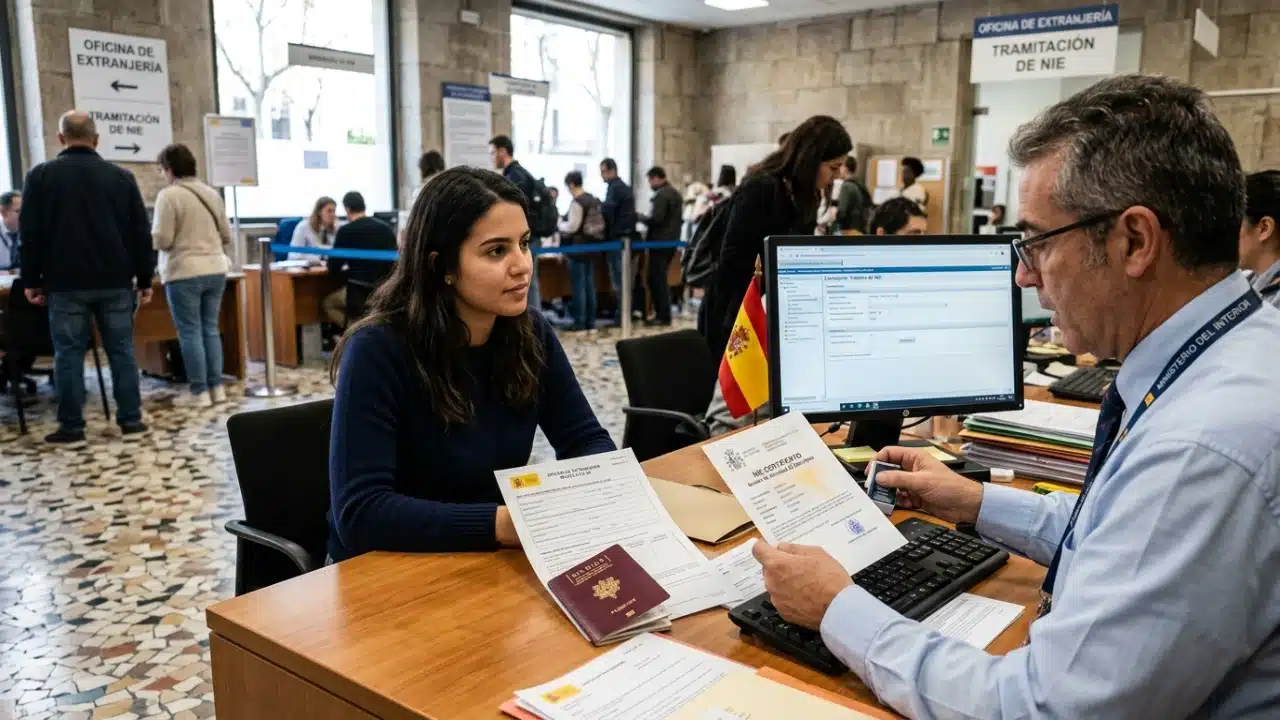
Foreign applicants need their NIE and a valid passport or identity document.
Anyone still without a foreign identification number should complete that step first, following our guide to obtaining the NIE in Spain.
Companies use separate representative certificates, which allow administrators to act online for the entity.
How to obtain the digital certificate step by step
Request the code online
The process starts on the FNMT website, where the applicant enters their NIE, surname and email and receives a request code.
Verify your identity
Identity is verified in one of two ways.
The traditional route is a short in-person appearance at a registration office, typically an AEAT delegation or a social security office, presenting the passport, NIE document and request code.
The alternative is video identification through the FNMT platform, completed from home with a small fee.
Download and back up the certificate
Within hours of verification, the certificate is downloaded onto the same device and browser used for the request.
It should immediately be exported and backed up securely, because a device failure otherwise means starting again.
Cl@ve PIN and Cl@ve Permanente as alternatives
Cl@ve is the state identification platform designed for citizens who prefer credentials over certificate files.
Cl@ve PIN issues a short-lived code through a mobile app for occasional procedures.
Cl@ve Permanente uses a fixed username and password with reinforcement codes, suited to regular users.
Registration in Cl@ve requires an initial identity verification, in person, by video or with an existing certificate.
Many expats maintain both systems, using Cl@ve on the phone for quick queries and the digital certificate Spain on the computer for signatures and filings.
Digital certificate and Cl@ve compared
| Feature | Digital certificate | Cl@ve PIN | Cl@ve Permanente |
|---|---|---|---|
| Form | File installed on a device | Temporary code in an app | Username and password |
| Validity | Four years, renewable online | Minutes per code | Until changed or revoked |
| Best for | Signatures, filings and professional use | Occasional consultations | Frequent personal procedures |
| Signing power | Full electronic signature | Limited | Limited, reinforced for some acts |
What you can do online with the digital certificate
- File income tax returns and every AEAT procedure through the agency’s electronic office at sede.agenciatributaria.gob.es.
- Consult and manage social security records, contributions and reports.
- Submit immigration applications and renewals through the extranjería platforms.
- Request padrón certificates from town halls without appointments.
- Receive official notifications electronically instead of by post.
- Sign contracts and documents with full legal validity.
For tax residents, the certificate is close to indispensable, because deadlines in the Spanish system are unforgiving, as our Spanish tax deadlines calendar makes clear.
Owners of foreign assets filing informative declarations also depend on it, since forms such as the one covered in our Modelo 720 guide are submitted exclusively online.
The overwhelming majority of Spanish tax filings are now submitted electronically, and the AEAT no longer accepts several key forms in any other format.
Electronic notifications are deemed served whether or not you open them, so an unmonitored certificate mailbox can silently start appeal deadlines.
Our tax law and accounting team in Valencia monitors clients’ electronic notifications as part of our ongoing engagements.
Security, renewal and revocation
The digital certificate carries your full signature, so it deserves the same care as a bank credential.
Protect exported copies with strong passwords, avoid installing the certificate on shared computers, and revoke it immediately through the FNMT if a device is lost or stolen.
Renewal can be completed online during the final weeks of validity, without repeating the identity verification in most cases.
Common mistakes with the digital certificate
- Requesting the code in one browser and trying to download the certificate in another.
- Failing to export a backup before a device is replaced or fails.
- Letting the certificate expire and losing online access at a critical deadline.
- Ignoring the electronic notification mailbox that the certificate activates.
- Sharing the certificate file with third parties instead of granting formal representation.
How Delaguía y Luzón can assist with your digital access
Delaguía y Luzón Abogados has represented international clients before the Spanish administration in Valencia since 1960.
We guide new residents through the FNMT and Cl@ve registrations, act as fiscal representatives where clients prefer not to manage procedures personally, and monitor electronic notifications so that no deadline passes unseen.
Around 90% of our clients are international, and we work in English, French, German, Spanish and Russian.
Speak to our team in Valencia
Contact our legal team for personalised guidance on your digital certificate, Cl@ve registration or representation before the Spanish administration.
Email: felix.delaguia@delaguialuzon.com
Phone: +34 963 74 16 57
Office: Avinguda Regne de Valencia, 6, 1º-2º, 46005 Valencia
FAQs about the Digital Certificate Spain
What is the Spanish digital certificate?
The digital certificate Spain is an electronic identity file that authenticates you and signs documents with full legal effect before Spanish administrations.
Can foreigners get the FNMT certificate?
Yes, any adult with an NIE and a valid passport can obtain it.
Is the certificate free?
The standard FNMT personal certificate is free, while the optional video identification route carries a small fee.
How long is the certificate valid?
Four years, and it can be renewed online before expiry.
What is the difference between the certificate and Cl@ve?
The certificate is a signing file installed on your device, while Cl@ve provides login credentials better suited to quick consultations.
Can I use the certificate on my phone?
Yes, the file can be installed on mobile devices, although many users prefer the Cl@ve app on the phone and the certificate on the computer.
What happens if I lose the device holding my certificate?
Revoke the certificate immediately through the FNMT and request a new one, exactly as you would cancel a lost bank card.
Do I need the certificate to file Spanish taxes?
Electronic identification through a certificate or Cl@ve is required for most filings, and several forms exist only online.
Can someone act online on my behalf instead?
Yes, you can grant formal representation to a lawyer or advisor, who then acts with their own certificate through the administration’s representation registers.
Does the certificate replace my NIE or TIE?
No, it complements them, because the certificate proves identity online while the NIE and TIE remain your underlying identification documents.