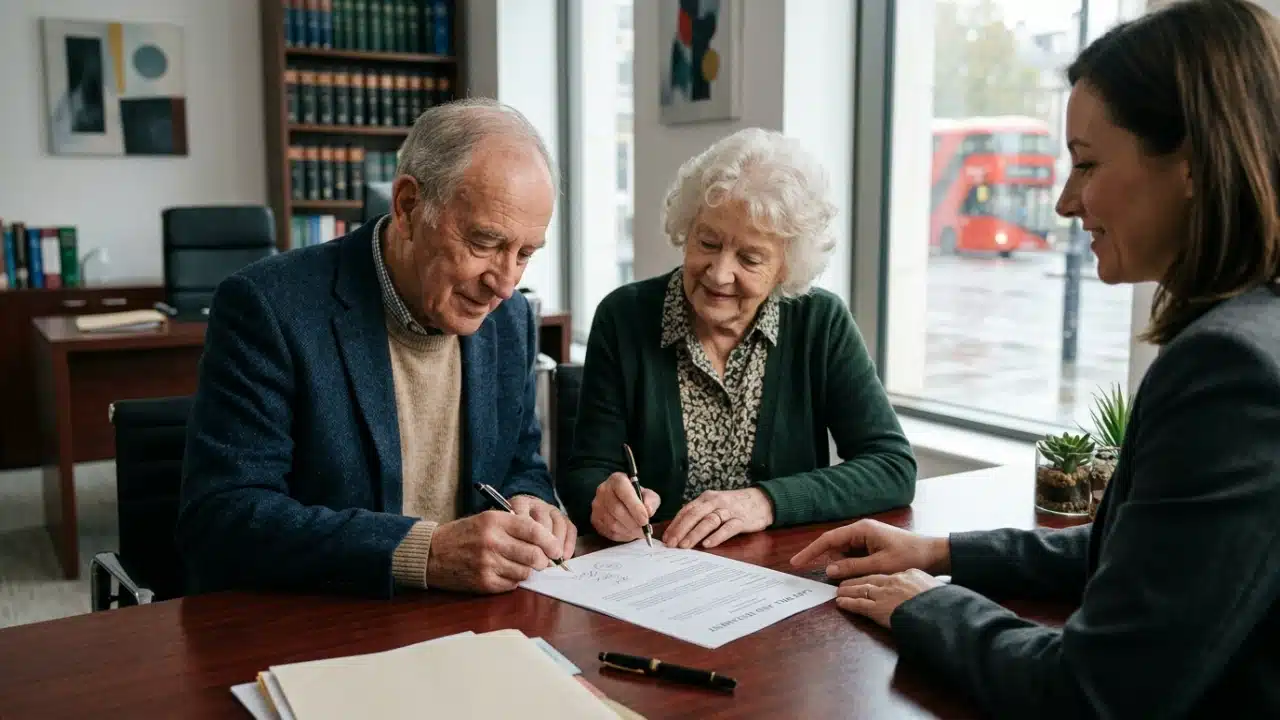
Spanish will: key points
- A Spanish will lets a UK national who owns property or other assets in Spain say who inherits them, and gives the heirs a notarial document drafted for Spanish procedures.
- The standard format is the open notarial will (testamento abierto), signed before a Spanish notary, registered automatically in the Registro General de Actos de Última Voluntad.
- Under Regulation (EU) No 650/2012, a person can choose the law of their nationality to govern the whole succession (article 22), and without a choice the law of the country of habitual residence at death applies (article 21).
- Spanish succession tax is separate from succession law: the law chosen for the will decides who inherits, while the tax follows Ley 29/1987 and the rules of the Community that applies, including the Valencian bonuses.
- A person who was UK resident for at least 10 of the previous 20 tax years is a long-term UK resident for Inheritance Tax and stays one for 3 to 10 tax years after leaving, so UK Inheritance Tax can still reach worldwide assets after a move to Spain.
- The choice of law in article 22 is open to US nationals as well, and the IRS list of countries with estate and gift tax treaties does not include Spain.
How to write a will in Spain as a foreigner
If you own a holiday home in Dénia, an investment apartment in Valencia, a bank account in Spain, or any other asset south of the Pyrenees, the question of what happens to those assets when you die is not academic.
Many UK nationals assume that an English will, properly executed at home, is enough to cover their Spanish assets.
It is not always wrong, but it is rarely the most efficient option, and in some cases it produces results the testator never intended, including the application of Spanish forced heirship rules to assets the testator had assumed they could freely leave to a spouse or chosen beneficiary.
This guide explains how to write a Spanish will, why UK nationals should generally make one, what choices of law are available, what the notarial process involves, what it costs, and how it fits into the wider picture of international inheritance planning for British expats in Spain.
Why UK nationals should consider a Spanish will
The main reason for making a Spanish will is operational rather than legal.
An English, Scottish or Northern Irish will can, in theory, cover assets located anywhere in the world.
In practice, when a UK-only will is presented to a Spanish notary or bank, it must first be translated by a sworn translator, legalised with an apostille, and then interpreted by Spanish professionals working under Spanish civil law procedures.
A Spanish will, by contrast, is drafted in Spanish from the outset, signed before a Spanish notary, and registered automatically in the central register of last wills.
When the testator dies, heirs can request a certificate of last wills and present the Spanish will to banks and the Land Registry without a sworn translation.
For UK families dealing with grief, distance and the post-Brexit administrative reality described in our analysis of British expats in Spain post-Brexit, this is not a marginal benefit.

The legal framework: EU Regulation 650/2012 and the choice of law
The single most important legal instrument for any UK national writing a Spanish will is Regulation (EU) No 650/2012, often referred to as Brussels IV.
The United Kingdom did not take part in the regulation and is no longer an EU Member State, but Spanish notaries and courts still apply it to the succession of a British national. Article 20 provides that any law specified by the regulation is applied whether or not it is the law of a Member State.
Article 21 of the regulation sets the default rule: the law of the country where the deceased had their habitual residence at the time of death governs the entire succession.
For a retired British couple who have lived full-time in Valencia for the last decade, that default would be Spanish law, including the forced heirship rules of the Spanish Civil Code, which make children and descendants forced heirs. The legítima is two thirds of the estate, and the testator can allocate one of those two thirds freely among the children as an improvement (article 808 of the Civil Code).
Article 22, however, allows any person to choose the law of their nationality to govern their succession as a whole.
A British national can therefore expressly elect English law, Scots law, or the law of Northern Ireland in their Spanish will, and that election will override the default rule.
This is the mechanism by which a British testator can ask for the succession to follow the law of their nationality instead of the Spanish forced heirship rules. Under article 35, a provision of the chosen law can be refused only if its application is manifestly incompatible with the public policy of the forum, so contact us to confirm how this applies to your estate.
The choice must be made expressly in the will, or be clear from its terms (article 22(2)).
A Spanish will drafted without an Article 22 declaration leaves the question of which law applies to be determined by the testator’s habitual residence at death, which is not always obvious and can be contested.
Succession law versus inheritance tax: A critical distinction
One point that catches almost every UK testator by surprise is that the choice of law under Article 22 affects only who inherits and in what proportions.
It does not change the tax treatment of the estate.
Spanish succession tax works differently. An heir who is habitually resident in Spain is taxed on what they inherit wherever the assets are (article 6 of Ley 29/1987), while a non-resident heir is taxed on the assets located in Spain (article 7). The law that governs the will does not change that.
The state scale runs from 7.65% to 34%, and where the Community has not set its own, state multipliers from 1.0 to 2.4 apply according to the heir’s existing wealth and relationship to the deceased (articles 21 and 22 of Ley 29/1987). Each Community can approve its own scale, reductions and bonuses.
The Valencian Tax Agency lists a 99% bonus on the tax payable for inheritances received by descendants, spouses and ascendants (groups I and II), together with reductions of the taxable base. From 1 June 2026 a 25% bonus also applies to siblings, uncles, aunts, nephews and nieces.
For a deceased person who was not resident in Spain, the heirs can apply the rules of the Community where the highest value of the Spanish assets lies (second additional provision of Ley 29/1987). Whether a bonus applies to your heirs is a point to confirm with us.
The position is set out in detail in our guides on Spain regional property taxes and the related UK Spain double taxation framework. There is no UK-Spain Inheritance Tax treaty: HMRC’s list of Inheritance Tax double taxation conventions does not include Spain.
For long-term UK residents whose estates may also fall within UK inheritance tax under HMRC’s post-April 2025 long-term residence test, cross-border tax planning has become a separate exercise from succession planning, and both need to be addressed in tandem.
UK inheritance tax after moving to Spain
This section covers Spanish law and the Valencian angle, and you should coordinate any UK inheritance tax planning with your UK adviser.
From 6 April 2025, UK Inheritance Tax looks at residence instead of domicile. Under section 6A of the Inheritance Tax Act 1984, an individual is a long-term UK resident in a tax year if they were UK resident for at least 10 of the previous 20 tax years. HMRC states that a long-term UK resident’s overseas assets may be subject to Inheritance Tax on a transfer or on death.
Moving to Spain does not end that status at once. It ends when you have been non-UK resident for a required number of consecutive tax years: 3 years if you were UK resident in 13 or fewer of the 20 tax years ending with your last UK-resident year, and one more year for each additional year of residence, up to 10 years at 20 years.
There is no UK-Spain Inheritance Tax treaty, but HMRC explains that unilateral relief may be available for a similar foreign tax. Spain, for its part, gives an heir who is taxed there on a worldwide basis a deduction for similar tax paid abroad (article 23 of Ley 29/1987).
Which State credits which tax in your case depends on residence, the location of the assets and the heirs, and we do not state it as a rule here. Contact us and we will work with your UK adviser to confirm your position.
US nationals and the choice of law
We cover the Spanish side only, and you should coordinate US estate and gift tax with your US adviser.
Article 22 of Regulation (EU) No 650/2012 is not limited to British nationals. A person may choose the law of the State whose nationality they possess at the time of making the choice or at the time of death, so a US national can make the same declaration in a Spanish will.
The United States has several legal systems, and article 36 deals with that. The internal conflict-of-laws rules of the State decide which territorial unit’s law applies and, if there are none, the law of the unit with the closest connection to the testator applies. We therefore check with you which US state’s law you want to choose and how it fits with your US will.
Spain and the United States have no inheritance tax treaty: the IRS list of estate and gift tax treaties does not include Spain. Spanish succession tax follows Ley 29/1987 and the regional rules described above, and how the United States treats it is a question for your US adviser.
The format: Open notarial will (testamento abierto)
| Aspect | Details |
|---|---|
| Recommended type of will | Open notarial will |
| Who it is suitable for | Both non-resident and resident UK nationals in Spain |
| How it is signed | Signed in front of a Spanish notary |
| Role of the notary | The notary reads the document aloud and confirms that the testator understands and consents to its terms |
| Where the original is kept | The original is retained in the protocol of the notary’s office |
| Copy given to the testator | The testator receives an authorised copy |
| Registration | The notary reports the existence of the will to the Registro General de Actos de Última Voluntad |
| Main advantages | The original stays in the notary’s protocol, the notary verifies identity and capacity, and heirs can locate the will after death |
| How heirs locate the will | By requesting a certificate from the central register |
| When heirs can request it | Not before fifteen working days have passed since the date of death |
What the Spanish will should contain
A well-drafted Spanish will for a UK national should typically cover the following points.
An express declaration under Article 22 of Regulation 650/2012 electing the law of England and Wales, Scotland or Northern Ireland to govern the succession as a whole.
A clear statement of whether the will covers only Spanish-situated assets or the testator’s worldwide estate.
A common approach is a Spanish will limited to Spanish assets, with a parallel UK will covering UK and other assets, drafted so that neither will revokes the other.
Identification of the heirs and any specific legacies, with full names, dates of birth, and tax identification numbers where possible.
Appointment of executors (albaceas), which is permitted under English law but optional under Spanish law.
Provisions on the family home and any specific real estate, particularly where the property was the subject of detailed planning at the time of purchase, as analysed in our guide on legal fees for buying property in Spain.
Who can write a Spanish will
A person aged fourteen or older who can form and express their will, with support if needed, can grant a Spanish will (article 663 of the Civil Code).
The testator does not need to be a Spanish resident and does not need to speak Spanish. Whether the notary asks for an NIE depends on the assets and the notary, and we confirm it when we arrange the appointment.
Where the testator does not speak Spanish, an interpreter can translate the testator’s wishes for the notary (article 698 of the Civil Code), and the will may be drafted bilingually, as agreed with the notary in advance.

Step-by-step: The process of granting a Spanish will
The practical process runs from the first instruction meeting to the signing before the notary.
The first step is a detailed instruction meeting with a Spanish lawyer experienced in cross-border estates.
The lawyer will review the testator’s existing UK will, the location and value of Spanish assets, family circumstances, tax residence, and any cross-border planning already in place, including any QROPS transfer to Spain or UK pension arrangements that may affect the broader estate plan.
The lawyer then prepares the draft, which is sent to the testator for review and, where appropriate, to the testator’s UK solicitor for confirmation that the Spanish will and any existing UK will operate consistently.
At the signing, the testator presents valid identification, the notary reads the will aloud, the testator signs each page, and the notary delivers an authorised copy.
Cost and timing
Notary fees for an open will follow an official tariff and depend on the length of the document. Ask us for a quote before the appointment.
Legal fees for drafting and supervising the process vary by complexity.
The fee depends on the assets, the family structure and whether an Article 22 election is included.
A will can be revoked or replaced at any time before death by granting a new one. Under article 739 of the Civil Code, a later valid will revokes the earlier one unless the testator states in it that the earlier will is to remain in force, in whole or in part.
What happens if there is no Spanish will
If a UK national dies owning Spanish assets without a Spanish will, the heirs must either present the UK will, apostilled and sworn-translated into Spanish, to a Spanish notary, or apply for a declaration of heirs if there is no UK will either.
The procedure is workable but consistently slower and more expensive than dealing with a Spanish will, and the application of the Article 22 election becomes a matter of construction by Spanish authorities rather than an express declaration on the face of the document.
Where the deceased was habitually resident in Spain at the time of death, the default rule applies and Spanish forced heirship can take effect over the entire estate, including UK assets, unless the UK will contains an express Article 22 election.
Coordinating with the UK will
For most UK nationals with assets in both countries, the optimal structure is two parallel wills: a Spanish will covering Spanish assets, and a UK will covering UK and other assets, each drafted with an express reference to the other to confirm that neither revokes the other.
This is a specialist area, and the two wills must be read together.
A UK will drafted with a standard revocation clause can inadvertently revoke a Spanish will granted earlier, leaving the Spanish estate to pass on intestacy.
For testators whose estate planning interacts with broader tax positions, including the Beckham Law regime, residence status under Spanish residency rules, or annual filings such as Modelo 720 for foreign assets, the will is one part of a wider planning exercise that should be reviewed after any significant change in family or financial circumstances.
Speak to a specialist
A Spanish will works best when it is drafted by a firm that understands both Spanish civil law and the UK side of the equation, and it is one practical step a UK national can take to protect a Spanish estate.
Contact our legal team for personalised guidance on your case.
felix.delaguia@delaguialuzon.com
+34 963 74 16 57
FAQs
Do I need a Spanish will if I already have an English will?
Not strictly, but a Spanish will is usually advisable.
A Spanish will is drafted for Spanish procedures and allows you to make an express Article 22 election, so that the law of your nationality governs the succession.
Can I write a Spanish will from the UK without travelling to Spain?
A Spanish notarial will is normally granted in person before a Spanish notary. If you cannot travel to Spain, ask us which options exist.
A power of attorney is not an acceptable substitute, because a will is a personal act that cannot be delegated.
Most clients sign their Spanish will during a routine visit to their Spanish property.
Does the Article 22 election apply to my UK assets too?
An election in your Spanish will applies to your succession as a whole, and Spanish notaries and courts follow it.
The UK does not apply Regulation 650/2012 and will determine succession to UK-situated assets under its own conflict-of-laws rules, so ask a UK solicitor how they apply to your UK assets.
Can my heirs find the will after I die?
Yes.
The Spanish notary reports the existence of every will to the Registro General de Actos de Última Voluntad, and heirs can request a certificate of last wills from the Ministry of Justice once fifteen working days have passed since the date of death.
Do I need witnesses when signing a Spanish will?
Witnesses are not generally required for an open notarial will.
Under article 697 of the Civil Code, two witnesses must attend if the testator declares that they cannot sign, or if the testator or the notary asks for them.
Can a married couple make a joint Spanish will?
No.
Article 669 of the Civil Code does not allow two or more people to make a will jointly or in the same instrument, so each spouse must grant a separate Spanish will, although the two wills can be signed at the same notarial appointment and drafted to mirror each other on the substantive provisions.