Power of attorney in Spain for non-residents
- A power of attorney in Spain for non-residents (poder notarial) allows a trusted representative to act on your behalf for property purchases, tax filings, inheritance acceptance, and many other legal procedures without you being physically present in Spain.
- Non-residents can grant a power of attorney from the UK by having the document executed before a UK notary public and apostilled through the FCDO, at a total cost of approximately £340 to £700.
- A special (limited) power of attorney is used for a single defined transaction; a general power of attorney covers ongoing affairs and requires greater care in scope and revocation.
- If both parties are available to travel to Spain, granting the power of attorney directly before a Spanish notary is simpler and cheaper, typically €230 to €450 all-in.
- Powers of attorney remain valid until expressly revoked by a notarial act; unrevoked outdated powers carry real legal risk and should be reviewed periodically.
- The Spanish Civil Code governs powers of attorney under Articles 1709 to 1739, with the Notarial Law setting the formal requirements for execution and registration.
- Our Valencia team drafts, coordinates, and advises on all types of poder notarial for British and international clients across every practice area.
Can an expat get power of attorney in Spain?
Purchasing a property in Spain without flying over for the signing.
Filing a Spanish tax return while still living in the UK.
Accepting an inheritance on behalf of your family.
All of these are legally possible in Spain without the principal being physically present, through a properly executed power of attorney in Spain for non-residents.
For British nationals who own Spanish property, manage cross-border estates or are in the process of relocating, the poder notarial is one of the most practically useful legal instruments available, and one of the most frequently misunderstood in terms of scope, limitations and revocation risk.
The legal framework governing the power of attorney in Spain for non-residents
The Spanish power of attorney is governed by the Civil Code under Articles 1709 to 1739, which establish the mandate relationship (contrato de mandato) between the principal (poderdante) and the attorney-in-fact (apoderado).
The formal requirements for execution are set out in the Ley del Notariado and the Reglamento Notarial, which require notarial intervention for powers of attorney that will be used in transactions requiring public deed form: most notably, property purchases, property sales, mortgage deeds, inheritance acceptances, and company formation acts.
A power of attorney executed abroad is recognised in Spain under the Hague Apostille Convention, to which both Spain and the United Kingdom are parties, provided it bears the relevant Apostille certification confirming the authenticity of the notary’s signature.
Post-Brexit, UK-executed powers of attorney continue to be recognised in Spain through the Apostille route without any additional requirements beyond those that applied before the UK departed from the European Union.
Spanish notaries executed approximately 2.8 million notarial powers of attorney in 2024, of which an estimated 340,000 involved foreign principals acting through representatives in Spain. Property transactions accounted for the largest single category. [Source: Consejo General del Notariado, Estadistica Notarial 2024]
Types of power of attorney used in Spain
The scope of a power of attorney in Spain for non-residents is defined by the document itself, and choosing the correct type is the first practical decision to make with your legal adviser.
| Type | Scope | Typical use | Revocation risk |
|---|---|---|---|
| General (poder general) | Broad authority over all affairs | Long-term asset management | High: must be actively managed |
| Special for property purchase | Named property only | Buying a specific property | Low: expires on completion |
| Special for property sale | Named property only | Selling a specific property | Low: expires on completion |
| Special for tax | AEAT filings only | Annual IRPF or IRNR return management | Medium: annual review recommended |
| Special for inheritance | Estate administration only | Accepting or renouncing an inheritance | Low: specific to one estate |
| Special for NIE and registration | Administrative registration only | Obtaining NIE, padrón registration | Low: purpose-limited |
The scope of a special power of attorney must be drafted precisely to cover the specific acts required.
A power drafted to authorise a purchase cannot be used to authorise a sale of the same property at a later date; a separate document is required.
The detail and precision of the drafting is therefore critical: a badly scoped power of attorney creates gaps that can delay or block a transaction at the notarial stage.
Route 1: granting a power of attorney in Spain for non-residents from the UK
For British nationals who cannot or do not wish to travel to Spain before their transaction, the UK apostille route is the standard mechanism for granting a valid power of attorney in Spain for non-residents.
Step-by-step process
- Your Spanish lawyer drafts the power of attorney in Spanish. The document is prepared in Spain to match the precise requirements of the intended transaction: property purchase, inheritance acceptance, tax representation, or otherwise. Drafting in Spanish from the outset avoids the need for a sworn translation later.
- You execute the document before a UK notary public. The UK notary certifies your identity, legal capacity, and signature on the document. They do not assess the content of the Spanish legal text: that is your Spanish lawyer’s role.
- You obtain an Apostille from the FCDO. The Apostille is a standardised certificate confirming the authenticity of the UK notary’s signature and seal. The cost is approximately £30 to £50, and the process can be completed online through the FCDO’s apostille service [4].
- The apostilled original is sent to your Spanish lawyer by secure post or courier. Once received, it is accepted by Spanish notaries, the Land Registry, the AEAT, and all other Spanish public bodies as a valid foreign-executed power of attorney.
The NIE (Número de Identificación de Extranjero) is required for most transactions in which the power will be used, including property purchases, tax filings, and inheritance acceptances.
If you do not yet hold an NIE, a power of attorney can itself be drafted to authorise your Spanish lawyer to obtain one on your behalf, removing the need for you to attend a Spanish consulate in person.
Route 2: granting a power of attorney directly in Spain
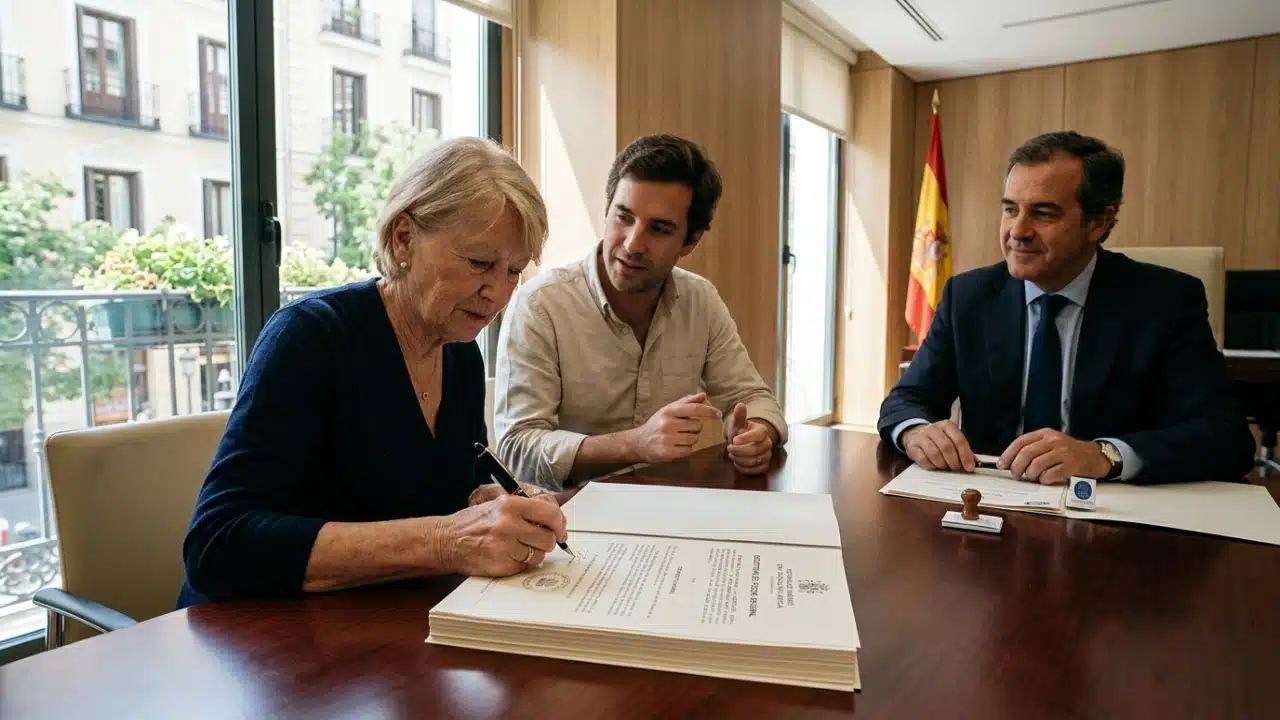
If you are travelling to Spain before the transaction requires completion, granting the power of attorney in Spain for non-residents directly before a Spanish notary is simpler, faster, and less expensive.
No apostille is required.
The document is drafted in Spanish, executed before the notary in a single appointment, and is immediately effective from the moment of execution.
The Spanish notary will verify your identity using your passport, confirm your legal capacity, and read the document to you in full before you sign.
If you do not speak Spanish, a sworn interpreter may be required to attend the notarial appointment, which adds a modest additional fee.
The Spanish notary fee for a power of attorney is typically between €80 and €150, depending on scope and complexity.
Cost comparison: UK route versus Spain route
| Item | UK apostille route | Spain direct route |
|---|---|---|
| Spanish lawyer drafting fee | €150–€300 | €150–€300 |
| UK notary public fee | £80–£200 | N/A |
| FCDO Apostille fee | £30–£50 | N/A |
| Spanish notary fee | N/A | €80–€150 |
| Sworn interpreter (if required) | N/A | €50–€100 |
| Total (approximate) | £340–£700 (plus €150–€300) | €230–€550 |
The UK joined the Hague Apostille Convention as a contracting state in 1965. As of June 2026, the Convention has 124 member states. Spanish notaries and public bodies are required to accept documents bearing a valid Apostille without requiring any further legalisation, including from UK-issued powers of attorney post-Brexit. [Source: Hague Conference on Private International Law, Status Table Convention No. 12, 2026]
Using a power of attorney in Spain for non-residents: common applications
The practical applications of a power of attorney in Spain for non-residents span most of the firm’s practice areas and are one of the first steps in almost any Spanish legal transaction involving a client based abroad.
Property purchase and sale
The most common use is authorising a Spanish lawyer to attend the notarial signing of a property purchase deed (escritura de compraventa) as the client’s representative.
The power must be drafted to cover the specific property by its Catastral reference, the agreed purchase price, the authorisation to pay the price and accept delivery, and the authority to sign all ancillary documents: mortgage deeds, utility transfer forms, Land Registry applications, and AEAT filings arising from the purchase.
The full process for purchasing property in Spain, including legal due diligence, NIE requirements, notary fees and regional taxes, is covered in our guide to buying property in Spain.
Inheritance acceptance and estate administration
When a non-resident is named as heir or beneficiary under a Spanish will or intestacy, they may need to accept or renounce the inheritance, sign a notarial deed of inheritance acceptance (escritura de aceptación de herencia), and apply for the transfer of assets.
All of these acts can be carried out by a representative acting under a special power of attorney granted for inheritance purposes.
Given that Spanish inheritance tax (Impuesto sobre Sucesiones y Donaciones) deadlines run from the date of death and late filings carry automatic penalties, having the power in place promptly is practically important.
Our team of inheritance law specialists advises on the full estate administration process for international clients, including the interaction between Spanish succession law and UK estate planning under EU Regulation 650/2012.
For a detailed overview of the cross-border inheritance framework, our article on international inheritances in Spain covers the applicable law rules, tax treatment, and the practical steps for non-resident heirs.
Tax representation before the AEAT
Non-resident property owners in Spain are required to file annual IRNR declarations (Modelo 210) on their Spanish property income and, on the sale of the property, to file capital gains returns and apply for the release of the 3% withholding retained by the buyer at completion.
A tax-specific power of attorney authorises your Spanish tax adviser to file all relevant returns, correspond with the AEAT, receive refunds, and respond to inspection notifications on your behalf.
UK nationals who are considering their overall tax position, including the interaction between Spanish IRNR and UK income tax under the Spain–UK double taxation treaty, should review both their filing obligations and their residency status before granting an open-ended tax power.
Company formation and commercial transactions
Non-resident entrepreneurs forming a Spanish company (Sociedad Limitada or Sociedad Anónima) can authorise a representative to attend the notarial incorporation deed, sign the company bylaws, make the initial capital contribution, and carry out the Mercantile Registry registration: all without travelling to Spain.
Our article on the legal structure for startups in Spain covers the company formation options available to foreign founders, including the SL, SA and branch structures.
Revocation and the risk of outstanding powers of attorney
A power of attorney in Spain for non-residents remains valid until the principal expressly revokes it by notarial deed (escritura de revocación de poder) or until it expires by operation of law: for example, upon the death of the principal, which automatically terminates all outstanding mandates under Article 1732 of the Spanish Civil Code.
An unrevoked power granted to someone whose relationship with you has changed creates real and potentially serious legal risk.
If that person uses the power after your intention to revoke it but before formal revocation has been completed, transactions they conclude may still be legally binding on you under the doctrine of apparent authority.
Third parties who transact in good faith relying on an unrevoked power are generally protected under Spanish law, even where the principal has privately communicated their intention to revoke.

Best practice for managing outstanding powers
- Maintain a written record of all powers of attorney granted, including the date, scope, grantee, and the transaction for which each was issued.
- Execute a notarial revocation immediately on completion of the relevant transaction for any special power that does not self-expire.
- Conduct an annual review of all general powers to confirm they remain current and their scope remains appropriate.
- Notify relevant institutions (the Land Registry, the AEAT, your bank) when a power has been revoked.
- Where a power was registered in the General Power of Attorney Register (Registro de Poderes Notariales), ensure the revocation is also registered.
Power of attorney in Spain for non-residents: what can and cannot be delegated
Not all legal acts can be performed by a representative under a power of attorney.
The following acts require the personal presence of the principal under Spanish law and cannot be delegated, regardless of how broadly the power is drafted:
- Making or revoking a Spanish will (testamento): this is a strictly personal act under Article 670 of the Civil Code.
- Registering on the padrón municipal as a resident: personal attendance at the Ayuntamiento is required.
- Biometric TIE (Tarjeta de Identidad de Extranjero) collection: the applicant must attend in person.
- Swearing an oath of allegiance for Spanish nationality acquisition.
- Appearing as a witness in court proceedings.
For acts that fall outside these limitations, a properly drafted power of attorney in Spain for non-residents provides broad practical coverage for the day-to-day legal and administrative needs of a non-resident property owner or investor.
How our property and legal teams can assist
At Delaguía y Luzón, our property law, ,inheritance law and tax law teams draft, coordinate, and advise on all types of power of attorney in Spain for non-residents, including property powers, inheritance mandates, tax representation authorities, and general powers for asset management.
We coordinate the full UK apostille process with our clients and liaise directly with UK notary offices to ensure the document meets Spanish requirements before execution.
We work in English, Spanish, French, German and Russian and have advised international clients from our Valencia office since 1960.
Contact our Valencia team about your power of attorney
Our multilingual team drafts powers of attorney in Spain for non-residents, advises on the correct type for your transaction, and coordinates the full UK notary and apostille process.
Email: felix.delaguia@delaguialuzon.com
Phone: +34 963 74 16 57
FAQs
What is a power of attorney in Spain for non-residents?
A power of attorney in Spain (poder notarial) is a legal instrument that authorises a named representative (apoderado) to act on behalf of the principal in defined legal and administrative matters in Spain.
For non-residents, it is most commonly used to complete property transactions, file tax returns, manage inheritance proceedings, and carry out company acts without the principal travelling to Spain.
Can my Spanish lawyer act under a power of attorney to buy property on my behalf?
Yes.
This is one of the most common uses of the poder notarial in Spanish property transactions.
Your lawyer attends the notarial signing of the escritura de compraventa as your legal representative, completing the transaction in your name without your physical presence.
The power must specifically name the property and authorise the payment of the purchase price.
Does a power of attorney from the UK need to be translated into Spanish?
If the document was drafted in Spanish from the outset by your Spanish lawyer, no translation is typically required.
If the document was executed in English, a sworn translation will be needed before Spanish authorities will accept it.
Having the document drafted in Spanish before UK notarisation avoids this step and the associated cost entirely.
How long does the UK apostille route take?
The standard FCDO online apostille service takes approximately 10 to 15 working days.
An express service is available for urgent applications.
Once apostilled, the original document is sent to Spain by courier, adding two to three working days.
The full UK apostille process typically takes three to four weeks from instruction.
Does the power of attorney expire when the transaction is completed?
A special power of attorney granted for a specific transaction effectively becomes spent once that transaction is completed, though it does not technically expire unless it contains an express expiry date or the transaction itself has defined natural termination.
Best practice is to execute a formal notarial revocation once the purpose for which the power was granted has been fulfilled.
Can I revoke a power of attorney if I change my mind?
Yes.
A power of attorney can be revoked at any time by the principal executing a notarial deed of revocation (escritura de revocación de poder) before a Spanish notary.
The revocation must be communicated to the attorney-in-fact and to any relevant institutions to be fully effective against third parties.
What happens to my power of attorney if I die?
Under Article 1732 of the Spanish Civil Code, a power of attorney is automatically extinguished on the death of the principal.
Any acts carried out by the attorney-in-fact after the principal’s death without knowledge of the death may be validated under the doctrine of good faith, but this creates significant legal complexity.
Estate planning, including the preparation of a Spanish will, is the appropriate mechanism to address post-death asset management rather than a power of attorney.
Do I need an NIE to grant a power of attorney in Spain?
You do not need an NIE to grant a power of attorney, but the NIE will almost certainly be required for the transaction the power is intended to authorise.
A power of attorney can itself include authority for the representative to obtain the NIE on the principal’s behalf, removing the need for a separate consular appointment.
Can a power of attorney be used to manage a Spanish rental property?
Yes.
A general or property management power can authorise a representative to enter into tenancy contracts, collect rent, instruct repairs, deal with utility providers, and handle administrative matters relating to a rental property.
Non-resident landlords using a power for tax representation purposes should ensure it specifically covers IRNR filing obligations and correspondence with the AEAT.
Is a power of attorney from Spain recognised in the UK?
A Spanish notarial power of attorney can be used in the UK, though recognition depends on the specific purpose and the institution involved.
UK banks and financial institutions may require a certified translation and additional verification before accepting a foreign power of attorney for account management purposes.
For estate planning purposes, a separate UK lasting power of attorney (LPA) is typically recommended alongside any Spanish instruments.