Buying property in Spain in 2026
Buying a property in Spain remains entirely legal and accessible for international purchasers in 2026, but the legal, tax and procedural environment has tightened considerably since 2024. Below are the essentials for any UK buyer, retiree or investor.
- The Spanish Government’s proposed 100% tax on property purchases by non-EU non-residents remains a draft measure and has not been adopted into law as of 2026. UK buyers should monitor the BOE publication closely.
- Post-Brexit UK nationals are non-EU for tax purposes: rental income is taxed at 24% IRNR with no expense deductibility, and a 3% retention applies on resale.
- An NIE, a Spanish bank account and independent legal due diligence are non-negotiable steps before signing any reservation contract or arras agreement.
- The Valencian Community remains one of Spain’s most attractive jurisdictions for foreign buyers.
Spain remains one of Europe’s most popular destinations for foreign property investment, particularly among British buyers, retirees and international entrepreneurs.
The combination of climate, lifestyle, infrastructure and comparative affordability against London, Paris or Munich continues to attract billions in foreign capital each year.
Buying a property in Spain in 2026, however, is no longer a simple expatriate exercise.
This guide updates our previous edition with the latest 2026 framework, regional comparison data, post-Brexit implications for UK purchasers and the practical conveyancing steps required to complete a transaction safely.
It draws on official figures from the Instituto Nacional de Estadística (INE), the Agencia Tributaria (AEAT), the Boletín Oficial del Estado (BOE) and the leading consultancy reports tracking the Spanish property market.
For a broader context on the typical buyer profile, see our analysis of the Valencia cost of living.
“International buyers accounted for 14.6% of all home purchases in Spain in 2024, with British nationals representing the single largest foreign cohort at approximately 8.5% of foreign acquisitions, followed by Germans, French and Moroccans.”
Source: Colegio de Registradores de la Propiedad, Estadística Registral Inmobiliaria 2024 [1].
The legal framework governing property purchases in Spain
The Spanish property market is regulated through a layered framework combining the Spanish Civil Code, sectoral laws, EU regulations and autonomous-community statutes.
Understanding which rules apply to your purchase is the first step toward avoiding costly errors.
Primary statutes that govern buying property in Spain
- Spanish Civil Code (Articles 1445 onward): the foundational rules on sale-and-purchase contracts, ownership transfer and contractual obligations.
- Mortgage Law (Ley Hipotecaria) and Land Registry Regulation: govern title registration, charges and the public faith of the Land Registry.
- Law 12/2023 on the Right to Housing: introduced new rules on rent control, large owners, vacant property and tourist accommodation.
- Real Decreto 1027/2024 (Foreigners’ Regulation): clarifies residency-related procedures relevant to buyers seeking to live in their Spanish home.
- Royal Decree 1312/2024: introduced new short-term rental registration requirements applicable from 1 July 2025.
- Law 7/2024: tax measures, including the new tax on large fortunes that affects high-value property holdings.
Authorities involved in a Spanish conveyance
A typical purchase touches several institutions, each with a specific competence:
- The Notary (Notario) signs the public deed (Escritura Pública).
- The Land Registry (Registro de la Propiedad) inscribes ownership and any mortgage charges.
- The Cadastre (Catastro) records the physical and fiscal description of the property.
- The AEAT handles ITP, IVA, IRNR and capital-gains filings.
- The Town Hall (Ayuntamiento) collects IBI, Plusvalía Municipal and issues building licences.
- The Conselleria d’Hisenda in the Valencian Community administers regional tax allowances and reductions.
For UK buyers, the legal framework is overlaid with the post-Brexit reality.
UK nationals are now treated as third-country nationals for residency, taxation and inheritance, and any cross-border issue between the two jurisdictions can be resolved with reference to our guide on UK-Spain cross-border legal disputes.
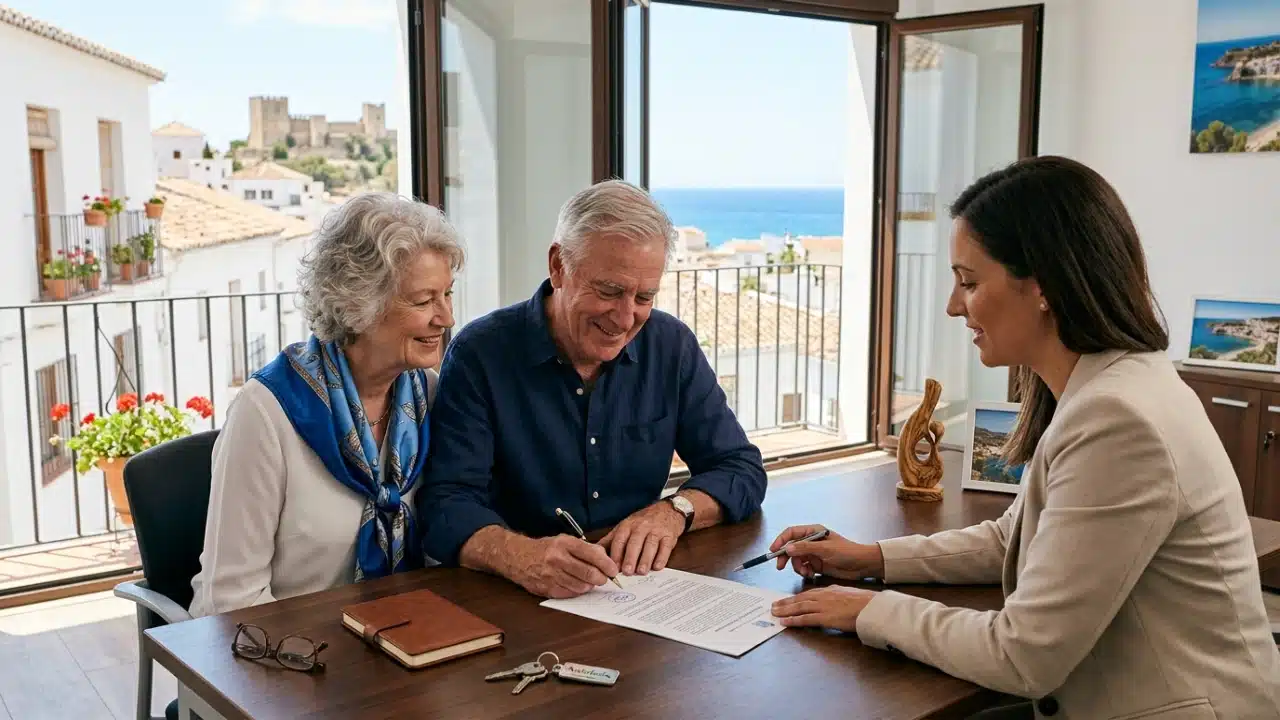
Who can buy property in Spain in 2026?
Spain has historically welcomed foreign property buyers, and that broad principle remains intact in 2026.
EU nationals enjoy full free-movement rights. Non-EU nationals, including British buyers post-Brexit, can purchase freely, subject to standard reporting and tax obligations.
Australians, Americans and other third-country nationals follow the same baseline rules, with country-specific tax overlays.
The Sánchez Government’s proposed 100% tax
In January 2025, Prime Minister Pedro Sánchez announced a proposed 100% tax on residential property purchases by non-EU non-residents, framed as a measure to address Spain’s housing crisis.
As of 2026, this proposal has not been enacted in the BOE and remains under parliamentary consideration.
It would, if adopted, apply only to non-EU non-residents (a segment representing under 5% of the market) and would not affect non-EU residents, EU buyers, or non-EU buyers obtaining residency before completion.
Until the law is published in the BOE, the existing tax regime continues to apply.
UK buyers planning a 2026 purchase should consult with our team to monitor parliamentary progress and consider transitional structures where necessary, including potentially establishing Spanish residency before completion.
Golden Visa closure
The Spanish Golden Visa, which previously offered residency to non-EU investors purchasing real estate worth €500,000 or more, was discontinued on 3 April 2025 through Organic Law 1/2025. Holders of valid Golden Visas retain their rights and renewal options.
Alternative residency routes for UK and other non-EU buyers now include:
- The Digital Nomad Visa under Startup Law 28/2022 for remote workers.
- The Spanish Non-Lucrative Visa for retirees and passive-income recipients.
- The Entrepreneur Visa for those launching a Spanish business.
- The Spanish Startup Visa for innovative ventures.
“The Valencian Community recorded approximately 23,400 home purchases by foreign buyers in 2024, second only to Andalusia and ahead of the Balearic Islands and Catalonia. British nationals were the single largest foreign group in the Valencian Community.”
Source: Colegio de Registradores, Foreign Buyer Statistics 2024 [1].
Step-by-step process for buying property in Spain
The Spanish purchase process differs from the English-and-Welsh model.
There is no equivalent of the SDLT-style single tax, no comparable conveyancing solicitor-vs-estate-agent split, and far greater notarial involvement.
The standard timeline runs from six to twelve weeks for a cash purchase and ten to sixteen weeks where mortgage finance is involved.
The eight key stages
- Obtain your NIE. The Número de Identidad de Extranjero is mandatory for any foreign buyer. It can be obtained at a Spanish consulate abroad or in Spain.
- Open a Spanish bank account. Required for the deposit, completion funds, mortgage payments and ongoing utilities.
- Engage independent legal counsel. Crucial for due diligence on title, charges, planning compliance, community debts and tourist-licence eligibility. Our breakdown of legal fees for buying Spanish property sets out the typical scope and budget.
- Reservation contract. A short agreement with a small holding deposit (typically €3,000 to €6,000) to take the property off the market while due diligence runs.
- Arras contract. The standard private sale agreement, with a 10% deposit. Three forms exist: arras confirmatorias, arras penales and arras penitenciales (Article 1454 Civil Code), each with different default consequences.
- Due diligence. Title check at the Land Registry, cadastral verification, energy certificate, IBI receipts, community fee status, urban planning compliance, mortgage searches and any pending legal actions. Where a property has unregistered extensions or annexes, see our note on legalising unregistered property in Spain.
- Notarial completion. Signature of the Escritura Pública before a notary, payment of the balance, and immediate filing for ITP or IVA. For mortgage buyers, our overview of the Spanish mortgage review process explains the bank’s pre-completion checks.
- Land Registry inscription. The notary or your lawyer files the deed for inscription, typically completed within 15 to 30 working days.
Power of attorney for remote completion
UK buyers who cannot travel can complete by granting a poder notarial (Spanish power of attorney) to their lawyer.
This must be executed before a UK notary and apostilled under the Hague Convention, then either translated by a sworn translator or signed in a bilingual format.
We routinely manage remote completions for international clients.
Costs and taxes when buying property in Spain
Total transaction costs typically range from 10% to 14% of the purchase price.
The breakdown depends primarily on whether the property is a new build (subject to IVA + AJD) or a resale (subject to ITP), and on the autonomous community where it is located.
Cost breakdown table
| Cost item | Resale property | New-build property | Who pays |
|---|---|---|---|
| ITP (Transfer Tax) | 6% to 11% (regional) | Not applicable | Buyer |
| IVA (VAT) | Not applicable | 10% residential / 21% land | Buyer |
| AJD (Stamp Duty) | Not applicable | 0.5% to 2.5% (regional) | Buyer |
| Notary fees | 0.1% to 0.5% | 0.1% to 0.5% | Buyer (custom) |
| Land Registry fees | 0.05% to 0.3% | 0.05% to 0.3% | Buyer |
| Legal fees | 1% to 1.5% | 1% to 1.5% | Buyer |
| Plusvalía Municipal | Variable | Not applicable (first transfer) | Seller (or buyer if non-resident) |
| Total estimate | 10% to 13% | 12% to 14% | Buyer side |
Worked example: a €350,000 resale flat in Valencia
For a UK buyer purchasing a €350,000 resale apartment in Valencia city, the typical cost breakdown is:
- ITP at 10%: €35,000.
- Notary fees: approximately €900.
- Land Registry: approximately €600.
- Legal fees (1.2% + IVA): approximately €5,082.
- Total ancillary costs: approximately €41,580, or about 11.9% of the purchase price.
The same property purchased as a new build would attract 10% IVA (€35,000) plus 1.5% AJD (€5,250) in the Valencian Community, totalling approximately 13% in transaction costs.
Note that certain edge cases qualify for VAT exemption in Spain, particularly second-hand transfers between private individuals.
Regional comparison: where to buy property in Spain in 2026
Spain’s autonomous communities each have their own ITP rates, AJD rates, regional tax reductions and tourist-licence regimes.
The differences are material and often determine where international buyers focus their search.
For a deeper analysis of the variation, our companion guide on Spanish regional property taxes covers this in detail.
| Region | ITP (resale) | AJD (new build) | Tourist-let regime | Reduced rates available |
|---|---|---|---|---|
| Valencian Community | 10% standard | 1.5% | Decreto 9/2024 (regional licence + national registry) | 8% under-35 first home, large families, disability |
| Madrid | 6% | 0.75% | Tightening; municipal licence required | 4% young buyer, large families |
| Catalonia | 10% to 11% (progressive) | 1.5% to 2.5% | Highly restrictive; Barcelona moratorium until 2028 | 5% under-32 first home |
| Andalusia | 7% | 1.2% | Tourist registration plus municipal rules | 3.5% to 6% under-35, large families |
| Balearic Islands | 8% to 13% (progressive) | 1.5% to 2% | Strict licence cap; moratorium areas | Limited regional reductions |
| Canary Islands | 6.5% to 7% | 1% | Variable; tightening proposed | IGIC instead of IVA on new builds |
Why the Valencian Community remains attractive
The Valencian Community offers a balanced combination of competitive transaction costs (despite the headline 10% ITP), reduced rates for primary residence and family buyers, lighter tourist-let restrictions than Catalonia or the Balearics, strong rental yields and excellent international connectivity through Valencia and Alicante airports.
For UK buyers in particular, the Costa Blanca, Costa Azahar and Valencia city continue to represent excellent value compared with established markets in Mallorca or coastal Catalonia.
The Valencian Community also recorded gross rental yields averaging 6.4% in 2024, materially above the eurozone average.
“Spanish residential property prices rose 8.4% nationally in 2024, with the Valencian Community recording 10.7% growth and Madrid 11.2%, marking the strongest annual increase since 2007.”
Source: Instituto Nacional de Estadística (INE), Índice de Precios de Vivienda Q4 2024 [4].
Ongoing tax obligations for foreign property owners
Once a property purchase completes, several recurring and event-driven taxes apply.

UK owners must factor these into the total cost of ownership, particularly given the post-Brexit IRNR rate of 24% on rental income.
Cross-border tax planning is best read alongside our overview of the UK-Spain double taxation framework.
Annual obligations
- IBI (Impuesto sobre Bienes Inmuebles): 0.4% to 1.1% of cadastral value, paid annually to the town hall.
- IRNR for non-residents (Modelo 210): due even if the property is not rented. Imputed income at 1.1% or 2% of cadastral value, taxed at 24% for non-EU residents.
- Rental income (Modelo 210 quarterly): 24% on gross rental income for UK residents, with no expense deductibility. UK landlords must also declare UK income in Spain if they become Spanish tax residents.
- Wealth tax (Impuesto sobre el Patrimonio): payable above €700,000 of net Spanish-located wealth (€500,000 in Catalonia). For a fuller treatment, see our Spanish wealth tax guide.
- Solidarity Tax on Large Fortunes: complementary to wealth tax for net assets above €3 million.
- Modelo 720: required for Spanish tax residents holding overseas assets above €50,000 per category. Our dedicated guide on Modelo 720 in Spain sets out the categories and penalties.
Sale-event taxes
- Capital gains tax: 19% to 28% on the gain (2026 savings income scale).
- 3% retention: the buyer must withhold 3% of the sale price and pay it to the AEAT via Modelo 211 if the seller is a non-resident.
- Plusvalía Municipal: tax on the increase in urban land value, paid to the town hall.
- Spanish exit tax: applicable when a Spanish tax resident with significant unrealised gains relocates abroad. See our specialist note on the Spanish exit tax for thresholds and exemptions.
Stay aware of the wider compliance calendar and key annual filing dates in our overview of Spanish tax deadlines.
Common pitfalls when buying property in Spain
The vast majority of property disputes in Spain originate from inadequate due diligence.
The Spanish system places heavy reliance on the Land Registry’s “public faith” principle, but the Registry does not record everything.
The most frequent issues we see
- Undeclared works (obra nueva pendiente de declarar): extensions or pools added without planning permission and not registered. The buyer inherits the legal exposure.
- Off-plan failures: buying from a developer without a bank guarantee under Law 38/1999. We always require these guarantees on off-plan purchases.
- Illegal tourist lets: buying a flat sold as a tourist apartment but lacking a valid licence. Recent restrictions are detailed in our analyses of short-term rentals in Spain and the VAT treatment of short-term tourist rentals.
- Plusvalía surprises: when the seller is non-resident, the buyer becomes liable in subsidiary capacity if the seller does not pay.
- Title charges and embargoes: undischarged mortgages, tax embargoes from the AEAT or Social Security, or judicial liens.
- Community debts: outstanding community-of-owners fees that transfer with the property up to the current year plus the three preceding years (Article 9.1.e of the Horizontal Property Law).
- Cadastral discrepancies: where the cadastral square metres differ from the registered or actual surface, with knock-on effects on IBI and ITP.
- Cédula de habitabilidad missing: the habitation certificate, required in many regions for utility connections and rental contracts.
Brexit-specific pitfalls for UK buyers
- Failing to register the apostilled UK power of attorney correctly, leading to invalid completion.
- Missing the Modelo 720 declaration when Spanish property is held alongside UK assets above €50,000 per category.
- Misunderstanding the 24% IRNR rate on rental income with no expense deductions, eroding rental yield.
- Mishandling pension transfers connected to the property purchase. UK retirees should review our note on QROPS transfers in Spain and the implications for UK pension contributions in Spain.
- Overlooking estate planning. Cross-border probate is rarely simple, and an international inheritance lawyer should be engaged early where Spanish-located assets are involved.
What has changed for 2026: regulatory updates UK buyers need to know
The Spanish property landscape has seen more regulatory change in the past three years than in the previous decade. The 2026 environment reflects a series of cumulative reforms that international buyers must factor into their planning.
Key 2024 to 2026 reforms
- Law 12/2023 on the Right to Housing: introduced the concept of stressed-market areas with rent caps, expanded the definition of “large owner” (10 properties nationally, 5 in stressed areas), and authorised increased IBI rates of up to 150% on long-vacant properties.
- Royal Decree 1312/2024 and the new tourist registry: from 1 July 2025, all short-term rentals advertised on platforms such as Airbnb and Booking must hold a unique national registration code.
- Decreto 9/2024 in the Valencian Community: tightened tourist licensing rules, introducing per-municipality caps and stricter compliance verification.
- Closure of the Golden Visa: residency-by-investment via real estate ended on 3 April 2025.
- Proposed 100% tax on non-EU non-resident buyers: announced January 2025, not yet enacted as of 2026.
- Strengthened Plusvalía Municipal calculation method: following Constitutional Court rulings, taxpayers can choose between objective and real-gain methods.
- Extension of the 3% IRNR retention: enforcement has tightened, with AEAT actively pursuing buyers who fail to retain.
Outlook for 2026
Despite the regulatory tightening, foreign demand has remained robust.
CBRE projected real estate investment in Spain to reach €16 billion in 2025, with international capital continuing to flow into the residential, build-to-rent and logistics sectors.
Falling ECB interest rates have improved mortgage affordability, with average Spanish mortgage rates falling toward 2.1% to 2.5% in 2025-2026 [5].
For UK buyers in particular, the combination of post-Brexit residency planning, careful tax structuring and rigorous due diligence is essential.
The benefits of buying property in Spain remain substantial, but the margin for error has narrowed.
How Delaguía y Luzón assists international property buyers
Founded in 1960, Delaguía y Luzón is a third-generation Valencia law firm specialising in cross-border property, tax, immigration and inheritance work for international clients.
We offer services in English, French, Spanish and Russian, with 90% of our clients international.
Speak to our property solicitors in Valencia
Contact our legal team for personalised guidance on buying property in Spain in 2026.
Email: felix.delaguia@delaguialuzon.com
Phone: +34 963 74 16 57
Office: Avinguda Regne de Valencia, 6, 1º-2º, 46005 Valencia, Spain
Visit our property law service page to learn more about our conveyancing and post-completion support.
Frequently asked questions on buying property in Spain
Can UK citizens still buy property in Spain after Brexit?
Yes. UK nationals can purchase property in Spain on the same legal basis as any other non-EU buyer. Brexit changed the tax and residency consequences (24% IRNR, 3% retention on sale, third-country immigration rules) but did not restrict the right to acquire real estate.
Has the proposed 100% tax on non-EU buyers been adopted?
As of 2026, the 100% tax announced by Prime Minister Pedro Sánchez in January 2025 has not been published in the BOE and is not in force. It remains a proposal under parliamentary review. UK buyers should seek current advice before completing.
How long does it take to buy a property in Spain?
A standard cash purchase typically takes 6 to 12 weeks from reservation to notarial completion. Mortgage transactions typically extend this to 10 to 16 weeks. Off-plan purchases follow the construction schedule, which can range from 12 to 36 months.
Do I need an NIE before buying?
Yes. The NIE is mandatory for any property transaction in Spain. It can be obtained at a Spanish consulate in the UK or in person in Spain. Our team manages NIE applications for all clients.
What are the total costs of buying property in Spain?
Total transaction costs typically range from 10% to 14% of the purchase price, depending on whether the property is new (IVA + AJD) or resale (ITP), and the autonomous community. Add ongoing costs such as IBI, community fees, Modelo 210 and any rental-income IRNR.
Can I get a mortgage in Spain as a non-resident?
Yes. Spanish banks routinely lend to non-resident foreign buyers, typically up to 60% to 70% of the property value (LTV). UK buyers should expect to provide tax returns, payslips, asset statements and proof of address. Average rates in 2026 sit around 2.5% to 3.5%, depending on profile.
What is the difference between ITP and IVA?
ITP applies to resale homes and is a regional tax. IVA applies to new builds and is a national VAT (10% for residential, 21% for commercial or land), accompanied by AJD stamp duty. You never pay both on the same transaction.
Is the Valencian Community a good place to buy?
Yes. The Valencian Community combines competitive prices, strong rental yields (around 6.4% gross), excellent international connections, lighter tourist-let restrictions than Catalonia or the Balearics, and reduced ITP rates for primary-residence and family buyers. It is one of the most popular UK-buyer destinations in Spain.
What happens if I want to rent the property as a tourist let?
You will need a regional tourist licence and, from 1 July 2025, a national registration code under Royal Decree 1312/2024. The Valencian Community operates under Decreto 9/2024 with municipal caps. The Balearics and Barcelona apply moratoria. Always check tourist-licence eligibility before purchase.
What about inheritance tax on my Spanish property?
Spanish ISD applies to all Spanish-located assets. UK IHT applies to UK-domiciled estates worldwide. There is no UK-Spain inheritance tax treaty. Cross-border planning, including a Spanish will electing English law under EU Regulation 650/2012, is essential for UK buyers.
Reference list
- Colegio de Registradores de la Propiedad, Estadística Registral Inmobiliaria 2024: https://www.registradores.org/
- Agencia Estatal de Administración Tributaria (AEAT), Manual de Tributos sobre la Renta de no Residentes y Modelo 210: https://www.agenciatributaria.gob.es/
- Conselleria d’Hisenda, Generalitat Valenciana, Tipos impositivos ITP y AJD 2026: https://atv.gva.es/
- Instituto Nacional de Estadística (INE), Índice de Precios de Vivienda, Q4 2024: https://www.ine.es/
- Banco de España, Boletín Estadístico, mercado hipotecario 2025: https://www.bde.es/
- BOE, Real Decreto 1312/2024 sobre el registro único de alquileres de corta duración: https://www.boe.es/
- BOE, Ley 12/2023 por el derecho a la vivienda: https://www.boe.es/
- HM Government, Living in Spain Guide: https://www.gov.uk/world/spain