Spain general election 2026: the essentials for foreign residents
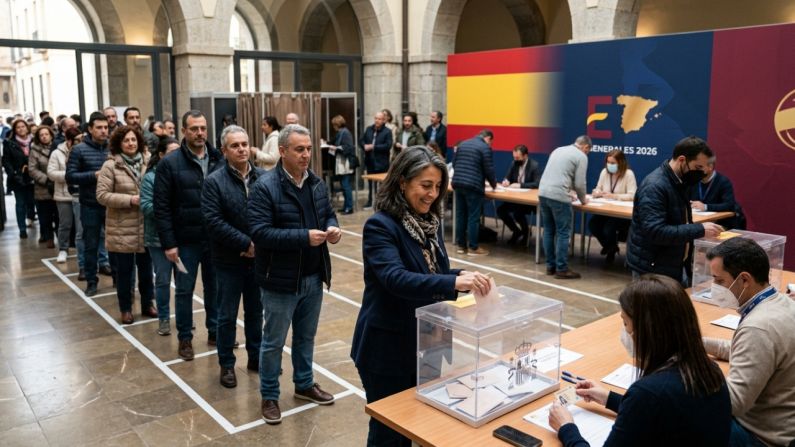
- The Spain general election 2026 takes place on Sunday 29 November 2026, after Royal Decree 806/2026 dissolved the Congress and the Senate on 6 October [1].
- The campaign runs from 13 to 27 November, and the new chambers meet on 23 December 2026 [1].
- Only Spanish nationals vote in general elections; foreign residents, including EU and UK citizens, cannot [2][3].
- EU citizens can vote in Spanish municipal and European elections, and UK nationals in municipal elections under a 2019 treaty, if they register in time [3][4][5].
- Bills still before Congress lapsed on dissolution, and the housing decree of 29 September 2026 had already been repealed on 2 October [6][7].
- Laws already in force, residence permits and pending applications are not affected by the election itself.
Why a snap election matters to people who cannot vote in it
The Spain general election 2026 was called on 5 October, after Congress rejected the government’s housing decree.
Most foreign residents cannot vote in it, but the result will shape the rules on housing, tax and immigration that affect them every day.
This guide explains the timetable, who can vote, what happens to laws and applications while parliament is dissolved, and which deadlines still apply.
It states the position at 7 October 2026 and does not discuss parties or programmes.
Spain votes on Sunday 29 November 2026, and the newly elected Congress and Senate meet for the first time on 23 December 2026 [1].
The Spain general election 2026 timetable
Royal Decree 806/2026, published in the BOE on 6 October, dissolved the chambers elected on 23 July 2023 and set the timetable below for the Spain general election 2026 [1].
| Step | Date |
|---|---|
| Congress and Senate dissolved | 6 October 2026 |
| Election campaign | 13 to 27 November 2026 |
| Polling day | Sunday 29 November 2026 |
| New chambers meet | 23 December 2026 |
| New government takes office | After a Prime Minister wins an investiture vote in Congress |
The election is governed by the Organic Law on the General Electoral Regime (LOREG), Organic Law 5/1985 [3].
Who can vote, and who cannot
Article 13.2 of the Spanish Constitution reserves the right to vote to Spanish nationals, with one exception: municipal elections, where treaties or laws can extend the vote to foreigners on a reciprocal basis [2].
Article 2 of the LOREG repeats the rule: the right to vote belongs to Spanish nationals of age who are on the electoral roll [3].
| Resident | General election | Municipal elections | European Parliament |
|---|---|---|---|
| Spanish national (including naturalised) | Yes | Yes | Yes |
| EU citizen | No | Yes, if registered [5] | Yes, if registered [5] |
| UK national | No | Yes, after three years of legal residence and registration [4] | No |
| US national and most other non-EU nationals | No | Only nationals of countries with a voting agreement [9] | No |
The Spain general election 2026 is therefore decided by Spanish nationals only, including those who live abroad.
Foreign residents who become Spanish nationals gain the vote in general elections; our guide to the CCSE exam for Spanish nationality covers one of the steps.
British residents can check the wider post-Brexit position, including residence documents and travel rules, in our guide for British expats in Spain after Brexit.
What happens to laws and reforms while parliament is dissolved
Under Article 207 of the Rules of the Congress, all matters pending before the chamber lapse when it is dissolved, except those its Permanent Deputation must deal with under the Constitution [6].
In practice, any bill that had not completed its passage before 6 October 2026 must start again after the Spain general election 2026.
The Permanent Deputation, a smaller body of each chamber, takes over the chamber’s powers on decree-laws and states of emergency while the chambers are dissolved, under Article 78 of the Constitution [2].
Laws already published in the BOE stay in force; a dissolution does not repeal anything.
The government before and after polling day
Until polling day the government keeps its full powers, although parliament is dissolved.
Under Article 21 of the Government Law (Law 50/1997), the government ceases after the general election and continues in office as a caretaker government until the new one takes office [8].
A caretaker government limits itself to ordinary business, except in duly justified urgent cases, and cannot approve the draft State Budget or send bills to parliament [8].
Under Article 207 of the Rules of the Congress, every matter pending before the chamber lapsed when it was dissolved on 6 October 2026 [6].
Housing: the issue that triggered the election
Royal Decree-law 26/2026, published on 30 September, set new rules on seasonal and room rentals, rent increases, evictions and landlord tax relief [10].
Congress repealed it on 2 October 2026, so none of those measures applies, and the Prime Minister called the Spain general election 2026 three days later [7].
An earlier decree with a 2% cap on annual rent updates, Royal Decree-law 8/2026, had been repealed in April [11].
The housing rules in force are those of Law 12/2023 on the right to housing and the Urban Leases Law, which our guide to housing rights under Law 12/2023 explains.
Our guide to the repealed 2026 rental decree explains what it proposed and which rental rules apply now.
Landlords and tenants should not act on proposals made during the campaign until a new law is published in the BOE.
What the general election does not decide
Spain shares power between the State, the 17 autonomous communities and the town halls, so many rules that matter to foreign residents are not decided in the Spain general election 2026.
- Regional taxes and reliefs: the Valencian Community sets its own income tax scale, inheritance tax reliefs and wealth tax allowance, and these stay as they are.
- Tourist rentals: licences, registers and maximum stays for holiday lets are regional and municipal rules.
- Padrón and local services: registration, schools and local taxes such as IBI are handled by town halls and the regions.
Immigration law, the State part of income tax, the Urban Leases Law and the national housing law are State matters, so those are the areas a new Cortes can change.
Our guide to Spain’s autonomous communities explains how the levels of government divide these powers.
Spanish nationals living abroad
Spaniards registered as resident abroad vote from their country of residence, by post or at a consulate.
Since Organic Law 12/2022 they no longer have to request the vote in advance: the electoral documents are sent to them automatically [13].
This matters to dual nationals and to families where one partner is Spanish and lives outside Spain.
Residence permits, nationality and other applications
Immigration offices, the tax agency and town halls keep working during the campaign, and applications already filed continue under the rules in force.
The extraordinary regularisation closed on 30 June 2026, and the election does not reopen it.
Ordinary routes, such as arraigo or long-term residence, are unaffected by the dissolution.
Tax deadlines also stay the same; our calendar of Spanish tax deadlines lists them.
Registration on the padrón is a condition for EU and UK residents to join the municipal electoral roll, so check your entry; our guide to empadronamiento in Spain explains how.
The next vote foreign residents can take part in
For most foreign residents, the next election after the Spain general election 2026 that they can vote in is the municipal election of 23 May 2027 [5].
EU citizens must be on the padrón and declare their wish to vote in Spain no later than 30 December 2026, online, by post or at the town hall [5].
UK nationals vote under the 2019 UK-Spain agreement, in force since 16 March 2023, if they hold a residence document and have lived in Spain legally and continuously for at least three years before applying [4][12].
Their registration on the electoral roll for nationals of countries with agreements is valid only for the election it is made for, so it must be renewed each time [9].
The INE publishes the application period for each municipal election; check it on the INE website before the end of 2026.
EU citizens who want to vote in the municipal election of 23 May 2027 must register their wish to vote by 30 December 2026 [5].
Checklist for foreign residents
- Do not change contracts or plans on the strength of campaign promises.
- Keep filing permits, renewals and tax returns on the usual deadlines.
- Check that your padrón registration is up to date.
- EU citizens: declare your wish to vote in the 2027 municipal election by 30 December 2026.
- UK nationals: check the INE application period for the 2027 municipal election.
- Naturalised Spaniards: check your entry on the electoral roll before 29 November.
How Delaguía y Luzón can help
Our immigration law team in Valencia has advised international clients since 1960.
We follow every change in housing, tax and immigration law after the Spain general election 2026, and can tell you how a new rule affects your permit, your property or your business once it is published.
Speak to our team about your position in Spain
Contact our legal team for personalised guidance on your case.
We work in English, French, Spanish and Russian from our office in Valencia.
Email: felix.delaguia@delaguialuzon.com
Phone: +34 963 74 16 57
Office: Avinguda Regne de València, 6, 1º-2º, 46005 Valencia
Frequently asked questions about the Spain general election 2026
When is the Spanish general election?
Sunday 29 November 2026.
The campaign runs from 13 to 27 November, and the new chambers meet on 23 December.
Can foreigners vote in the Spain general election 2026?
No.
Only Spanish nationals vote in the Spain general election 2026, under Article 13.2 of the Constitution and Article 2 of the LOREG.
Can EU citizens living in Spain vote?
Not in the general election.
They can vote in municipal and European elections if they are registered.
Can British residents vote in Spain?
Only in municipal elections, under the 2019 UK-Spain agreement.
They need a residence document, three years of legal residence and registration for each election.
Can I vote if I have become a Spanish national?
Yes.
Naturalised Spaniards vote in general elections once they appear on the electoral roll.
What happens to laws that were going through parliament?
They lapsed when Congress was dissolved on 6 October 2026.
A new parliament must start them again.
Is the housing decree of September 2026 in force?
No.
Congress repealed Royal Decree-law 26/2026 on 2 October 2026.
Does the election affect my residence permit application?
No.
Applications continue under the rules in force, and offices keep working.
What is a caretaker government?
After the election, the outgoing government stays in office until a new one is formed.
It handles ordinary business and cannot approve the draft budget or send bills to parliament.
When is the next election foreign residents can vote in?
For EU and UK residents, the municipal election of 23 May 2027.
EU citizens must register their wish to vote by 30 December 2026.
References
- Royal Decree 806/2026, of 5 October, dissolving the Congress and the Senate and calling elections (BOE)
- Spanish Constitution, Articles 13 and 78 (BOE)
- Organic Law 5/1985 on the General Electoral Regime, Articles 2 and 176 (BOE)
- Agreement between Spain and the United Kingdom on participation in certain elections, 2019 (BOE)
- INE: electoral roll of foreign residents for the 2027 municipal elections
- Rules of the Congress of Deputies, Article 207 (BOE)
- Resolution of 2 October 2026 repealing Royal Decree-law 26/2026 (BOE)
- Law 50/1997 on the Government, Article 21 (BOE)
- Electoral Roll Office resolution on registration of nationals of countries with agreements (BOE)
- Royal Decree-law 26/2026, of 29 September, on housing (BOE)
- Resolution of 28 April 2026 repealing Royal Decree-law 8/2026 (BOE)
- Entry into force of the UK-Spain elections agreement, 16 March 2023 (BOE)
- Organic Law 12/2022 on voting by Spaniards living abroad (BOE)