The CCSE exam and Spanish nationality tests
- Nationality by residence requires passing the CCSE exam, a constitutional and cultural knowledge test run by the Instituto Cervantes.
- Most applicants must also pass the DELE A2 Spanish language exam or a higher DELE level.
- The CCSE exam has 25 multiple-choice questions, and 15 correct answers are enough to pass.
- Nationals of Spanish-speaking countries are exempt from the language requirement but not from the CCSE.
- Minors and persons with legally recognised incapacity are exempt from both tests.
- A CCSE pass certificate is valid for four years for nationality purposes.
- The exams are only one requirement; applicants must also prove sufficient residence, good civic conduct and integration.
What is the CCSE exam, and who can take it?
For most foreign residents, the final stretch of the road to a Spanish passport runs through two examinations.
The CCSE exam tests knowledge of the Spanish Constitution, institutions and culture, while the DELE A2 certifies a basic command of Spanish.
Both are administered by the Instituto Cervantes, and both are compulsory elements of the nationality file, so preparing them properly saves months of delay.
This guide explains who must sit each test, what the CCSE exam contains, the exemptions, and how the results fit into the wider nationality application.
The legal framework behind the nationality exams
Nationality by residence is governed by the Civil Code and by Royal Decree 1004/2015, which regulates the application procedure.
That regulation made the Instituto Cervantes tests the standard method of proving integration into Spanish society.
Before 2015, integration was assessed through personal interviews with uneven criteria, so the exams introduced objectivity and predictability.
The requirement applies to applications for nationality by residence, which is the route used by most expats after living legally in Spain for the qualifying period.
The residence periods themselves, ten years as the general rule with shorter periods for specific groups, are explained in our guide to long-term residence and the route to citizenship.
Spain granted more than 240,000 nationality applications in a single recent year according to Ministry of Justice data, and the overwhelming majority of adult applicants passed through the Instituto Cervantes examinations.
What the CCSE exam contains
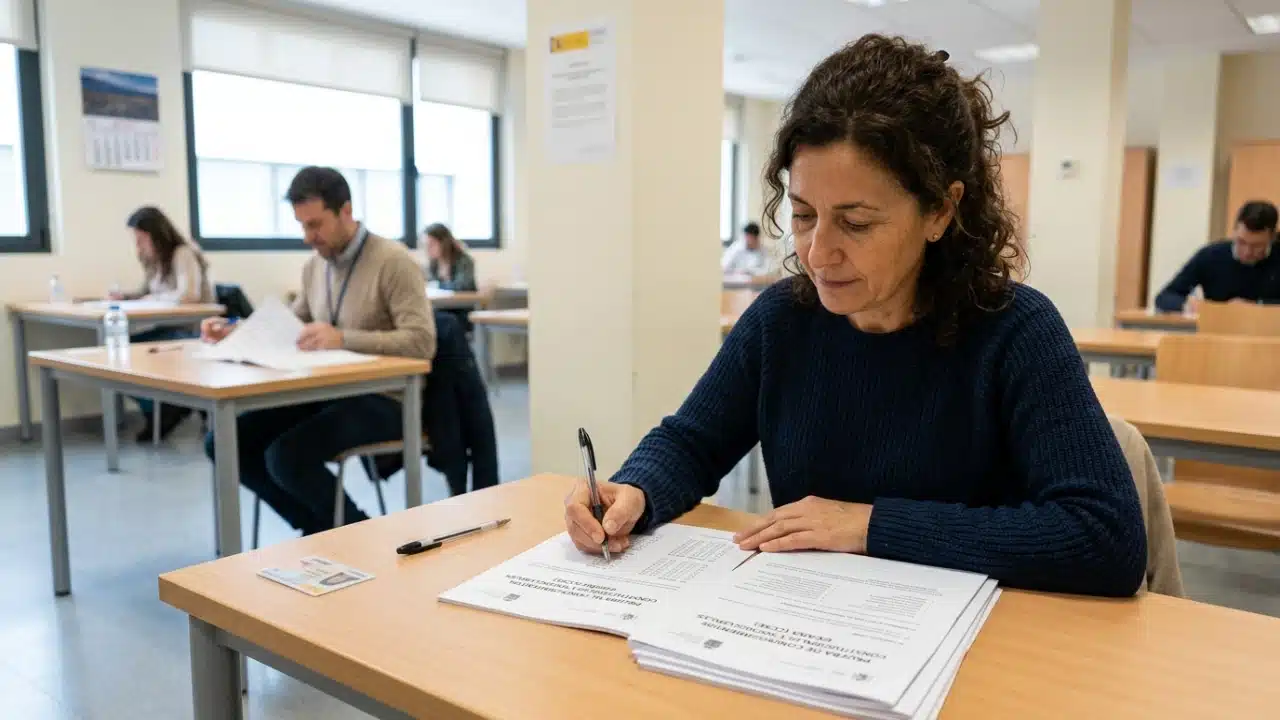
The CCSE exam, Conocimientos Constitucionales y Socioculturales de España, is a 45-minute multiple-choice test.
It contains 25 questions divided into two blocks.
The first block covers the Spanish Constitution, government, institutions, laws and citizen participation.
The second block covers Spanish culture, history, society, geography and daily life.
Applicants need 15 correct answers, equivalent to 60%, to pass.
The Instituto Cervantes publishes the complete question bank in advance, so every question in the real test comes from a known list.
More than 90% of candidates pass the CCSE at each sitting according to Instituto Cervantes results data, a success rate that reflects the published question bank and the accessible pass mark.
The DELE A2 language requirement
Alongside the culture test, applicants must certify at least an A2 level of Spanish under the Common European Framework.
The standard route is the DELE A2 diploma, which examines reading, writing, listening and speaking.
Higher DELE diplomas are also accepted, so residents who already hold a B1 or B2 certificate need not sit the A2 exam.
The language requirement demands more preparation than the culture test, particularly from applicants who work in English-speaking environments.
Exemptions from the nationality exams
The rules exempt several groups from one or both tests.
- Nationals of Spanish-speaking countries in Ibero-America, plus Andorra, the Philippines, Equatorial Guinea and Portugal, in terms of the regulation, are exempt from the DELE requirement.
- Minors under 18 are exempt from both exams and prove integration through schooling certificates.
- Persons with a legally recognised incapacity are exempt from both exams.
- Applicants who completed compulsory education in Spain can request exemption from the DELE in certain cases.
No general exemption exists from the CCSE exam for adult applicants with full capacity, regardless of how long they have lived in Spain.
CCSE exam and DELE A2 compared
| Feature | CCSE exam | DELE A2 |
|---|---|---|
| Content | Constitution, institutions, culture and society | Spanish language at basic user level |
| Format | 25 multiple-choice questions in 45 minutes | Reading, writing, listening and speaking papers |
| Pass mark | 15 correct answers out of 25 | Pass in each grouped skill area |
| Sittings | Monthly during most of the year | Several sittings per year |
| Main exemption | Minors and persons with recognised incapacity | Nationals of Spanish-speaking countries |
| Certificate validity | Four years | Indefinite |
Registering for the exams and sitting them in Valencia
Registration is completed online through the Instituto Cervantes examination portal at examenes.cervantes.es.
Candidates choose an accredited examination centre, and Valencia has several, including university language centres and private academies.
Exam fees are paid at registration, and places for popular sittings fill quickly in spring and autumn.
Results for the CCSE exam are normally published within a few weeks of the sitting.
How the exams fit into the nationality application
Passing the tests does not itself grant anything; the certificates are documents within the wider nationality file.
The application also requires the qualifying period of legal and continuous residence, a clean criminal record in Spain and the country of origin, and civil status documents that are properly apostilled and sworn translated, following the standards described in our guide to apostilles and sworn translations for Spain.
Families should note that children born in Spain may acquire nationality much faster, as explained in our article on children born in Spain to foreign parents.
Applicants married to Spanish citizens qualify after one year of residence, a route connected to the residency pathways in Spain that we regularly manage for international couples.
The general nationality rule requires ten years of legal residence, but the period falls to two years for nationals of Ibero-American countries and to one year for spouses of Spanish citizens.
Exam certificates are frequently the easiest part of the file, while residence continuity and document legalisation cause most refusals.
Our immigration law team in Valencia reviews the complete nationality file before submission.
Common mistakes with the CCSE exam and nationality tests
- Sitting the exams years before applying and letting the CCSE certificate expire.
- Booking the DELE A2 without preparation and underestimating the writing and speaking papers.
- Assuming that long residence in Spain replaces the exam requirement.
- Registering with personal details that do not match the passport exactly.
- Passing the exams but neglecting the apostilles and sworn translations of civil documents.
- Missing the exemption that higher DELE diplomas already satisfy the language requirement.
How Delaguía y Luzón can assist with your nationality application
Delaguía y Luzón Abogados has advised international residents from Valencia since 1960, with a client base that is approximately 90% international.
We plan the nationality timetable around the exam sittings, verify every exemption, and prepare the complete file, including residence evidence, criminal record certificates and legalised civil documents.
After submission, we monitor the file with the Ministry of Justice and handle any requests for additional documentation.
We work in English, German, French, Spanish and Russian, so applicants prepare for the exams while we manage the law.
Speak to our nationality team in Valencia
Contact our legal team for personalised guidance on the CCSE, the DELE A2 and your Spanish nationality application.
Email: felix.delaguia@delaguialuzon.com
Phone: +34 963 74 16 57
Office: Avinguda Regne de Valencia, 6, 1º-2º, 46005 Valencia
FAQs about the CCSE exam and DELE A2
What is the CCSE exam?
The CCSE exam is the Instituto Cervantes test of Spanish constitutional and sociocultural knowledge required for nationality by residence.
How many questions does the CCSE have, and what is the pass mark?
It has 25 multiple-choice questions, and 15 correct answers are needed to pass.
Are the CCSE questions published in advance?
Yes, the Instituto Cervantes publishes the full question bank, and every question in the sitting comes from that list.
Who is exempt from the DELE A2?
Nationals of Spanish-speaking countries and applicants holding a higher DELE diploma, among the specific cases listed in the regulation.
Who is exempt from the CCSE?
Minors under 18 and persons with legally recognised incapacity, while adult applicants generally must sit it.
How long is a CCSE pass valid?
The certificate is valid for four years for nationality purposes.
How often can I retake the exams if I fail?
You can register for later sittings, and the CCSE fee includes a second attempt within the registration period.
Where can I take the exams in Valencia?
Several accredited centres in Valencia run monthly CCSE sittings and periodic DELE sessions, all booked through the Cervantes portal.
Do the exams alone give me Spanish nationality?
No, they are one requirement within the application, alongside qualifying residence, clean criminal records and legalised civil documents.
How long does the nationality application take after the exams?
Resolution times vary, and files commonly take one to two years, so early and complete preparation matters.