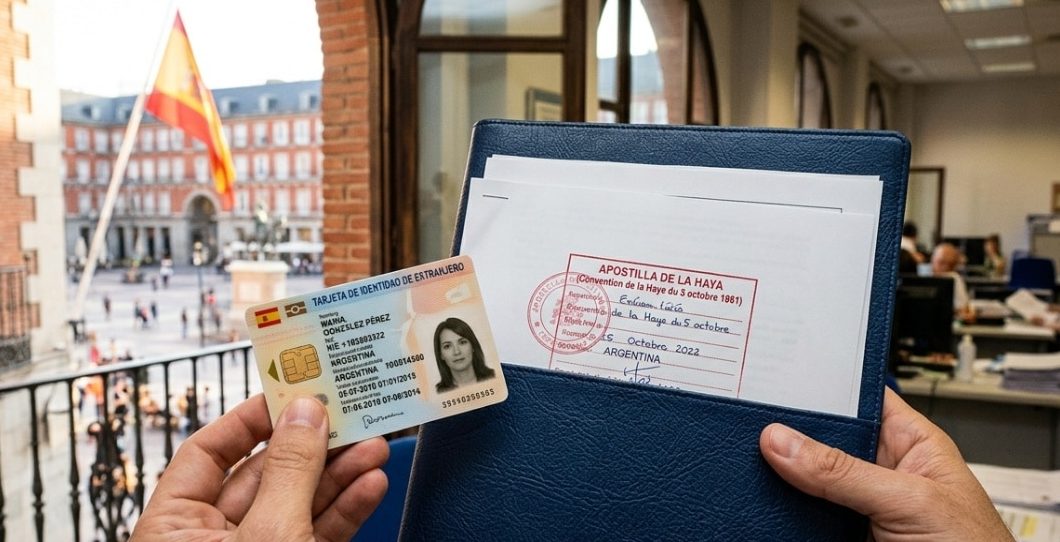
Working remotely for a UK employer from Spain: the essentials at 21 October 2026
- More than 183 days in Spain, or your main economic interests here, make you Spanish tax resident, and Spain then taxes pay for work done here [1][2].
- A UK employer that does not operate in Spain need not withhold Spanish tax, so you pay it with your annual return [3][4].
- PAYE continues until HMRC confirms a new code after you file form P85 [5][6].
- UK National Insurance continues only for temporary work of up to 24 months with a certificate; otherwise the employer contributes in Spain [9][10][11].
- An English law contract cannot remove mandatory Spanish employment protections [19][20].
- Delaguía y Luzón advises on Spanish law only, so every UK payroll, PAYE and HMRC point must be confirmed with a UK adviser.
Why staying on UK payroll while living in Spain needs a plan
Working remotely for a UK employer from Spain looks simple: same job, same payslip, different view.
This guide is for British employees on a UK payroll in Spain, and for the HR teams and payroll providers who support them.
It states the Spanish position at 21 October 2026 and explains who must do what.
We are a Spanish law firm, so anything we say about PAYE, National Insurance or HMRC procedure must be confirmed by your UK adviser.
The legal framework after Brexit for working remotely for a UK employer from Spain
Since free movement ended, working remotely for a UK employer from Spain has to be analysed in four separate layers.
- Immigration: a right to live and work in Spain, such as Withdrawal Agreement residence or the teleworking visa [14][16].
- Tax: Spanish income tax law and the UK-Spain treaty [1][2].
- Social security: the Protocol on Social Security Coordination in the UK-EU Trade and Cooperation Agreement [9].
- Labour law: the Rome I Regulation, which Spanish courts still apply [19].
A visa does not settle your tax, so working remotely for a UK employer from Spain needs an answer on each layer.
Spanish tax residence and your UK salary
When you become resident in Spain
Under article 9 of the Personal Income Tax Law (LIRPF), you are resident if you spend more than 183 days in Spain in a calendar year, counting sporadic absences [1].
You are also resident if Spain is the main base of your economic interests, and residence is presumed if your spouse and minor children live here [1].
The tax period is the calendar year, so there is no Spanish split-year rule [1].
More than 183 days in Spain in a calendar year makes you a Spanish tax resident, taxed on your worldwide income [1].
What the treaty says about your salary
If both countries treat you as resident, article 4 of the 2013 UK-Spain convention looks first at your permanent home, then your centre of vital interests [2].
Under article 14, a Spanish resident’s pay for days worked in Spain is taxable only in Spain, while UK workdays may also be taxed in the UK, with a Spanish credit under article 22 [2].
Our guide to UK-Spain double taxation covers the treaty more widely.
What happens to PAYE
HMRC tells employers to keep deducting PAYE, and the employee reports the move on form P85 [5][6].
HMRC then confirms the code to use, which may be code NT for a non-resident working for a UK employer abroad [5][7].
UK residence follows the statutory residence test in HMRC’s guidance RDR3, for your UK adviser to confirm [8].
Spanish withholding and your own return
Article 76 of the Income Tax Regulations requires a non-resident company to withhold on salaries only if it operates in Spain [3].
Binding ruling V1339-26 of 2 June 2026 confirms that an employer without a permanent establishment or economic activity in Spain need not withhold, leaving the facts of each case to the Tax Agency [4].
Instalment payments apply only to economic activities, so if you are working remotely for a UK employer from Spain without withholding, the whole year’s tax falls due with your Modelo 100 return [1].
When the employer is not obliged to withhold, the filing threshold for salary falls from €22,000 to €15,876 a year [1].
The Beckham regime
Article 93 LIRPF accepts a move for remote work, with the option filed within six months of your social security start date [1][3].
The conditions are set out in our guide to the Beckham Law Spanish tax regime.
Social security: UK National Insurance or Spanish contributions
Temporary work: the 24-month rule
Article SSC.10 of the Protocol applies one State’s law only, normally where you work [9].
Article SSC.11 keeps an employee sent by a UK employer in the UK system if the work does not exceed 24 months and does not replace another detached worker [9].
HMRC applies this where the employer sent you or agreed to the temporary work, and issues a certificate of coverage, also called a PDA1 [10].
A detached employee can stay in UK National Insurance for up to 24 months, and only with a certificate of coverage [9][10].
Ongoing remote work: Spanish contributions
If the move is open-ended, Spanish social security applies from the start, and Article SSC.14 obliges the UK employer to meet all Spanish obligations as if it were based here [9][10].
The Ministry of Inclusion’s Large Companies Unit states that the company must first register as a non-resident entity without establishments in Spain [11].
The employee’s registration must be requested before work starts, and no more than 60 calendar days earlier [12].
Ministry of Labour guidance adds that the employer needs a Spanish address and a representative, who may be the employee [13].
Splitting time between the UK and Spain
If working remotely for a UK employer from Spain is mixed with regular UK workdays, Article SSC.12 applies Spanish law when a substantial part of your work is done here, and under 25% indicates it is not [9].
EU-based employers follow different rules, explained in our article on social security for cross-border teleworkers, and pensions are covered in our guide to UK pension contributions in Spain.
Immigration routes for British nationals
Your route decides whether you may work here at all.
| Route | Remote work allowed | Tax and social security notes |
|---|---|---|
| Withdrawal Agreement resident with a TIE | Yes, if legally resident since before 1 January 2021 | Usually tax resident already; Beckham normally excluded |
| International teleworking (digital nomad) visa | Yes, for employers located outside Spain | Spanish registration or a certificate covering telework in Spain; Beckham available |
| Non-lucrative residence | No | Authorises residence without work |
| Visitor without a visa | Short stays only | Up to 90 days in any 180-day period |
Sources: [11][14][15][16][17].
See our guide to applying for the digital nomad visa in Spain, and our immigration law team for applications and renewals.
Permanent establishment risk for the UK employer
Corporate tax is easily overlooked when working remotely for a UK employer from Spain becomes long term.
Under article 5 of the treaty, a permanent establishment is a fixed place of business, or a person who habitually concludes contracts in the company’s name [2].
Spanish law likewise refers to workplaces of any kind at the company’s disposal on a continuing or habitual basis [18].
Neither text mentions home offices, so whether your home is in practice at the company’s disposal turns on the facts, and the BOE warns that the multilateral BEPS convention may affect the treaty [2].
A permanent establishment is taxed in Spain on its profits and must withhold on salaries, as our overview of Spain corporate tax explains [3][18].
Spanish labour law that applies to a UK employment contract
As an EU Member State, Spain applies the Rome I Regulation whatever law the contract chooses [19].
Under article 8, an English law clause cannot remove the mandatory protections of the country where you habitually work, which for working remotely for a UK employer from Spain is usually Spain [19].
- A 40-hour maximum ordinary week on an annual average [21].
- At least 30 calendar days of paid annual leave [21].
- 33 days’ salary per year of service, up to 24 months, for unfair dismissal [21].
- A daily record of start and finish times, kept for four years [21].
At 21 October 2026, article 34.9 keeps its 2019 wording; we found no BOE publication of the planned decree on digital time records [21].
Law 10/2021 applies where at least 30% of working time is remote over three months, and requires a written agreement before remote work starts, expense compensation and a right to disconnect [20].
Options for UK employers with staff in Spain
| Option | How it works | Main points to watch |
|---|---|---|
| UK payroll with Spanish registration | UK company registers with Spanish Social Security | Spanish contributions; employee files own return; PE review |
| Spanish subsidiary or branch | Spanish entity employs and pays the worker | Set-up costs, Spanish withholding, corporate tax |
| Employer of record | A Spanish provider employs the worker for the UK company | Assigning workers is lawful only through authorised temporary work agencies |
| Short-term posting | Worker stays on UK payroll and in UK National Insurance | Up to 24 months with a certificate; not for permanent moves |
Sources: [9][11][21].
Larger teams often compare a subsidiary with a branch office in Spain for a UK company.
If you hire through a Spanish entity instead, our guide to hiring employees in Spain covers contracts and costs, and sponsored moves are covered in our article on relocating UK employees to Spain.
The Valencian Community compared with other regions and countries
Each region sets its own income tax scale for ordinary residents, on top of the state scale of 9.5% to 24.5% [1].
| Region | Regional scale 2026 | Top rate applies from |
|---|---|---|
| Valencian Community | 8.8% to 29.35% | €200,000 |
| Madrid | 8.5% to 20.5% | €57,320.40 |
| Catalonia | 9.5% to 25.5% | €175,000 |
| Andalusia | 9.5% to 22.5% | €60,000 |
Sources: [22][23][24][25].
The Valencian top rate starts only at €200,000, and Law 5/2026 trims the scale to 8.7% to 29.25% from 2027 [22].
Under the Beckham regime no regional scale applies [1].
Portugal’s IFICI regime is limited to listed activities and entities, and Ireland’s SARP needs an employer assignment and a basic salary of at least €125,000, unlike the Spanish regime, which expressly covers remote work [1][26][27].
For the practical side, see our guide to moving to Valencia.
Step-by-step checklist for employee and employer
For anyone working remotely for a UK employer from Spain, the steps run from the decision to move to the first Spanish return.
| When | Who | Action |
|---|---|---|
| Before the move | Employee | Secure an immigration route that allows work [14][16] |
| Before remote work starts | Both | Sign the written remote work agreement [20] |
| Before remote work starts | Employer | Obtain a certificate of coverage, or register in Spain [10][12] |
| On leaving the UK | Employee | File form P85; employer applies the code HMRC confirms [5][6] |
| Within six months of the social security start date | Employee | Opt for the Beckham regime with Modelo 149, if eligible [3] |
| 1 January to 31 March after the first resident year | Employee | Modelo 720 if assets abroad in a category exceed €50,000 [29][30] |
| April to 30 June after the first resident year | Employee | File Modelo 100 and pay the tax not withheld [28] |
For 2025 income the window ran from 8 April to 30 June 2026 [28].
Common mistakes
- Assuming UK PAYE deductions settle Spanish tax.
- Treating an open-ended move as a 24-month posting.
- Starting work in Spain before the employer’s Spanish registration.
- Ignoring permanent establishment risk when the employee negotiates contracts.
- Using an employer of record without checking article 43 of the Workers’ Statute.
If you are considering contractor status instead, our comparison of an SL versus self-employment sets out the Spanish options.
How Delaguía y Luzón can help
Our human resources consultancy team in Valencia has advised international employers and employees since 1960.
For working remotely for a UK employer from Spain, we draft remote work agreements, register UK employers with Spanish Social Security, review permanent establishment risk and prepare tax returns.
We advise on Spanish law only, so UK payroll, PAYE and National Insurance points must be confirmed with your UK adviser.
Speak to our team about remote work from Spain
Contact our legal team for personalised guidance on your case.
We work in English, French, Spanish and Russian from our office in Valencia.
Email: felix.delaguia@delaguialuzon.com
Phone: +34 963 74 16 57
Office: Avinguda Regne de València, 6, 1º-2º, 46005 Valencia
Frequently asked questions about working remotely for a UK employer from Spain
Can my UK employer keep me on UK payroll after I move to Spain?
Yes, Spanish law does not require a Spanish payroll.
Spanish social security and labour rules still apply.
Will my salary be taxed twice?
Pay for days worked in Spain by a Spanish resident is taxable only in Spain under the treaty.
Any UK tax deducted after the move is a matter for your UK adviser.
Who pays Spanish income tax if my employer does not withhold?
You do, with your annual Modelo 100 return.
Set money aside each month.
Must I file a Spanish return on a salary below €22,000?
Yes, if it exceeds €15,876, the threshold when the payer is not obliged to withhold.
You must also file if you claim a credit for tax paid abroad.
Can I stay in UK National Insurance if I move for good?
No, the detached worker rule covers temporary work of up to 24 months.
An open-ended move brings Spanish contributions.
Does my employer need a Spanish company to employ me?
No, it can register as a non-resident employer without establishment.
That registration does not answer the permanent establishment question.
Can I work for my UK employer on a non-lucrative visa?
No, that permit authorises residence without work.
You need a route that allows work, such as the teleworking visa.
Does my English law employment contract still apply?
Yes, but it cannot remove the mandatory protections of Spanish law.
Holidays and dismissal protection are examples.
What if I work some days each month in the UK?
Pay for UK workdays may be taxed in the UK, with a credit in Spain.
For social security, less than 25% of your work in Spain points away from Spanish cover.
Is Valencia a sensible base for a UK-employed remote worker?
Its top rate is higher than Madrid’s but starts only at €200,000.
Under the Beckham regime no regional scale applies.
References
- Law 35/2006 on Personal Income Tax, Articles 9, 12, 63, 93, 96 and 99 (BOE)
- Convention between Spain and the United Kingdom for the avoidance of double taxation, London, 14 March 2013, Articles 4, 5, 14 and 22 (BOE)
- Royal Decree 439/2007, Personal Income Tax Regulations, Articles 76 and 116 (BOE)
- Directorate General of Taxes, binding ruling V1339-26 of 2 June 2026 (Ministry of Finance)
- HMRC: Employees working abroad (GOV.UK)
- HMRC: Get your Income Tax right if you’re leaving the UK (P85) (GOV.UK)
- HMRC PAYE Manual PAYE81665: employee treated as not resident (GOV.UK)
- HMRC: RDR3 Statutory Residence Test (GOV.UK)
- UK-EU Trade and Cooperation Agreement, Protocol on Social Security Coordination, Articles SSC.10 to SSC.14 and Annex SSC-7, Article SSCI.13 (GOV.UK)
- HMRC: Paying National Insurance if you’re going to work in the EU (GOV.UK)
- Large Companies Unit: FAQ on international teleworkers (Ministry of Inclusion, Social Security and Migration)
- Royal Decree 84/1996, General Regulation on registration of companies and workers in Social Security, Article 32 (BOE)
- Labour and Social Security Office in Germany: information note on remote work for a foreign employer (Ministry of Labour)
- Living in Spain (GOV.UK)
- Spain travel advice: entry requirements (GOV.UK)
- Law 14/2013 supporting entrepreneurs, Articles 74 bis and 74 ter (BOE)
- Royal Decree 1155/2024, Immigration Regulations, Article 61 (BOE)
- Royal Legislative Decree 5/2004, Non-Resident Income Tax Law, Article 13 (BOE)
- Regulation (EC) No 593/2008 on the law applicable to contractual obligations (Rome I), Article 8 (BOE)
- Law 10/2021 on remote work, Articles 1, 6, 12 and 18 (BOE)
- Royal Legislative Decree 2/2015, Workers’ Statute, Articles 34, 38, 43 and 56 (BOE)
- Valencian Law 13/1997 on the regional share of income tax, Article 2 (BOE)
- Madrid Legislative Decree 1/2010 on ceded taxes, Article 1 (BOE)
- Andalusian Law 5/2021 on ceded taxes, Article 23 (BOE)
- Catalan Legislative Decree 1/2024, Book Six of the Tax Code, Article 611-1 (BOE)
- Portuguese Tax and Customs Authority: IFICI information leaflet (Portal das Finanças)
- Revenue: SARP conditions (Irish Revenue)
- AEAT: Personal income tax manual 2025, filing period and method (AEAT)
- AEAT: Modelo 720 filing period (AEAT)
- Royal Decree 1065/2007, General Tax Management Regulations, Articles 42 bis, 42 ter and 54 bis (BOE)