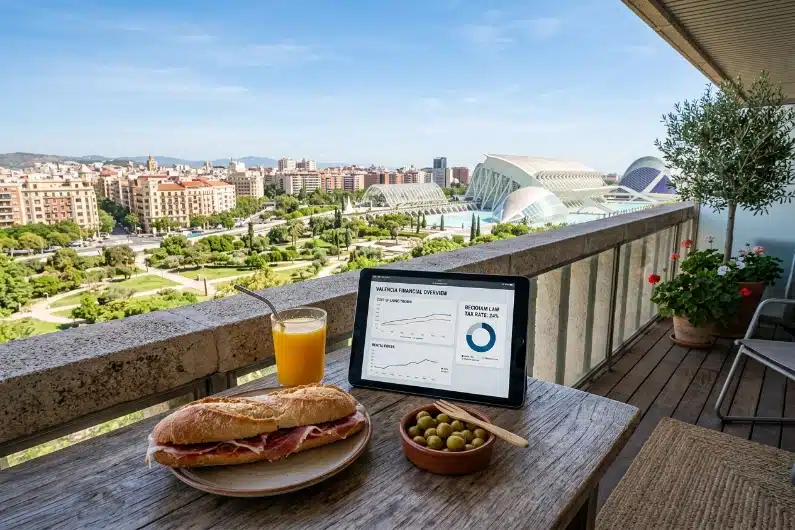
Moving to Valencia in 2026
- Valencia ranks as the world’s number one expat city for the third consecutive year, with 91% of foreign residents reporting they are happy with their life in the city.
- EU and EFTA citizens can move freely under EU coordination rules. UK, US, Canadian, and Australian nationals are third-country nationals and require a visa to be secured before relocation.
- The EU’s Entry/Exit System (EES) went live in October 2025, replacing manual passport stamping with biometric registration of every Schengen entry and exit.
- The Valencian Community remains one of Spain’s most foreigner-friendly autonomous communities, with strong international schooling, a Mediterranean climate, and lighter tourist-led restrictions.
Enjoy your life in Valencia
Valencia has shed its reputation as Spain’s “hidden gem” and become the most-talked-about relocation destination in Western Europe. The city consistently outranks Madrid, Barcelona and Lisbon in the InterNations Expat City Ranking, the Turia gardens have expanded, the City of Arts and Sciences continues to draw global tech investment, and the international airport now connects directly to over 90 destinations. Moving to Valencia in 2026, however, is no longer a simple matter of booking a flight and turning up. The post-Brexit customs regime, the EU’s new biometric border system, the matured Animal Welfare Law, the closure of the Golden Visa and the digitalisation of Valencian bureaucracy have all reshaped the practical and legal framework for newcomers.“Valencia has consistently ranked as the number one city for expats globally, with 91% of residents reporting they are happy with their life in the city, compared to a global average of 72%.”
Source: InterNations Expat City Ranking 2025/2026 [1].
Why Valencia is Spain’s leading expat city in 2026
Valencia’s appeal combines climate, infrastructure and economics in a way few European cities can match. The Mediterranean coast offers around 300 days of sunshine, the historic centre has been carefully preserved, and the post-2007 urban planning has prioritised cycling, public transport and green spaces. The Turia riverbed park alone runs for nine kilometres through the heart of the city.
The economic context
Valencia is the third-largest Spanish metropolitan area, with a GDP per capita that has grown faster than the national average since 2018. The Port of Valencia is the largest container port in the Mediterranean, and the regional government has pursued an active policy of attracting foreign investment, technology and remote workers. The Volkswagen battery gigafactory under construction in Sagunto and the consolidation of Lanzadera as one of Spain’s leading startup accelerators have anchored the city’s tech credentials. The cost-of-living advantage compared with London, Paris, Munich, Amsterdam, or Dublin remains substantial, although prices have risen. A typical international family will find their day-to-day expenses materially lower than in any major Northern European capital, with details in our breakdown of the Valencia cost of living.The international community
The Valencian Community hosts approximately 800,000 foreign residents, with British, Romanian, Moroccan, Italian, French, German and Dutch nationals among the largest groups. The city of Valencia itself has seen a sharp rise in arrivals from the UK, Ireland, the United States, Latin America and the Nordic countries since 2021. The professional community is concentrated in Ruzafa, El Carmen, El Pla del Real and the coastal districts of Cabanyal and Patacona.The geographic divide: planning your route
The complexity of moving to Valencia is largely dictated by your point of origin. In 2026, the distinction between EU/EFTA citizens and third-country nationals (UK, USA, Canada, Australia, South Africa) remains the single most important factor in logistics planning.The overland crew (EU, EFTA and the UK)
For relocators from Ireland, the UK or mainland Europe, the overland route is increasingly popular for its sustainability and the option to bring a personal vehicle. Many UK and Irish movers use the Brittany Ferries crossings from Portsmouth or Rosslare to Santander or Bilbao, followed by a six-hour drive south to Valencia. UK movers must remember that customs declarations for household goods are now strictly enforced. Without a properly documented cambio de residencia file, used belongings can attract 21% IVA on declared value. The customs treatment is closely tied to the residency status, and our wider analysis of the post-Brexit position for British expats in Spain sets out the supporting documentation that is now required at the border.The transatlantic and long-haul crew (USA, Canada, Australia)
Movers from outside Europe face a “ship or sell” decision. A 20ft or 40ft container is the standard option for full households from New York, Toronto or Sydney, with transit times of 30 to 45 days to the Port of Valencia. For lighter moves, palletised LCL (Less than Container Load) shipping is more economical, particularly when furniture is purchased locally to take advantage of Valencia’s design ecosystem. US movers should be aware that Spanish tax residency follows distinct rules from the US worldwide-citizenship-based regime, and the interaction between the two systems is complex. Our specialist analysis of the US and Spanish tax implications covers the FBAR, PFIC and treaty issues in detail.“The Port of Valencia handled 5.47 million TEUs in 2024, retaining its position as the busiest container port in the Mediterranean and the fifth-busiest in Europe. International household-goods volumes grew by approximately 18% year-on-year, driven by remote-worker relocations from the UK, Germany and the United States.”
Source: Valenciaport, Port of Valencia Annual Statistics 2024 [2].
Visa routes for moving to Valencia in 2026
Third-country nationals must secure a visa before relocating to Valencia. The right route depends on your professional situation, your income sources and your long-term plans. The Spanish Government closed the Golden Visa to new applicants on 3 April 2025, leaving four main pathways for most international movers.The Non-Lucrative Visa
The Spanish Non-Lucrative Visa is the workhorse route for retirees, financially independent individuals and families with passive income. Applicants must demonstrate sufficient passive income (€2,400 per month for the principal applicant, plus 25% per dependant) and private health insurance. The visa does not permit employment in Spain.The Digital Nomad Visa
Introduced under Startup Law 28/2022 and refined for 2026, the Digital Nomad Visa allows remote workers to live in Spain while continuing to work for non-Spanish employers or clients. Applicants need to evidence three years of professional experience or relevant qualifications, a minimum income of approximately €2,762 per month (200% of the SMI for 2026) and a contractual relationship of at least three months’ standing. We address the structural questions for W-2 employees applying for the Spanish Digital Nomad Visa in a dedicated note.The Startup Visa and Entrepreneur Visa
For founders and entrepreneurs, the Spain Startup Visa and the broader Entrepreneur Visa offer routes to residency tied to innovative ventures or substantial business plans. ENISA (the Empresa Nacional de Innovación) issues a favourable opinion on innovation that underpins the Startup Visa application.
Family reunification and EU routes
Family members of Spanish or legally resident foreign nationals can apply for family reunification. EU and EFTA citizens move under the EU coordination regime and register their residency directly with the Spanish authorities once present in Spain.Typical moving to Valencia timeline
1 Visa file Month -3 2 Consulate Month -2 3 Shipping Month -1 4 Arrival Month 0 5 Padrón + TIE Week 1-3 6 Banking Week 2-4 7 Healthcare Week 3-6Indicative timeline for a third-country national with a pre-secured visa. EU and EFTA citizens can compress steps 1-3.
Shipping, customs and the cambio de residencia
The customs treatment of household goods is one of the most frequently mishandled aspects of moving to Valencia from outside the EU. Spain offers a duty-free and IVA-free regime for used personal effects imported in connection with a change of residence, but the relief is conditional on rigorous documentation.The cambio de residencia exemption
To qualify for the exemption, the relocating individual must:- Have lived outside the EU for at least 12 months before the move.
- Be transferring their main residence to Spain.
- Import the goods within 12 months of establishing Spanish residency.
- Have owned and used the goods for at least six months before relocation.
- Undertake not to sell, lend or transfer the goods within 12 months of importation.
Choosing a Valencia moving company
Local knowledge is a legal requirement. The Valencia Ayuntamiento issues a Permiso de Ocupación de Vía Pública for moving trucks, which must be applied for at least 72 hours before the move date. Historic-centre districts such as El Carmen, Ruzafa and the old Velluters quarter have narrow streets, restricted-access zones and frequent pedestrianisation, all of which need to be coordinated with municipal services. Many traditional Valencian apartments lack large lifts, so professional movers commonly use external furniture hoists to bring items in through balconies. A reputable mover should hold the in-house customs broker capability for non-EU consignments and a full insurance package covering transit and delivery.
Bringing your pets: the 2026 Animal Welfare Law
Spain’s Animal Welfare Law (Law 7/2023), fully matured for 2026, has materially tightened the requirements for pet owners. The law applies nationally with regional implementing rules in the Valencian Community.Documentation requirements
| Origin | Required document | Key requirement |
|---|---|---|
| EU and Ireland | EU Pet Passport | Valid rabies vaccination and ISO microchip |
| UK / USA / Canada / Australia | EU Health Certificate (Annex IV) | Issued by an authorised vet within 10 days of arrival |
| Switzerland and Norway | EFTA Pet Passport | Full alignment with EU standards |
| High-rabies-risk countries | Health Certificate plus serology | Rabies titre test minimum 0.5 IU/ml, 30-day wait |
Civil liability insurance and RIVIA registration
All dog owners in the Valencian Community must hold mandatory seguro de responsabilidad civil (civil liability insurance). The cover must be active from the moment of registration with the Valencian animal database (RIVIA), and breach exposes the owner to administrative fines that escalate with the severity and recurrence of the breach. The 2023 law also introduced training course requirements for new dog owners, although the implementing regulation has been postponed to 2026 in the Valencian Community.The first 30 days: administrative checklist
Once the boxes are unloaded, the administrative work begins. The Valencian administration has digitalised most procedures, but the sequencing still matters: each step depends on the completion of the previous one.The seven essential procedures
- NIE and TIE: the Número de Identidad de Extranjero is the foundational document for any administrative action in Spain. The TIE (Tarjeta de Identidad de Extranjero) is the physical card issued to non-EU residents.
- Empadronamiento: registration at the local town hall confirms your residence in Valencia. It is the gateway to schooling, healthcare, voting in municipal elections (where applicable) and many other public services.
- Spanish bank account: needed for direct debits, salary payments and tax filings. Most major banks now offer non-resident and resident accounts in English.
- Digital Certificate or Cl@ve PIN: the keys to most online interactions with the Spanish administration, including the AEAT, Social Security and the Valencian regional government.
- Utilities: electricity (Iberdrola, Endesa), water (Global Omnium in Valencia city) and internet (Movistar, Orange, Vodafone, Digi). Most contracts require a Spanish IBAN for direct debit setup.
- SIP card or private health insurance: the SIP card (Sistema de Información Poblacional) is the Valencian regional health card; private insurance is required for Non-Lucrative Visa holders and recommended in transition periods.
- Spanish driving licence: EU licences are recognised. UK licences typically require the Spanish theory and practical exams. International licences from non-EU jurisdictions follow specific bilateral arrangements.
“The Valencian Community recorded approximately 97,000 British residents in 2025, the second-largest UK population in Spain after Andalusia. Alicante province alone accounts for over 76,000 British nationals, the highest concentration of UK residents anywhere in Spain.”
Source: Instituto Nacional de Estadística (INE), Padrón Continuo 2025 [4].
Tax setup when moving to Valencia
Tax residency in Spain is triggered once you spend more than 183 days in the country in a calendar year, or when Spain becomes the centre of your economic or family interests. Crossing that threshold means worldwide income reporting on Modelo 100, with consequential obligations on overseas assets, savings income and pensions.The Beckham Law for newly arriving professionals
Newly arriving foreign professionals may qualify for Spain’s special expatriate regime under Article 93 of Law 35/2006. The Beckham Law, popularly known after its early footballing beneficiaries, taxes qualifying income at a flat 24% up to €600,000 (47% above) for up to six tax years.Modelo 720 and overseas assets
Spanish tax residents holding overseas assets above €50,000 in any of three categories (bank accounts, securities, real estate) must file Modelo 720. The 2022 ECJ ruling reformed the disproportionate penalty regime, but the declaration obligation remains live.Wealth tax and the solidarity tax
Spain’s wealth tax applies above €700,000 of net Spanish-located assets (with regional variations), complemented by a solidarity tax on net assets above €3 million.Pension sequencing for retirees
UK retirees relocating to Valencia should plan pension drawdown carefully before becoming Spanish tax residents. The 25% UK tax-free lump sum is fully taxable in Spain, and ISA and SIPP treatment changes materially. Reviewing UK pension contributions in Spain and the rules on QROPS transfers to Spain before the move can save tens of thousands of pounds in unnecessary tax.Finding a home: rentals, purchases and neighbourhoods
Valencia’s housing market has tightened materially since 2021, with rents up approximately 35% and purchase prices up around 30% in the city’s most desirable districts. Demand from international buyers and remote workers has been a significant factor, and rental supply remains constrained by the conversion of long-term lets into tourist accommodation in some districts.Rent versus buy
For most international newcomers, renting for the first 6 to 12 months is the sensible default. It avoids transaction costs (typically 10% to 14% on a purchase), allows time to identify the right neighbourhood and provides flexibility if circumstances change. Long-term Spanish rental contracts under the Urban Lease Law (LAU) offer significant tenant protection, including five-year renewals (seven for institutional landlords) and rent indexation tied to the IGC index. For those ready to buy, our 2026 walkthrough on buying a property in Spain covers the full conveyancing process, the ITP/AJD framework and the post-Brexit IRNR position. The regional cost variations are addressed in our companion analysis of Spain’s regional property taxes, and budget planning for the legal-fee component is covered in our note on legal fees for buying Spanish property.Neighbourhoods at a glance
- El Carmen and Ciutat Vella: the historic centre. Atmospheric, walkable, lively but noisy; popular with international singles and couples without children.
- Ruzafa: the design and gastronomy hub. Strong international community, excellent independent shopping, and premium rents.
- El Pla del Real and Mestalla: residential, leafy, close to the Turia gardens. Popular with international families.
- Cabanyal and Patacona: the seaside neighbourhoods. Beach lifestyle, traditional fishermen’s houses, increasingly fashionable.
- L’Eixample and Gran Via: classic 19th-century architecture, central, premium price points.
- Benimaclet: bohemian and university-adjacent, strong community feel, lower rents.
Healthcare, schooling and the everyday administration
Valencia’s public services compare favourably with those of any Western European city. The healthcare system is consistently rated among the best in Europe, the international schooling ecosystem is strong, and the post-2020 digitalisation of administrative procedures has materially shortened processing times.Healthcare access
The Sistema Nacional de Salud is universal for residents who pay into the social security system, for state-pension holders with an S1 form, for family members of insured persons and for individuals enrolled in the Convenio Especial pay-in scheme. Non-Lucrative Visa holders must hold private insurance during their visa validity, although they may convert to public cover after a qualifying period.International schooling
The Valencian Community is home to over 30 international schools, the majority in or near Valencia city. Curricula include British (IGCSE, A-Level), International Baccalaureate, American and French.
Annual fees range from approximately €5,000 at the lower end to €18,000 at premium institutions.
Spanish state and concertada (semi-private) schools offer high-quality bilingual programmes for families integrating fully into the Spanish system.
Curricula include British (IGCSE, A-Level), International Baccalaureate, American and French.
Annual fees range from approximately €5,000 at the lower end to €18,000 at premium institutions.
Spanish state and concertada (semi-private) schools offer high-quality bilingual programmes for families integrating fully into the Spanish system.
Public transport and connectivity
Valencia’s metro, tram and bus network is integrated through the EMT and FGV systems, with monthly travel passes priced at approximately €10 to €40 depending on zones. The Valencia airport (VLC) connects directly to over 90 destinations, and the Joaquín Sorolla high-speed train station links Valencia to Madrid in 1 hour 50 minutes and to Barcelona in around 3 hours.What has changed for 2026: regulatory updates
The framework for international newcomers has tightened in some respects and modernised in others. The 2026 environment reflects a series of cumulative reforms that affect both incoming residents and the everyday administration of life in the city.Key 2024 to 2026 reforms
- EES rollout (October 2025): biometric registration of every Schengen entry and exit for non-EU nationals, replacing manual passport stamping.
- ETIAS (expected late 2026): pre-travel authorisation for visa-exempt third-country nationals visiting the Schengen Area.
- Closure of the Golden Visa (3 April 2025): the residency-by-investment route via real estate ended for new applicants under Organic Law 1/2025.
- Animal Welfare Law (Law 7/2023): civil liability insurance for dogs, RIVIA registration in the Valencian Community, and training course requirements implemented from 2026.
- Royal Decree 1312/2024: national tourist registry for short-term rentals applicable from 1 July 2025, with implications for those buying property to part-let. The detail is in our note on short-term rentals in Spain.
- Real Decreto 1027/2024 (Foreigners’ Regulation): substantial procedural reforms to immigration applications, residency renewals and family reunification.
- Decreto 9/2024 in the Valencian Community: tightened tourist-licence rules with per-municipality caps, particularly relevant to those considering an investment-and-let strategy.
- Beckham Law extensions: Startup Law 28/2022 expanded the special expatriate regime to remote workers, family members and digital nomads.
Speak to our relocation lawyers in Valencia
Contact our legal team for personalised guidance on moving to Valencia in 2026. We work in English, French, Spanish and Russian, and have advised international clients from our Valencia office for over 65 years. Our immigration, tax, property and family law teams coordinate seamlessly to deliver a single point of contact for your relocation, residency, customs and tax setup. Email: felix.delaguia@delaguialuzon.com Phone: +34 963 74 16 57 Office: Avinguda Regne de Valencia, 6, 1º-2º, 46005 Valencia, SpainVisit our immigration law service page to learn more about our visa, residency and relocation support.
Frequently asked questions about moving to Valencia
How long does the visa process take?
For most third-country nationals, the consular processing of a Non-Lucrative Visa or Digital Nomad Visa takes 2 to 4 months from filing. Add 1 to 2 weeks for biometric appointments at the Spanish consulate of jurisdiction, plus a further 30 to 40 days post-arrival for TIE collection.Can I bring my used belongings without paying IVA?
Yes, if you qualify for the cambio de residencia exemption: 12 months of foreign residency, ownership of the goods for at least 6 months, importation within 12 months of establishing Spanish residency, and a full DUA customs file. Without the exemption, 21% IVA applies on declared value.Do I need to learn Spanish before moving?
It is not legally required, but highly recommended. Day-to-day administration, healthcare interactions, schooling and most professional services are conducted in Spanish (and Valencian in the Valencian Community). The international community is large enough to function in English in some districts, but Spanish materially improves quality of life.How do I open a Spanish bank account?
Most major banks (BBVA, Santander, CaixaBank, Sabadell) allow non-resident accounts to be opened with a passport and proof of address abroad. A resident account requires the NIE and proof of Spanish address. Online challengers (N26, Revolut, Wise) are widely used for everyday banking.What is the best neighbourhood to live in Valencia?
It depends on your profile. Couples without children often prefer Ruzafa or El Carmen. Families typically choose El Pla del Real, Mestalla or the suburban Pla del Remei area. Beach lovers favour Cabanyal and Patacona. Younger arrivals on a budget often start in Benimaclet.Can I drive in Spain on my UK or US licence?
UK licences require either an exchange (under specific bilateral arrangements that have been variable since Brexit) or the Spanish theory and practical exams within 6 months of obtaining residency. US licences must be exchanged for a Spanish licence, with state-by-state arrangements; some require the full Spanish exam, others a simplified procedure.Do I need private health insurance?
Yes during the validity of a Non-Lucrative Visa, a Digital Nomad Visa for non-employees and most other initial-residency routes. EU citizens, employees registered with Spanish social security and S1 holders can rely on the public system. The Convenio Especial pay-in option is available after one year of padrón registration.What about tourist rentals as an income strategy?
The 2024-2025 tightening (Royal Decree 1312/2024 and Decreto 9/2024 in the Valencian Community) has made tourist letting significantly more regulated. Compliance with the national registry, the regional licence and any municipal cap is essential. The tax treatment is covered in our specialist note on VAT on short-term tourist rentals.Is the Beckham Law worth applying for?
It depends on your income profile. The flat 24% rate is highly favourable for high earners with significant Spanish-source employment income. It is generally less attractive for lower earners or for those whose income is largely passive. A cross-border tax review before relocation is essential.How long until I can apply for Spanish nationality?
Most third-country nationals qualify after 10 years of legal residency. Latin American nationals, Andorrans, Filipinos, Equatorial Guineans, Portuguese and Sephardic Jews qualify after 2 years. Marriage to a Spanish national reduces the timeline to 1 year of legal residency. Additional language and integration tests apply (DELE A2 and CCSE).Reference list
- InterNations, Expat City Ranking 2025/2026: https://www.internations.org/expat-insider/
- Valenciaport, Port of Valencia Annual Statistics 2024: https://www.valenciaport.com/
- Spanish Ministry of Agriculture and Food, EU Regulation 576/2013 on pet movements: https://www.mapa.gob.es/
- Instituto Nacional de Estadística (INE), Padrón Continuo 2025: https://www.ine.es/
- Ministry of Inclusion, Social Security and Migration, Foreign Residents Statistics 2025: https://www.inclusion.gob.es/
- BOE, Real Decreto 1027/2024 (Reglamento de Extranjería): https://www.boe.es/
- BOE, Ley 7/2023 de protección de los derechos y el bienestar de los animales: https://www.boe.es/
- European Commission, Entry/Exit System (EES) and ETIAS: https://travel-europe.europa.eu/ees_en