
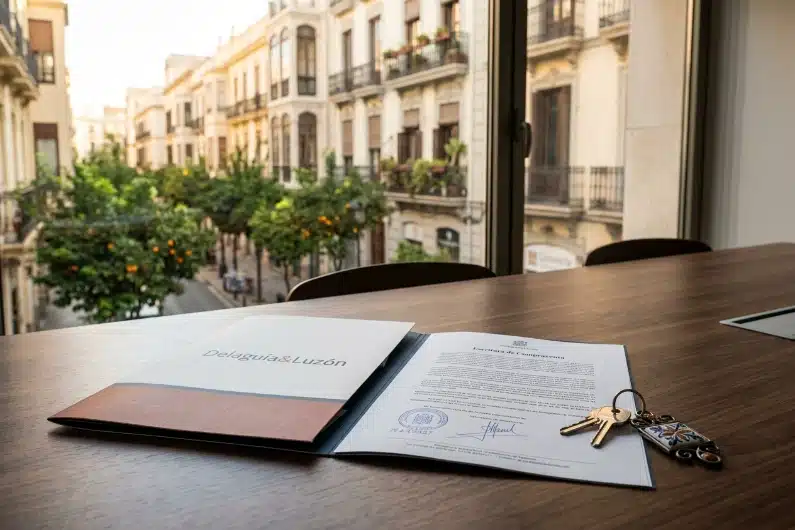
Legal steps to buy a property in Valencia as a non-resident
Buying a house in Valencia as a non-resident is one of the most common questions our office hears from foreign buyers each month.
The Spanish property market remains open to international purchasers without nationality restrictions, including buyers from outside the European Union.
The process requires a Spanish tax identification number, a competent lawyer and a clear understanding of the taxes that apply at completion and every year thereafter.
Done properly, a Valencian property purchase takes between six and twelve weeks from offer to keys.
Done badly, it can drag on for months and expose you to undisclosed debts, planning issues or tax surprises that are difficult to undo.
This guide explains the full purchase process for non-residents buying in Valencia and across the Comunitat Valenciana.
Why Valencia Attracts Foreign Buyers
Valencia is Spain’s third-largest city and one of Europe’s most affordable Mediterranean capitals.
Property prices remain well below those of Madrid and Barcelona, while quality-of-life rankings consistently place the city in the top tier of European destinations.
The Costa Blanca and Costa del Azahar coastlines bring established expat communities, good infrastructure and direct flights from most major European capitals.
Foreign buyers from the United Kingdom, Germany, the Netherlands, France, Belgium, the Nordic countries and increasingly the United States account for a significant share of property transactions in the region.
Inland towns such as La Eliana, Bétera and Paterna offer family-friendly communities within twenty minutes of central Valencia.
Coastal towns such as Calpe, Moraira, Jávea and Altea remain perennial favourites with British and German buyers.
Legal Eligibility for Non-Resident Buyers in Spain
There are no legal restrictions on foreign nationals buying residential property anywhere in Spain.
EU citizens, UK citizens post-Brexit, Americans, Canadians, Australians and citizens of any other country can purchase freehold property without permits or special authorisations.
The single hard requirement is a Número de Identificación de Extranjero, commonly known as the NIE.
This is a tax identification number for foreigners and it is mandatory for any significant economic transaction in Spain.
You will also need to prove the lawful origin of the funds you intend to use, a standard requirement under Spanish anti-money-laundering law.
Get Your NIE Before Anything Else
The NIE is the first practical step before you start serious negotiations on a property.
Three routes exist to obtain one: in person at a National Police station in Spain, through a Spanish consulate in your country of residence, or via a Spanish lawyer holding power of attorney on your behalf.
The third option is by far the most common for non-resident buyers because it removes the need to travel and dramatically shortens the timeline.
At our office, the NIE is typically obtained within ten to fifteen working days of receiving your power of attorney.
Once issued, the NIE is permanent and serves as your tax identifier for property tax filings, banking, utility contracts and any future transaction in Spain.
Our immigration law team handles dozens of NIE applications every month for clients across Europe and North America.
Open a Spanish Bank Account
A Spanish bank account is not legally mandatory but it is strongly advisable.
Notary completion payments, taxes, utility bills and the annual modelo 210 filing all run more smoothly through a domestic Spanish account.
Most major Spanish banks offer non-resident accounts that can be opened with your NIE, your passport and proof of address from your home country.
Bank charges for non-resident accounts tend to be marginally higher than for resident accounts.
Your lawyer can recommend banks accustomed to working with international buyers and can introduce you directly to the relevant relationship manager.
Mortgage Options for Non-Residents in Spain
Spanish banks lend to non-resident buyers but on different terms than they offer to residents.
Loan-to-value ratios for non-residents typically range from 60 to 70 percent of the purchase price or appraisal value, whichever is lower.
Resident buyers can usually borrow up to 80 percent on a primary residence.
Interest rates for non-resident mortgages are slightly higher and the bank will require a full income file: payslips, tax returns from your country of residence, bank statements and existing debt schedules.
Mortgage approval normally takes between three and six weeks and should run in parallel with your legal due diligence on the property.
If you intend to finance the purchase, secure a written pre-approval before signing any reservation agreement.
The Valencia property ourchase process step by step
Reservation contract
Once you find a property and agree a price, the seller or estate agent will usually present a contrato de reserva.
This is a short reservation agreement in which you place a small deposit, typically between 3,000 and 6,000 euros, in exchange for the property being taken off the market for a defined period.
The reservation period generally lasts two to four weeks and is intended to allow your lawyer to complete due diligence.
If the seller withdraws after signing, the deposit is returned and a penalty may be due.
If you withdraw without legal grounds, the deposit is normally forfeit.
Legal due diligence
Due diligence is where a Spanish lawyer earns their fee.
Your property lawyer will obtain an updated Land Registry extract (nota simple) confirming the seller is the registered owner and that the property is free of mortgages, embargoes or third-party rights.
The town planning office (Ayuntamiento) is consulted to confirm planning permissions, building licences and any pending infringement proceedings.
Outstanding council tax, community fees, supply contracts and IBI charges are checked, and certificates of zero debt are requested in writing.
For new builds, the certificate of habitability (cédula de habitabilidad) and the first occupation licence (licencia de primera ocupación) are essential documents to verify before signing.
If there are tenants, our team reviews the lease, the rent register and any pending litigation between the parties.
Arras contract and 10 percent deposit
Once due diligence is complete and clean, the parties usually sign a contrato de arras, also known as a private purchase agreement.
At this stage you pay 10 percent of the agreed purchase price as a deposit, with the balance due at notary completion.
Three types of arras contracts exist under Spanish law: penitenciales, confirmatorias and penales.
The penitenciales version is the most common because it allows either party to withdraw, with the buyer losing the deposit and the seller paying double if they pull out.
The arras typically schedules notary completion within thirty to ninety days, depending on whether financing is involved.
Notary signing and Escritura Pública
Completion takes place before a Spanish notary and is documented in a public deed known as the escritura pública de compraventa.
Both parties (or their legal representatives) attend, the seller hands over keys, the buyer pays the balance and the notary issues a copy of the deed on the same day.
If you are not in Spain on completion day, your lawyer can attend on your behalf under power of attorney.
This is an extremely common arrangement and is perfectly secure when handled by an experienced Spanish solicitor.
The notary withholds the seller’s tax retention if they are also a non-resident, applying the corresponding provisions of Spanish income tax law.
Land registry inscription
Following the notary signature, the deed is registered at the Registro de la Propiedad of the relevant municipality.
This is the formal step that transfers ownership in the public records and protects your title against third-party claims.
Inscription typically takes between fifteen and forty-five days, during which your lawyer monitors the registry process and resolves any technical observations raised by the registrar.
Once registration is complete, you receive a certified copy of the registered deed, which is the definitive proof of your ownership.
Taxes and fees when buying property in Valencia
Transfer Tax for Resale Properties
The main tax on a resale property in the Comunitat Valenciana is the Impuesto de Transmisiones Patrimoniales, or ITP.
The standard rate is 10 percent of the declared purchase price.
Reduced rates of 8 percent apply to large families, buyers with disabilities and certain young first-time buyers acquiring habitual residence properties below set price thresholds.
ITP must be filed and paid within thirty calendar days of the notary signing.
VAT and stamp duty on new builds
New build properties sold directly by the developer are not subject to ITP.
Instead, you pay 10 percent VAT (IVA) on the purchase price plus 1.5 percent stamp duty, known as Actos Jurídicos Documentados or AJD.
This combined 11.5 percent is generally on a par with the ITP burden on a resale.
Furniture, garages and storage rooms purchased separately may attract different rates and should be itemised correctly in the contract.
Notary, registry and legal fees
Notary fees in Spain are regulated by national tariff and run from 0.4 to 0.6 percent of the purchase price.
Land Registry fees follow a similar tariff and represent roughly 0.2 to 0.3 percent.
Legal fees for a standard residential conveyance typically range from 1 to 1.5 percent plus VAT, depending on the complexity of the transaction.
Total acquisition costs for a non-resident buyer in Valencia therefore land between 12 and 14 percent of the headline purchase price.
Always budget at this level rather than relying on lower estimates from estate agents.
Annual taxes for non-resident property owners
Council Tax (IBI)
The Impuesto sobre Bienes Inmuebles, or IBI, is the Spanish equivalent of council tax.
It is paid annually to the local town hall and varies between roughly 0.4 and 1.1 percent of the cadastral value of the property.
The cadastral value is typically a fraction of the market value, often 40 to 60 percent.
For most residential properties in Valencia, the annual IBI bill ranges from 200 to 1,500 euros.
Modelo 210: Non-Resident Imputed Income Tax
This is the most overlooked tax for new foreign owners.
If you own a property in Spain but do not rent it out, the Spanish tax office still applies an imputed income calculation: a deemed annual rental value taxed at the non-resident rate.
The deemed income is calculated as 1.1 or 2 percent of the cadastral value, depending on whether the cadastral value has been recently revised.
EU and EEA residents pay 19 percent on this base; non-EU and non-EEA residents pay 24 percent.
The annual filing is the famous modelo 210 and it is due by 31 December of the year following the relevant tax period.
Our tax law and accounting team handles modelo 210 filings for foreign clients across Valencia, Alicante and Castellón.
Wealth tax in the Comunitat Valenciana
The Comunitat Valenciana applies wealth tax to non-residents on their Spanish-located assets above a regional threshold.
For 2026, the exempt threshold for non-residents in the region sits at 500,000 euros of net Spanish assets, after deduction of mortgage debt secured on those assets.
Above the threshold, progressive rates apply from 0.25 to 3.5 percent.
For most foreign buyers acquiring a single residential property below 500,000 euros, no wealth tax is payable.
For higher-value purchases or multiple properties, structured advice from a Spanish solicitor is essential before signing.
Where to buy in Valencia
Valencia city offers very different micro-markets within a small geographical footprint.
El Cabanyal has become the city’s most active gentrification project, with restored fishermen’s cottages now changing hands at a fraction of central Valencia prices.
Ruzafa combines hipster culture with strong rental yields, particularly for short-term licensed rentals.
El Carmen and Ciutat Vella appeal to buyers seeking historic apartments in the medieval old town.
Patacona and Malvarrosa are the city’s beachside neighbourhoods, popular with international buyers seeking weekday city access and weekend sea views.
Beyond the city, the Costa del Azahar to the north and the Costa Blanca to the south offer everything from quiet Spanish villages to international resort towns.
If you are still narrowing down your area, our local-law-firm pages cover most of the towns where foreign buyers concentrate, including Denia, Jávea, Moraira and Altea.
Common pitfalls and red flags for foreign buyers
Most legal problems with Spanish property purchases come from a small set of recurring issues.
The first is undisclosed urbanistic debts: properties built without proper licences, with pending planning enforcement or with payments owed to the Ayuntamiento.
The second is community of owners debts in apartment blocks, where the seller has unpaid quotas that legally transfer with the property.
The third is tenant-occupied properties where the lease and tenant rights have not been disclosed, leaving the buyer unable to take vacant possession.
The fourth is rural land classification issues, particularly for villas in the countryside that turn out to be on protected agricultural or non-developable land.
The fifth is tax retention errors at completion, especially when the seller is also a non-resident and the 3 percent retention rule applies.
A competent Spanish solicitor catches each of these in due diligence and either resolves them or stops the transaction before money is committed.
Why choose a Spanish lawyer for your valencia property purchase
Estate agents, mortgage brokers and notaries all play a role in the transaction, but none of them legally represents your interests as the buyer.
The notary is a public official whose duty is to the deed, not to either party.
The estate agent represents the seller and earns a commission on completion.
Your Spanish solicitor is the only professional whose duty is exclusively to you.
At Delaguía & Luzón, our property team has handled foreign-buyer transactions in Valencia for more than twenty-five years, working in English, French, Spanish and Russian.
We coordinate every step from NIE applications and bank account openings through to conveyancing, post-completion tax filings and ongoing modelo 210 compliance.
Frequently Asked Questions
Do I need to live in Spain to buy a house in Valencia?
No.
You can purchase any residential property in Valencia or anywhere in Spain without becoming a Spanish resident.
The only mandatory requirement is your NIE.
How long does it take to buy a property in Valencia as a non-resident?
From accepted offer to keys, six to twelve weeks is typical for a cash purchase.
Mortgage-financed purchases tend to run between ten and sixteen weeks because of underwriting and appraisal timelines.
What is the modelo 210 and when do I pay it?
The modelo 210 is the annual non-resident income tax filing in Spain.
Owners who do not rent out their property still pay an imputed income tax on a deemed rental value derived from the cadastral value.
The deadline is 31 December of the year following the tax year.
Can I buy a property in Spain remotely without travelling?
Yes.
Through a power of attorney granted to your Spanish solicitor, every step of the purchase can be completed remotely, including the NIE application, the arras contract and the notary signing.
Many of our foreign clients complete their entire transaction without setting foot in Valencia until they collect their keys.
What happens to my property if i die without a Spanish will?
Your home country’s succession law may apply by default under EU Regulation 650/2012, but this can create complications if local authorities insist on Spanish formalities.
For full clarity and lower inheritance tax exposure, our inheritance law team strongly recommends a Spanish will dealing specifically with your Spanish assets.
Speak to our English-speaking property team in valencia
If you are considering buying property in Valencia and want a clear picture of the legal process, taxes and total cost before committing, our team is happy to provide a free initial consultation.
Our office is located at Avinguda Regne de València, 6, 1º – 2º, 46005 Valencia, Spain.
Office hours are Monday to Thursday from 8:30 to 18:00 and Friday from 8:30 to 15:00.
Reach us at felix.delaguia@delaguialuzon.com or call +34 963 74 16 57.
Visit our contact page for the secure online enquiry form, or browse our areas of expertise to see how we support foreign clients across all Spanish legal matters.


