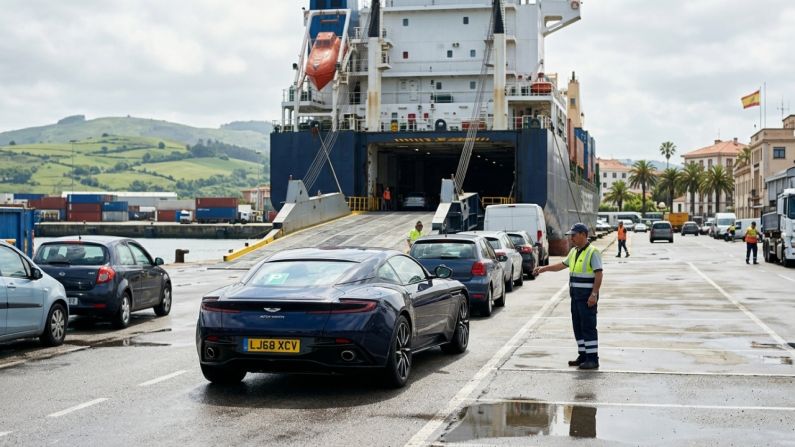
Importing a car to Spain from the UK: the key facts
- Since Brexit, importing a car to Spain from the UK means the vehicle is treated as a third-country import, subject to customs duty, VAT and registration tax.
- Residents relocating permanently may qualify for tax-free removal relief (franquicia de mudanza) if the vehicle has been owned for at least twelve months before the move.
- All imported vehicles must pass the Spanish ITV roadworthiness inspection before re-registration with the DGT.
- Registration Tax (IEDMT) varies from 0% to 14.75% depending on the vehicle’s CO2 emissions.
- The full process, from customs clearance to receiving a Spanish number plate, typically takes between 30 and 90 days.
- Right-hand drive vehicles are legal in Spain, but create practical complications worth considering before you ship.
- Our Valencia-based legal team advises on tax relief eligibility, DGT procedures and customs documentation for anyone importing a car to Spain from the UK.
Wondering how to bring your car to Spain from the UK?
Moving to Spain from the UK is one of the most significant life decisions a person can make.
Most of the major steps, such as the NIE application, the residency permit and the property search, are well documented.
The question of importing a car to Spain from the UK, however, consistently catches newly arrived residents off guard.
Before 2021, British nationals moving to Spain could bring their vehicles without customs formalities, because UK vehicles were treated as EU goods under freedom of movement rules.
Since Brexit, that is no longer the case.
For British nationals in Spain after Brexit, a UK car arriving in Spain is classified as a third-country import, and the full range of EU customs, VAT and registration procedures applies.
This guide covers every stage of the process in full.
The legal framework governing vehicle imports in Spain
The legal framework for importing a car to Spain from the UK involves several overlapping authorities.
The primary authority for road vehicle registration is the Dirección General de Tráfico (DGT), which operates under the Ministerio del Interior.
Customs procedures are administered by the Agencia Estatal de Administración Tributaria (AEAT), which applies the EU Customs Code (Regulation 952/2013) to all goods entering from outside the EU, including UK vehicles post-Brexit.
The registration tax, the Impuesto Especial sobre Determinados Medios de Transporte (IEDMT), is governed by Law 38/1992 on Special Taxes.
Understanding which authority handles which stage matters, because attempting to approach them out of sequence, such as booking an ITV before completing customs clearance, will require you to restart the process entirely.
Who can import a vehicle to Spain tax-free?
Spanish law provides a specific exemption from customs duty and VAT for residents who are importing a car to Spain from the UK as part of a permanent household relocation.
This exemption, known as the franquicia de mudanza, requires all of the following conditions to be met:
- You are establishing your habitual residence in Spain for the first time. For a full overview of what establishing residency involves, see our guide to Spanish residency requirements.
- You have owned the vehicle for at least twelve consecutive months before the date of your move.
- The vehicle is for your personal use only, not for commercial activity.
- You do not sell or transfer the vehicle within twelve months of importing it under the exemption.
- You submit the exemption claim within twelve months of establishing your new residence in Spain.
Confirming eligibility for the franquicia de mudanza before beginning the import process is the single most financially important step for anyone importing a car to Spain from the UK permanently.
Import taxes without relief
For anyone importing a car to Spain from the UK who does not qualify for the franquicia de mudanza, or who is importing a second vehicle, the full tax stack applies.
| Tax | Rate | Basis |
|---|---|---|
| Customs Duty (Arancel) | 6.5% | Customs value of the vehicle |
| VAT (IVA) | 21% | Customs value + duty |
| Registration Tax (IEDMT) | 0% – 14.75% | Vehicle value, banded by CO2 g/km |
For a vehicle valued at €25,000 with CO2 emissions of 145 g/km, the combined customs duty, VAT and IEDMT without any relief would amount to approximately €8,500 on top of the vehicle’s value, which is precisely why confirming the franquicia de mudanza position before shipping is essential.
IEDMT CO2 emission bands
| CO2 emissions (g/km) | IEDMT rate | Typical vehicle type |
|---|---|---|
| 0 – 120 (incl. electric) | 0% | Electric vehicles, small petrol/diesel cars |
| 121 – 160 | 4.75% | Mid-range saloons and SUVs |
| 161 – 200 | 9.75% | Larger SUVs, performance vehicles |
| Over 200 | 14.75% | High-performance and luxury vehicles |
The step-by-step process for importing a car to Spain from the UK
- Obtain your Spanish NIE. The NIE is required for every official transaction in Spain without exception. Without it, customs clearance, DGT registration and AEAT filings cannot proceed. Our detailed guide to obtaining your NIE in Spain covers the full process for both EU and non-EU nationals. You can also review the NIE, green card and TIE guide for how these documents relate to one another.
- Submit a customs declaration (DUA). Filed with the AEAT at the point of entry into Spain. If claiming the franquicia de mudanza, the relevant relief code must be cited at this stage. A customs agent (agente de aduanas) can handle the DUA on your behalf.
- Pay applicable taxes or present relief documentation. If relief applies, supporting documentation must accompany the DUA. If taxes are due, payment is made to the AEAT before the vehicle can proceed.
- Book and pass the ITV inspection. UK vehicles regularly encounter specific failures at the ITV. Allow time for rectifications before rebooking.
- Obtain a Certificate of Conformity (COC). Required by the DGT to confirm the vehicle’s technical specification. If unavailable from the manufacturer, an individual technical inspection report (informe técnico) may substitute.
- Apply to the DGT for matriculación. Submit to the Jefatura Provincial de Tráfico with AEAT customs clearance, ITV certificate, COC, NIE and empadronamiento. Application fee: approximately €97.
- File the IEDMT return with AEAT within 15 days. This is a separate filing from the customs declaration and must be submitted within 15 days of the matriculación application. Our guide to Spanish tax deadlines sets out all the key filing dates for new residents.
- Collect your Spanish plates and permiso de circulación. The UK plates must be removed once the Spanish registration is complete.
ITV issues specific to importing a car to Spain from the UK
The ITV is the Spanish roadworthiness test, equivalent to the UK MOT but more comprehensive for imported foreign vehicles.
When importing a car to Spain from the UK, the following issues arise consistently:
- Headlight beam alignment. UK headlights dip left for left-hand traffic and must be adjusted to dip right for Spain. Beam deflectors are not sufficient for a permanent pass — the headlight units must be properly adjusted or replaced.
- Speedometer display. The primary unit must be km/h. A miles-only speedometer will fail the inspection.
- Rear fog light. Must be positioned on the right-hand side of the vehicle under Spanish regulations.
ITV fees range from approximately €35 to €90, depending on vehicle class and province.
Building time for potential ITV failures into your overall timeline when importing a car to Spain from the UK is strongly recommended, as rectification of headlight issues can take several weeks if parts need to be ordered.
Timeline and key deadlines
| Stage | Typical timeframe | Authority |
|---|---|---|
| Customs clearance (DUA) | 1–5 days | AEAT |
| ITV inspection and any rectifications | 1–3 weeks | Authorised ITV station |
| DGT processing | 2–6 weeks | DGT Jefatura Provincial |
| IEDMT return | Within 15 days of matriculación application | AEAT |
| Total (arrival to Spanish plate) | 30–90 days typical | Multiple |
Common mistakes when importing a car to Spain from the UK
The most avoidable errors people make when importing a car to Spain from the UK include:
- Importing before establishing Spanish residency. The franquicia de mudanza exemption clock does not start until you are registered as a Spanish resident. Shipping the car before that date can cause the twelve-month exemption window to expire before the administrative process is complete.
- Failing to notify the DVLA. The DVLA must be informed that the vehicle is being permanently exported from the UK.
- Attempting DGT registration without completing AEAT customs clearance first. The DGT will not accept a matriculación application without the AEAT clearance certificate.
- Missing the IEDMT fifteen-day filing deadline. Late filing attracts surcharges from the AEAT.
- Using UK motor insurance after moving to Spain. UK motor insurance policies typically do not cover a vehicle once it has become its country of habitual use. Spanish insurance must be arranged from the date of arrival.
Tax obligations that arise alongside the import
The vehicle import is rarely the only tax obligation that arises when a UK national relocates to Spain.
Becoming a Spanish tax resident means your worldwide income falls within the scope of Spanish taxation.
UK pension income, rental income from UK property and dividends from UK companies all require specific treatment under the Spain–UK Double Tax Treaty, which our guide to declaring UK income in Spain explains in full.
For qualifying workers, the Beckham Law tax regime may reduce Spanish income tax to a flat 24% for up to six years, but the election must be made within six months of your first Spanish Social Security registration and cannot be made retrospectively.
For UK companies relocating employees to Spain, our guide to relocating UK employees to Spain sets out the employer compliance obligations alongside the individual steps.
How Delaguía y Luzón can assist with importing a car to Spain from the UK
Our Valencia-based legal and tax team assists clients with every aspect of importing a car to Spain from the UK, from confirming franquicia de mudanza eligibility and preparing the customs documentation to coordinating the IEDMT return and managing DGT registration.
We coordinate the vehicle import alongside your broader relocation, covering immigration law and residency applications, tax registration and annual compliance and property law as a single coordinated service.
Speak to our team about your move to Spain
Our multilingual legal team advises British nationals on every aspect of relocating to Spain, from vehicle and customs compliance to residency applications, tax registration and property law.
Email: felix.delaguia@delaguialuzon.com
Phone: +34 963 74 16 57
Address: Avinguda Regne de Valencia, 6, 1º–2º, 46005 Valencia, Spain
FAQs
Can I drive my UK car in Spain before completing re-registration?
You may drive your UK-registered vehicle for up to 30 days after establishing Spanish residency without penalty under DGT regulations.
After that period, you should have initiated the import process and carried documentation to demonstrate this if stopped by the Guardia Civil or Policía Local.
Is it worth importing a car to Spain from the UK, or should I buy locally?
For most people relocating permanently, purchasing a left-hand drive vehicle in Spain is more cost-effective than importing a car to Spain from the UK once the full tax stack, ITV rectification costs and right-hand drive complications are factored in.
For specialist, high-value or very recently purchased vehicles, a formal cost comparison is worth undertaking before deciding.
What happens if I sell a vehicle imported under the franquicia de mudanza within 12 months?
Selling or transferring the vehicle within twelve months triggers a clawback of the relief.
The customs duty, VAT and applicable IEDMT all fall due in full at the point of disposal, regardless of the sale price achieved.
Are electric vehicles treated differently when importing a car to Spain from the UK?
Yes.
Electric vehicles with zero CO2 emissions qualify for the 0% IEDMT band, making them considerably cheaper to import in tax terms than an equivalent petrol or diesel vehicle of the same value.
This makes importing a car to Spain from the UK considerably more cost-effective for EV owners, particularly those with recently purchased high-value electric vehicles.
Do I need to exchange my UK driving licence before registering the vehicle?
No — the driving licence exchange and vehicle registration are separate processes run by different arms of the DGT.
You can complete the matriculación with a valid UK driving licence, but UK nationals must exchange their licence for a Spanish one within two years of becoming resident to avoid having to sit the full Spanish driving test.