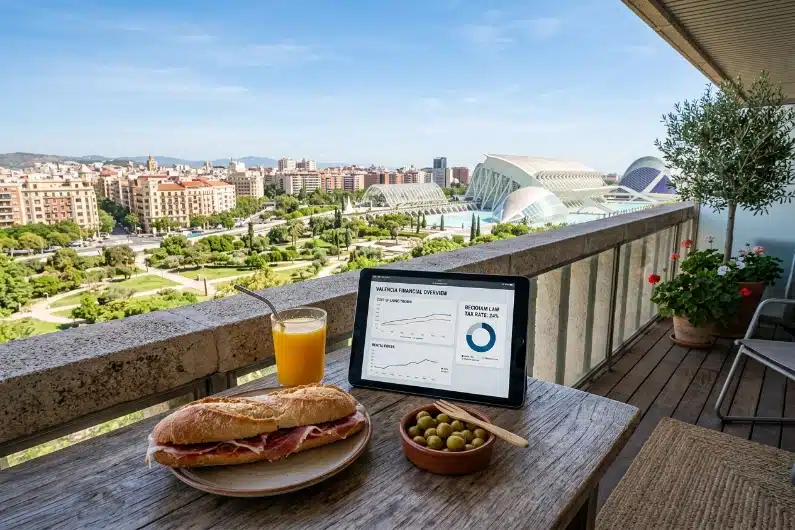
Real estate in Valencia in 2026
- Real estate in Valencia has reached historic activity levels in 2026
- Average asking price reached €3,290 per square metre in March 2026, a 15.4% rise on 2025.
- Total transaction costs typically run from 10% to 14% of the purchase price, depending on whether the home is resale (ITP) or new build (IVA + AJD).
- The Valencian Community applies a standard 10% ITP on resale homes and 1.5% AJD on new builds, with reduced rates for under-35s, large families and protected housing.
- The Spanish Government’s proposed 100% tax on non-EU non-resident buyers remains a draft measure as of 2026.
Living in Turia City
From the green corridor of the Turia Garden to the high-tech hubs near the port, the city offers a rare combination of historical character and forward-looking ambition.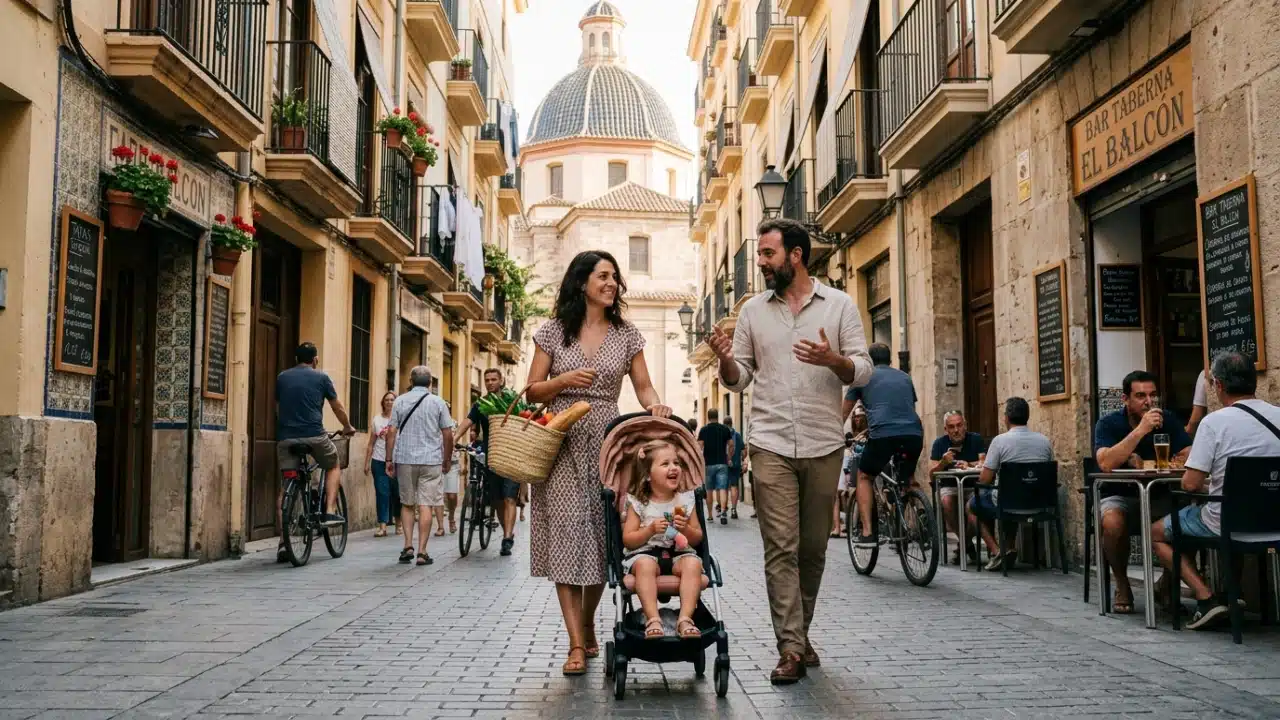 For international residents arriving from the UK, Ireland, the United States and beyond, choosing the right neighbourhood and understanding the local market are the foundations of a successful relocation.
“In March 2026, the average asking price for residential properties in Valencia reached €3,290 per square metre, a 15.4% increase from 2025, driven by intense international demand and limited supply in prime districts.”
Source: Indomio Real Estate Market Report 2026.
The Valencia neighbourhood guide
Valencia is best understood as a city of villages, each with its own character. In 2026, four districts dominate international buyer interest:- Ruzafa, the creative heart. Often called the Soho of Valencia, with modernist facades, independent galleries and a culinary scene that rivals Madrid.
- El Cabanyal, the maritime quarter. Once a fishermen’s district, now a coastal hub with tram links to the centre and a wave of careful renovation.
- Extramurs and Gran Via, the upscale family option. Wide avenues, high ceilings and proximity to the city’s leading bilingual schools.
- Patraix, the rising star. Quieter, more affordable, with a strong community feel and a growing number of artisanal cafes.
From buying to belonging: Moving to Spain
For many international buyers, the property purchase is only the first step.
Establishing a life in the Valencian Community involves visa selection, NIE and TIE registration, padrón filing, banking, healthcare enrolment and tax-residency planning, all sequenced carefully to avoid double-taxation traps and visa conflicts.
UK, US, Canadian and Australian buyers are third-country nationals, and they typically arrive through the Non-Lucrative Visa, the Digital Nomad Visa under Startup Law 28/2022, or the Entrepreneur Visa.
The customs treatment of household goods, the post-October 2025 EES border system and the matured Animal Welfare Law all add layers to what was once a simple administrative move.
Our complete 2026 walkthrough on moving to Valencia covers the visa routes, the cambio de residencia exemption for used belongings, the first-30-days checklist and the Beckham Law tax regime that newly arriving professionals can use to shelter Spanish-source income at a flat 24%.
Why the world is buying real estate in Valencia
The 2026 market combines historic activity with constrained supply. While prices have risen sharply, Valencia continues to offer a value play compared with Barcelona, Madrid and other European coastal capitals. The principal demand drivers are American, British, Australian and Irish buyers seeking modern infrastructure, large terraces and the urban-coastal lifestyle that the city’s eastern districts deliver. Areas surrounding the City of Arts and Sciences, with their proximity to the nine-kilometre Turia Garden, attract particular interest from transatlantic buyers. The wider macroeconomic context, including falling ECB rates and the closure of the Spanish Golden Visa in April 2025, has reshaped buyer profiles toward genuine residents rather than passive investors. UK arrivals continue to be a significant force in the market, with the post-Brexit framework explained in our overview of British expats in Spain.The property purchase process
Buying property in Spain is a multi-step legal journey, with notarial completion at its heart and Land Registry inscription as the final step. The process typically takes 6 to 12 weeks for cash purchases and 10 to 16 weeks where mortgage finance is involved.- Reservation contract: a small holding deposit (typically €3,000 to €6,000) takes the property off the market while due diligence runs.
- Arras contract: the private sale agreement with a 10% deposit. Most buyers in 2026 use arras penitenciales under Article 1454 of the Civil Code, which allows either party to withdraw at a defined cost.
- Public deed (Escritura): signed before a Spanish notary on the completion date.
- Land Registry inscription: the deed is filed for registration, typically completed within 15 to 30 working days.
Transaction costs
| Cost category | Estimated amount |
|---|---|
| ITP (Property Transfer Tax) | 10% (resale, Valencian Community) |
| IVA + AJD | 10% + 1.5% (new builds) |
| Notary and Registry fees | Approximately 1% to 1.5% |
| Legal fees | 1% (+ IVA) |
| Total estimate | 10% to 14% |
Tax and ongoing obligations for international owners
Once completion is signed, several recurring obligations apply. Non-resident owners pay 24% IRNR on rental income (UK, US, Canadian and Australian buyers) with no expense deductibility, plus annual IBI to the town hall and imputed-income IRNR even when the property is not let. Spanish tax residents move to a worldwide-income regime, with overseas-asset reporting through Modelo 720 once the €50,000 thresholds are crossed; full details are in our Modelo 720 guide. High-value owners should also review the Spanish wealth tax framework, which applies above €700,000 of net Spanish-located assets, and the proposed 100% tax on non-EU non-resident buyers, which has not yet been enacted but is monitored closely. Tax-residency planning before completion can yield substantial savings, and our note on how to reduce your tax burden in Spain covers the principal levers.
Tourist letting and the 2025-2026 framework
Royal Decree 1312/2024 introduced a national registry for short-term rentals applicable from 1 July 2025, and Decreto 9/2024 in the Valencian Community has tightened licensing with municipal caps. Buyers considering a part-let or full tourist-let strategy must verify licence eligibility before completion. The full picture, including platform compliance and the VAT treatment of short-term rentals in Spain, sits at the heart of any rental-income business plan.“The Valencian Community recorded approximately 23,400 home purchases by foreign buyers in 2024, with British nationals the single largest foreign cohort, followed by Germans, French and Dutch buyers.”
Source: Colegio de Registradores, Foreign Buyer Statistics 2024.
Speak to our property lawyers in Valencia
Contact our legal team for personalised guidance on real estate in Valencia in 2026. We work in English, French, Spanish and Russian, and have advised international clients from our Valencia office for over 65 years. Our property, tax and immigration teams coordinate seamlessly to deliver a single point of contact for buyers, sellers and investors. Email: felix.delaguia@delaguialuzon.com Phone: +34 963 74 16 57 Office: Avinguda Regne de Valencia, 6, 1º-2º, 46005 Valencia, SpainVisit our property law service page to learn more about our conveyancing and post-completion support.