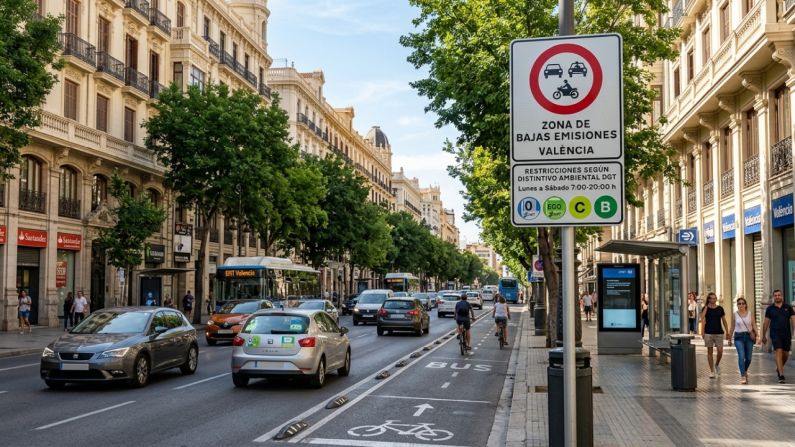
Valencia low emission zone: the essentials for drivers and expats
- As at 7 October 2026, no Valencia low emission zone restrictions are in force, and no driver can be fined for entering the city with an unlabelled car [1][2].
- The plenary of Valencia City Council rejected the final approval of the ZBE ordinance on 28 October 2025, and the council says final approval is still pending [1][3].
- The rejected text would have restricted cars, motorcycles and mopeds without a DGT environmental label, starting with vehicles registered outside Valencia province [4].
- Spanish law requires municipalities with more than 50,000 inhabitants to establish low-emission zones, so a new ordinance is expected [6].
- Where a zone is in force, breaching its restrictions is a serious traffic offence with a fine of 200 euros [8].
- The old town’s residential priority area (APR Ciutat Vella Nord) already restricts access and remains in force [2][12].
Where the Valencia ZBE stands in October 2026
Many people who are moving to Valencia, or driving in from elsewhere, have read that the Valencia low emission zone started fining cars in December 2025.
That is not what happened.
This guide explains the official position, what the rejected ordinance proposed, how DGT environmental labels work, and what owners of foreign-registered or non-Valencia cars should prepare for.
It states the position at 7 October 2026, based on Valencia City Council documents and Spanish legislation.
On 28 October 2025, the city plenary rejected the proposal to give final approval to the ZBE ordinance of the city of Valencia [3].
Why the Valencia low emission zone is not yet in force
The council’s Board of Local Government approved the draft ordinance on 27 December 2024, and the plenary gave it initial approval on 25 February 2025 [1][5].
After a public consultation period from 5 March to 16 April 2025, a council committee backed the final text on 21 October 2025 [4].
The official results of the plenary session of 28 October 2025 record the proposal for final approval as rejected [3].
The council’s own ZBE page, consulted on 7 October 2026, still describes the final plenary approval as pending [1].
Its frequently asked questions, updated in January 2026, add that the start date of any restrictions cannot be set until the ordinance is approved [2].
The council has said it will run an information campaign with enough notice before any restrictions begin [2].
The cameras installed for the Valencia low emission zone therefore have no legal basis to produce ZBE fines at present.
The legal duty behind the zone
Article 14.3 of Law 7/2021 on climate change and energy transition requires municipalities with more than 50,000 inhabitants to establish low-emission zones before 2023 [6].
Royal Decree 1052/2022 sets the minimum requirements for those zones, while each town hall decides its own boundaries, calendar and exemptions [7].
Valencia is above that population threshold, so the duty remains, and a new or revised ordinance will need to go back to the plenary.
What the rejected ordinance would have done
The text put to the vote gives the clearest picture of how a future Valencia low emission zone could work, although it has no legal force today [4].
It created a single zone of about 27.8 square kilometres, bounded by the Ronda Nord, Avinguda dels Tarongers, Carrer de la Serradora and the Bulevard Sud [1][14].
The perimeter roads themselves were excluded, so drivers could use them to go around the zone [4].
Restrictions were to apply 24 hours a day, every day of the year [2].
Only the “most polluting vehicles” were affected: cars, motorcycles and mopeds for private use with no DGT environmental label, which the council calls category A [4][10].
Vans, lorries and buses were left out, and bicycles and personal mobility vehicles were outside the ordinance altogether [2][4].
| Proposed phase | Unlabelled vehicles affected | Status today |
|---|---|---|
| Information phase until 30 November 2025 | None; warning letters only | Never started |
| From 1 December 2025 | Registered outside Valencia province, including foreign-registered vehicles | Not in force |
| From 1 January 2027 | Also registered in other municipalities of Valencia province | Not in force |
| From 1 January 2028 | Also registered in the city of Valencia | Not in force |
| Flood (DANA) moratorium | Vehicles from municipalities hit by the October 2024 floods exempt until 31 December 2027; from the city’s affected districts until 31 December 2028 | Not in force |
The calendar depended on the municipality where the vehicle is registered in the DGT vehicle register, not on where the driver lives [4].
The flood moratorium covered the municipalities and districts listed in the annex to Valencian Government Decree 164/2024 [4].
If you are still choosing where to live, our guide to the best neighbourhoods in Valencia city and our overview of Valencia suburbs for expats can help you weigh public transport against daily driving.
Exemptions in the rejected text
Some unlabelled vehicles would have entered freely, while others needed to be entered on a municipal register first [4].
- No paperwork: emergency and essential public service vehicles, and vehicles registered as historic under Royal Decree 892/2024, within that decree’s annual limit on occasional journeys [4][11].
- Prior registration: holders of a disabled parking card, vehicles linked to an economic activity registered for business tax (IAE), large families, families with children under three, pregnant women and people with temporarily reduced mobility [4].
- Occasional access: any unlabelled vehicle could use up to 48 single-day passes per calendar year, which do not carry over to the next year [2][4].
Under the rejected text, every unlabelled vehicle could still enter on 48 days a year, each pass valid from 00:00 to 23:59 [2].
DGT environmental labels explained
Every low-emission zone in Spain, including any future Valencia low emission zone, relies on the DGT environmental label (distintivo ambiental) [9].
The label depends on fuel type and the date of first registration, as recorded in the DGT vehicle register [9].
| Label | Cars and light vans that qualify |
|---|---|
| 0 emissions (blue) | Battery electric, extended-range electric, plug-in hybrids with at least 40 km of electric range, fuel cell vehicles |
| ECO | Plug-in hybrids with less than 40 km of range, non-plug-in hybrids, natural gas and LPG vehicles that also meet the C criteria |
| C (green) | Petrol registered from January 2006; diesel from September 2015 |
| B (yellow) | Petrol registered from 1 January 2001; diesel from 2006 |
| No label (A) | Older vehicles that meet none of the above criteria |
You can check any Spanish-registered vehicle’s label with its number plate on the DGT website, in the miDGT app, by phone or in person [9].
The sticker costs 5 euros, plus any delivery charges, at Correos post offices and other authorised outlets such as garages [9].
Displaying it is voluntary under DGT rules, but the council has said its cameras read number plates and check the DGT register, so a sticker would not be needed for the Valencia zone [2][9].
Foreign-registered and non-Valencia cars
Owners of cars on foreign plates face the most uncertainty under any Valencia low emission zone, because the DGT register only holds Spanish vehicles.
The DGT does not issue Spanish labels to foreign-registered vehicles [9].
It says a vehicle with a label from a country that has its own classification, such as France, Austria, Denmark or Germany, can use that label in restricted zones in Spain, and it publishes an equivalence table [9].
The rejected Valencia text went further: all foreign-registered motor vehicles, of any type, would have had to be entered on the municipal register before entering the zone [4].
The council’s January 2026 answers say foreign-registered vehicles will have to prove they are not in the most polluting category, using a procedure still to be set up [2].
If they are, they would enter on the same terms as Spanish vehicles, including the 48 annual passes [2].
For cars registered elsewhere in Spain, the proposed phases turned on the municipality of registration, so a Madrid-registered car would have been affected from the first day [4].
If you live in Spain and still drive a car on British or other foreign plates, our guide to importing a car to Spain from the UK explains registration, and our guide to exchanging a UK driving licence in Spain covers your licence.
Fines and how a zone is enforced
Article 76 z3) of the Traffic Law makes it a serious offence to ignore the traffic restrictions of a low-emission zone [8].
Article 80 sets the fine for serious offences at 200 euros, and Article 94 reduces it by 50% if paid within 20 calendar days of notification [8].
This national rule would apply to the Valencia low emission zone once an ordinance is in force, and it already applies in towns whose zones are active.
Valencia’s planned system uses automatic number plate recognition cameras connected to the DGT database and the council’s own register [2].
The council has reported 278 cameras at 68 control points across the city [14].
Breaching a low-emission zone anywhere in Spain is a serious offence with a fine of 200 euros, or 100 euros if paid within 20 days [8].
The old town restriction that does apply
The residential priority area of Ciutat Vella Nord, in the old town, has controlled vehicle access since 1 December 2021 [12].
Only residents registered on the padrón there and other authorised groups, such as businesses, hotels, public car parks and people with reduced mobility, can drive in [12].
The council confirmed in January 2026 that the area and its restrictions remain in force [2].
If you rent in the old town, our guide to empadronamiento in Spain explains how to register at your address.
Other Spanish cities have their own rules
Each low-emission zone in Spain is set by its own town hall, so restrictions, exemptions and calendars differ from one city to the next [7][13].
A car that may enter one city could be fined in another, and foreign-registered vehicles may need to register in advance in some places.
The Ministry for the Ecological Transition (MITECO) keeps an interactive map of zones that are in force, in progress or pending [13].
Check the city council’s website before a trip, including towns you visit on day trips from Valencia.
What drivers should do now
| Step | What to do |
|---|---|
| 1. Check your label | Enter your Spanish plate on the DGT website or in the miDGT app [9]. |
| 2. Foreign plates | Find your vehicle’s equivalent category in the DGT table and keep its documents in the car [9]. |
| 3. Exemptions | Gather proof such as a disabled parking card, large-family title or business tax registration, in case a new ordinance keeps them. |
| 4. Old town | Check whether you have an access right to the APR Ciutat Vella Nord [12]. |
| 5. Watch for news | Follow the council’s ZBE page for a new ordinance and its start dates [1]. |
Anyone planning a move to residency in Spain with an older car should factor a possible Valencia low emission zone into the decision to bring it, register it or replace it.
How Delaguía y Luzón can help
Delaguía y Luzón has advised international clients in Valencia since 1960.
Our lawyers can review a ZBE fine notice from any Spanish city, help with vehicle registration and residency questions, and explain how a new ordinance affects you once it is published; see our areas of expertise.
Speak to our team about driving in Spain
Contact our legal team for personalised guidance on your case.
We work in English, French, Spanish and Russian from our office in Valencia.
Email: felix.delaguia@delaguialuzon.com
Phone: +34 963 74 16 57
Office: Avinguda Regne de València, 6, 1º-2º, 46005 Valencia
Frequently asked questions about the Valencia low emission zone
Is the Valencia low emission zone in force?
No.
The ordinance was rejected on 28 October 2025, and the council says final approval is still pending.
Can I be fined for driving an unlabelled car into Valencia?
Not under a ZBE rule at present.
Normal traffic rules, and the old town’s APR Ciutat Vella Nord, still apply.
Which vehicles would be restricted?
Under the rejected text, private cars, motorcycles and mopeds with no DGT environmental label.
Vans, lorries and buses were not affected.
Does my car need a sticker on the windscreen?
The DGT sticker is voluntary.
The council has said its cameras read the label from the DGT register.
Can foreign-registered cars enter the zone?
Yes, once rules exist, if they are not in the most polluting category.
The council expects them to prove their category through a procedure still to be set up.
Can I get a Spanish DGT label for a car on foreign plates?
No.
The DGT accepts labels from countries with their own system, using its equivalence table.
How much is the fine in a Spanish low-emission zone?
200 euros, as a serious offence under the Traffic Law.
It falls to 100 euros if paid within 20 calendar days.
Are historic vehicles exempt?
Under the rejected text, yes, within the annual limit on journeys set by Royal Decree 892/2024.
The council’s FAQ mentions up to 96 occasional accesses a year.
Would Valencia residents be affected straight away?
No.
The rejected calendar for the Valencia low emission zone delayed vehicles registered in the city until 1 January 2028.
Do other Spanish cities follow the same rules?
No.
Each town hall sets its own zone, so the Valencia low emission zone rules will not apply elsewhere; check the local rules before you drive there.
References
- Valencia City Council: Ordinance regulating the low-emission zone (status page, consulted 7 October 2026)
- Valencia City Council: Frequently asked questions on the ZBE, January 2026 (PDF)
- Valencia City Council: Agenda and results of the ordinary plenary session of 28 October 2025, item 108 (PDF)
- Valencia City Council: Committee opinion of 21 October 2025 with the full ordinance text proposed for final approval (PDF)
- Valencia City Council: Plenary resolution of 25 February 2025 giving initial approval to the ordinance (PDF)
- Law 7/2021 on climate change and energy transition, Article 14 (BOE)
- Royal Decree 1052/2022 regulating low-emission zones (BOE)
- Traffic Law, Royal Legislative Decree 6/2015, Articles 76, 80 and 94 (BOE)
- DGT: Environmental label (distintivo ambiental)
- General Vehicle Regulation, Royal Decree 2822/1998, Annex II (BOE)
- Royal Decree 892/2024 approving the Historic Vehicles Regulation (BOE)
- Valencia City Council: Residential priority area of Ciutat Vella (APR Ciutat Vella Nord)
- MITECO: Low-emission zones in Spain and interactive map
- Valencia City Council: News release on the initial plenary approval of the ZBE ordinance, February 2025