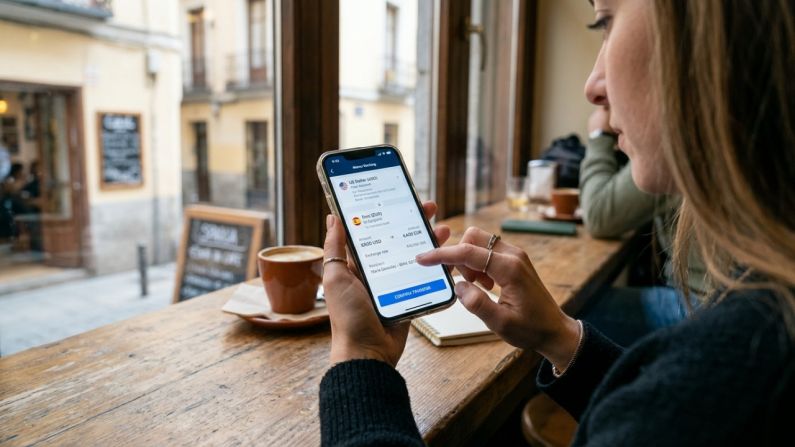
Transferring money from the US to Spain: the essentials at 22 October 2026
- Capital movements between Spain and abroad are free, and an individual does not have to declare a bank transfer to any Spanish authority, whatever the amount [1][3].
- Cash, bearer cheques and similar means of payment of €10,000 or more must be declared before you bring them into or take them out of Spain, and that duty does not apply to wire transfers [2][3].
- Spanish banks and notaries must check where your money comes from, so source-of-funds documents are the real key to a smooth transfer [2][9].
- In a property purchase, the deed must identify how the price was paid, and the Land Registry will not register a deed where the buyers refused to identify the payment [11][12].
- Once you are resident in Spain, foreign accounts above €50,000 go on Modelo 720 every year it is due, and gifts from family can trigger Spanish gift tax [20][24].
- Delaguía y Luzón advises on Spanish law only, so FinCEN, IRS and other US reporting and tax points must be handled with a US adviser [29][30].
Why moving dollars to Spain needs a legal plan, not just a bank form
Transferring money from the US to Spain is legal and common, but a large transfer touches Spanish exchange control rules, anti-money-laundering checks, notarial rules and tax law at the same time.
This guide is for American property buyers, US retirees on a non-lucrative visa and remote workers moving their savings, and states the Spanish position at 22 October 2026.
Delaguía y Luzón is a Spanish law firm, so anything said here about FBAR, Form 8938, Form 3520 or US gift tax is a pointer for your US adviser, not advice.
The legal framework for transferring money from the US to Spain
Law 19/2003 declares transfers to or from abroad free, and requires banks to report their clients’ cross-border transactions to the Ministry of Economy and the Bank of Spain [1].
For a private individual, that means transferring money from the US to Spain needs no prior authorisation and no personal declaration when it travels as a bank transfer [1][3].
Cash and other means of payment
Article 34 of Law 10/2010 requires anyone carrying means of payment of €10,000 or more into or out of Spain to declare them beforehand, and movements inside Spain must be declared from €100,000 [2].
Means of payment include banknotes, bearer cheques, unlinked prepaid cards and gold [2][5].
Cash brought from the US uses the EU form E1, while Modelo S1 covers movements within Spain or with other EU countries [3][4].
The Tax Agency confirms that bank transfers are not subject to declaration, even above €10,000, while cash of €10,000 or more must be declared before it crosses the border [3].
Bank of Spain statistics and foreign investment declarations
Bank of Spain Circular 4/2012 also covers resident individuals, but where their foreign transactions stay at or below €1 million a year, they report only if the Bank of Spain asks [6].
Royal Decree 571/2023, which replaced Royal Decree 664/1999, requires a non-resident’s purchase of Spanish property above €500,000 to be declared on form D-2A within one month, and the notary files it when the deed is signed in Spain [7][8].
So transferring money from the US to Spain rarely creates a personal filing for an individual, but it always creates a paper trail.
Anti-money-laundering rules and source-of-funds evidence
Law 10/2010 makes banks, notaries and land registrars obliged entities, and article 6 requires them to monitor the origin of the funds, with details in Royal Decree 304/2014 [2][9].
Enhanced checks apply to politically exposed persons, which can include senior US officials and their close family [2].
Transferring money from the US to Spain goes smoothly when your bank has the evidence before the money arrives.
- US bank or brokerage statements showing how the balance built up.
- A closing statement for a US home you sold.
- Recent US tax returns, W-2 forms or retirement distribution statements.
- A gift letter and the donor’s evidence of funds, if family money is involved.
Some documents need an apostille and a sworn translation, which our guide to apostilles and sworn translations in Spain explains.
EU Regulation 2023/1113 requires every transfer to carry payer and payee details, so the sending account should be in the buyer’s name [10].
Before the money moves, you will need a tax number and usually an account here: see our guide to the Spanish NIF and NIE and our explanation of Spanish bank accounts for non-residents.
Notarial rules when your transfer pays for a property
Article 24 of the Notarial Law requires every property sale deed to identify the means of payment: amount, date and whether it was paid by transfer, cheque or cash [11].
If cash or bearer cheques were brought into Spain, the notary attaches the prior declaration or records that it is missing [11].
Under article 254 of the Mortgage Law, the Land Registry will not register a deed where payment was not identified or tax numbers are missing [12].
For anyone transferring money from the US to Spain to buy a home, that means an NIE before signing and a SWIFT confirmation for every payment.
Cash payment limits
Article 7 of Law 7/2012 bans cash payments of €1,000 or more where one party acts as a business or professional [13].
The limit rises to €10,000 when the payer is an individual who proves they are not tax resident in Spain and does not act as a business [13].
Breaching the cash limit carries a fine of 25% of the amount paid, and the payer and the recipient are jointly liable [13].
Purchase taxes the transfer must cover
In the Valencian Community, transfer tax (ITP) on a resale property is 9%, or 11% above €1 million, for purchases taxed from 1 June 2026 [14].
A new home pays 10% VAT plus stamp duty (AJD), which is 1.4% in the Valencian Community in the general case [14][15].
Fees come on top, and our breakdown of legal fees when buying Spanish property helps you size the final transfer.
Choosing a route for transferring money from the US to Spain
The route you choose affects the exchange rate, the fees and the paperwork, but the Spanish legal checks apply to all of them.
| Route | How it works | Cost points to compare | What to check |
|---|---|---|---|
| US bank wire | Your US bank sends dollars or euros over SWIFT, often via intermediary banks | Sending fee, intermediary charges, exchange margin | Which bank converts the currency |
| Specialist currency provider | A licensed payment institution converts and pays euros into your Spanish account | Exchange margin, transfer fee, cost of fixing a rate | Its entry in the Bank of Spain or EU register |
| Spanish bank receiving SWIFT | Your resident or non-resident account receives the wire and credits euros | Incoming fee, conversion margin if dollars arrive | The documents its compliance team will ask for |
Sources: Law 19/2003 [1]; Law 10/2010 [2]; Bank of Spain register of institutions [19].
For transferring money from the US to Spain by any route, send from an account in your own name and keep the full SWIFT message.
Spanish tax consequences of moving savings and family money
Moving your own savings is not income, so transferring money from the US to Spain does not by itself create Spanish income tax [32].
Interest earned on it once you are resident is taxed normally, and the US-Spain tax treaty allocates taxing rights.
Gifts from parents or relatives
A Spanish resident pays Spanish gift tax on gifts wherever the money was, while a non-resident pays only on assets located in Spain [20].
For a gift of money, the region where the recipient lived for most of the previous five years sets the rules [21].
In the Valencian Community, gifts to spouses, parents, children, grandchildren and grandparents get a 99% bonus on the tax due, at 22 October 2026 [14].
The gift must be in a public document, and for money the deed must state the origin of the funds and identify the payment, or the bonus is lost [14].
Form 3520 for large gifts from a foreign person, and US gift tax for the donor, are questions for a US adviser [31].
Family loans
A loan is exempt from transfer tax, but the borrower must still file a return [22].
The Valencian Tax Agency asks the borrower to file Modelo 600, marked exempt, within one month [23].
When transferring money from the US to Spain as a family loan, a written agreement with a repayment schedule shows it is not a disguised gift.
Declaring foreign accounts once you live in Spain
Once you are tax resident in Spain, usually after more than 183 days in a calendar year, US accounts become foreign assets for Spanish purposes [32].
Modelo 720 must be filed when your foreign accounts, securities or property each exceed €50,000 in total, and filed again when a block rises by more than €20,000 [24][25].
The filing period runs from 1 January to 31 March of the following year [25].
No Modelo 720 is due for accounts when the balances at 31 December and the average balances of the last quarter stay at or below €50,000 in total [24].
After the Court of Justice ruling in case C-788/19, Law 5/2022 replaced the old penalty regime with the general penalties of the General Tax Law [26][27].
Crypto-assets held abroad go on Modelo 721, also above €50,000, and our Modelo 720 and 721 guide covers the detail [24].
Spanish banks report accounts of US persons to the Tax Agency under the Spain-US FATCA agreement [28].
FBAR applies when foreign accounts exceed $10,000 in total at any time in the year, and Form 8938 has its own thresholds: both are for your US adviser [29][30].
The Valencian Community: registers, notaries and regional taxes
Spanish property rests on the notary, who authorises the deed, the Land Registry (Registro de la Propiedad), which protects title, and the Catastro, which records the physical description.
Our guide to conveyancing in Spain explains those checks, so here we compare the tax cost across regions.
| Region | General ITP on a resale property | Notes |
|---|---|---|
| Valencian Community | 9%; 11% above €1,000,000 | 9% applies to purchases taxed from 1 June 2026 |
| Madrid | 6% | General rate for property transfers |
| Catalonia | 10% to 13% | Progressive scale: 10% up to €600,000, then 11%, 12% and 13% above €1,500,000 |
| Andalusia | 7% | Single general rate |
Sources: Valencian Law 13/1997, art. 13 [14]; Madrid Legislative Decree 1/2010 [16]; Andalusian Law 5/2021 [17]; Catalan Legislative Decree 1/2024, art. 641-1 [18].
For a buyer transferring money from the US to Spain, these rates change the total to send.
Buyers can follow every legal step in our guide to buying a house in Valencia as a non-resident, and compare regions in our overview of Spain’s regional property taxes.
Step-by-step checklist from decision to completion
The table follows a typical resale purchase, which is the most common reason for transferring money from the US to Spain in large amounts.
| Step | When | Action |
|---|---|---|
| 1 | Before you look at properties | Gather source-of-funds documents and check US reporting with your US adviser |
| 2 | Early | Obtain your NIE and open a Spanish account; sign a power of attorney if you will not travel |
| 3 | At the reservation or deposit contract | Send the deposit by traceable transfer and keep the SWIFT confirmation |
| 4 | Two to four weeks before signing | Send the balance, taxes and fees, leaving time for compliance checks |
| 5 | At the notary | Identify every payment in the deed; the notary files form D-2A if the price exceeds €500,000 |
| 6 | Within the tax deadline | Pay ITP, or VAT and AJD, and file the deed with the Land Registry |
| 7 | After you become resident | Check Modelo 720 for your US accounts by 31 March of the following year |
If you cannot travel, our guide to a power of attorney in Spain explains how to sign from the US.
Buyers who also borrow can ask for a Spanish mortgage review first.
Common mistakes Americans make with large transfers
- Sending money from a relative’s or a company’s account with no document explaining why.
- Carrying cash or cashier’s checks to Spain without the prior declaration.
- Wiring the balance a day before the notary appointment.
- Treating a parent’s help as a loan without a written agreement or Modelo 600.
- Forgetting Modelo 720 once you become resident.
Selling US investments to fund a home has its own tax effects, covered in our analysis of US and Spanish tax implications.
How Delaguía y Luzón can help
Our property law team in Valencia has advised international buyers since 1960.
For transferring money from the US to Spain, we review your source-of-funds file, liaise with your bank and the notary, and draft family loan and gift documents.
Our tax law and accounting team files Modelo 600, Modelo 720 and gift tax returns.
We advise on Spanish law only, so FinCEN and IRS reporting must be handled with your US adviser.
Speak to our property team about your transfer
Contact our legal team for personalised guidance on your case.
We work in English, French, Spanish and Russian from our office in Valencia.
Email: felix.delaguia@delaguialuzon.com
Phone: +34 963 74 16 57
Office: Avinguda Regne de València, 6, 1º-2º, 46005 Valencia
Frequently asked questions about transferring money from the US to Spain
Do I have to declare a large wire transfer to the Spanish authorities?
No, an individual does not declare a bank transfer, whatever the amount.
Your bank reports it for statistical and anti-money-laundering purposes.
Can I bring cash from the US to pay for a property?
You must declare €10,000 or more at the border, and the price cannot be paid in cash above the legal limits.
Pay the price by bank transfer.
Which documents prove the source of my funds?
Bank or brokerage statements, sale documents and tax returns.
Some may need an apostille and a sworn translation.
Is money I move to Spain taxed as income?
No, moving your own savings is not income in Spain.
Interest earned on it after you become resident is taxed normally.
Does a gift from my parents in the US carry Spanish tax?
If you live in Spain, yes, Spanish gift tax applies, with a 99% bonus on the tax in the Valencian Community for children if the formal conditions are met.
If you do not live in Spain, it generally applies only to assets located in Spain.
Do I need to document a loan from a family member?
Yes, a written loan agreement is strongly advisable.
In the Valencian Community, the borrower files Modelo 600 within one month, marking the loan as exempt.
Does the notary report my purchase to anyone?
The notary records how you paid and, if a non-resident pays more than €500,000, files form D-2A with the Investment Register.
Notaries also apply anti-money-laundering checks.
When do I have to file Modelo 720?
From the first year you are tax resident in Spain, if a block of foreign assets exceeds €50,000.
It is filed between 1 January and 31 March of the following year.
Does Spain report my Spanish account to the IRS?
Spanish banks report accounts of US persons to the Tax Agency under the FATCA agreement.
Your own FBAR and Form 8938 duties are for your US adviser.
Can a specialist currency provider pay the seller directly?
It can, if it is an authorised payment institution and the transfer is traceable to you.
Agree the route with your lawyer and the notary first.
References
- Law 19/2003 on capital movements and economic transactions with abroad, Articles 1 to 3 (BOE)
- Law 10/2010 on the prevention of money laundering, Articles 2, 6, 14 and 34 (BOE)
- AEAT: declaration of means of payment for travellers (AEAT)
- Order ETD/1217/2022 regulating declarations of movements of means of payment, Modelos S1 and S2 (BOE)
- Regulation (EU) 2018/1672 on controls on cash entering or leaving the Union (EUR-Lex)
- Bank of Spain Circular 4/2012 on reporting transactions and balances with abroad (BOE)
- Royal Decree 571/2023 on foreign investments, Articles 4 and 5 (BOE)
- Order ECM/57/2024 on foreign investment declaration procedures, Article 14 (BOE)
- Royal Decree 304/2014, Regulations of Law 10/2010 (BOE)
- Regulation (EU) 2023/1113 on information accompanying transfers of funds (EUR-Lex)
- Notarial Law of 28 May 1862, Article 24 (BOE)
- Mortgage Law, Article 254 (BOE)
- Law 7/2012, Article 7, limits on cash payments (BOE)
- Valencian Law 13/1997, Articles 12 bis, 13 and 14 (BOE)
- Law 37/1992 on VAT, Article 91 (BOE)
- Madrid Legislative Decree 1/2010 on ceded taxes (BOE)
- Andalusian Law 5/2021 on ceded taxes (BOE)
- Catalan Legislative Decree 1/2024, Book Six of the Tax Code, Article 641-1 (BOE)
- Bank of Spain: registers of institutions (Bank of Spain)
- Law 29/1987 on Inheritance and Gift Tax, Articles 6 and 7 (BOE)
- Law 22/2009 on regional financing, Articles 28 and 32 (BOE)
- Royal Legislative Decree 1/1993, Transfer Tax Law, Articles 45 and 51 (BOE)
- Valencian Tax Agency: loans between individuals (ATV)
- Royal Decree 1065/2007, Articles 42 bis, 42 ter, 42 quater and 54 bis (BOE)
- AEAT: Modelo 720 filing period (AEAT)
- Court of Justice of the EU, judgment of 27 January 2022, Commission v Spain, C-788/19 (EUR-Lex)
- Law 5/2022 of 9 March, amending the Modelo 720 penalty regime (BOE)
- Agreement between Spain and the United States to implement FATCA, 14 May 2013 (BOE)
- FinCEN: report foreign bank and financial accounts (FinCEN)
- IRS: comparison of Form 8938 and FBAR requirements (IRS)
- IRS: gifts from a foreign person (IRS)
- Law 35/2006 on Personal Income Tax, Articles 6 and 9 (BOE)